You are using an outdated browser and your browsing experience will not be optimal. Please update to the latest version of Microsoft Edge, Google Chrome or Mozilla Firefox. Install Microsoft Edge

October 21, 2024

Thai Court Decision Moves Design Assessment Closer to International Standards

Managing Intellectual Property

Thailand’s Central Intellectual Property and International Trade (IP&IT) Court has delivered a favorable ruling for Sumitomo Rubber Industries, Ltd., a major player in the tire manufacturing industry, regarding the registration of its motorcycle tire design patent. In this case, Tilleke & Gibbins represented Sumitomo in successfully advocating for recognition of the unique design elements in the company’s motorcycle tire products.

Case Overview

The case revolved around Sumitomo’s two design patent applications for motorcycle tire designs, which were initially rejected by the Department of Intellectual Property (DIP) on the grounds that they were similar to prior art. Based on an examination of the design elements, primarily focusing on the tire tread patterns, the DIP’s Patent Board had concluded that Sumitomo’s designs were not sufficiently unique to warrant patent protection, as the tread patterns of the new designs were deemed too similar to one found in prior art for tire products.

In response, Tilleke & Gibbins filed a complaint with the IP&IT Court on behalf of Sumitomo, seeking a revocation of the Patent Board’s decision and requesting that the court compel the DIP, as the defendant, to proceed with the registration of Sumitomo’s design patents. The complaint emphasized that the designs were novel and distinct, warranting patent protection under Thai law.

Legal Strategy

The firm’s legal argument focused on the interpretation of Thai patent law, particularly regarding the protection of a product’s external appearance, and emphasized that the determination of a design’s novelty must consider the product’s overall appearance rather than isolating individual features. This approach is consistent with international guidelines on design patents, which require the evaluation of novelty and distinctiveness based on how an informed user would perceive the design as a whole.

While Sumitomo’s tire tread patterns may share some superficial similarities to existing designs, the overall impression of the designs was unique. The grooves in the tread of Sumitomo’s design were arranged diagonally—with sharp, narrow ends—and extended fully to the tire edge, features absent in existing designs. These unique elements contributed to a distinctive appearance that set Sumitomo’s designs apart.

During the trial, Tilleke & Gibbins provided detailed technical testimony regarding the design features, aiming to show how the design’s unique diagonal grooves and sharp, pointed ends made it look noticeably different from the more rounded and thicker lines in the existing designs. This testimony was essential in convincing the IP&IT Court that the designs were novel and deserved patent protection under Thai law.

Court Ruling

The IP&IT Court issued a favorable ruling revoking the DIP’s rejection of Sumitomo’s design patent applications. In its judgment, the IP&IT Court considered the definition of “product design” under the Patent Act B.E. 2522 (1979), which refers to the shape, pattern, or color of the product having special characteristics that make it suitable as a model for industrial products. Therefore, product design patents protect the external appearance of products, including their shape, pattern, and color. When assessing whether a product design is similar to an existing design, only the product’s external appearance should be compared. This principle further supported the court’s ruling that Sumitomo’s designs were distinct and deserving of patent protection.

The IP&IT Court further agreed with the argument that the DIP had failed to assess the overall appearance of the tire designs properly. The IP&IT Court emphasized that a design patent protects a product’s external appearance and identified some critical differences between Sumitomo’s designs and the prior art. For instance:

  • The groove patterns in Sumitomo’s designs were narrower and sharper, with the grooves extending fully to the tire edges, while the grooves in the existing designs were thicker and more rounded and did not reach the tire edges.
  • The side pattern of Sumitomo’s tires, which featured alternating short and long diagonal grooves, was a feature absent in the existing designs.

The court’s consideration and thoughtfulness aligned with the diagram the firm presented to the court during the trial.
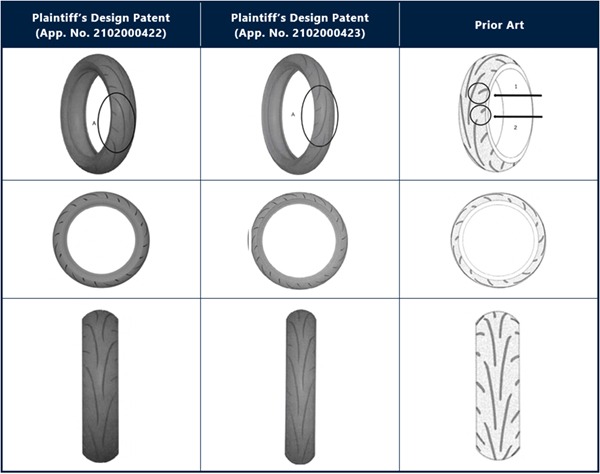
Based on these considerations, the IP&IT Court ruled that Sumitomo’s tire designs were indeed novel and not mere imitations of the prior art. As a result, the IP&IT Court ordered the DIP to proceed with the registration of Sumitomo’s design patents.

Key Takeaways

The IP&IT Court judgment emphasized the need to assess the overall appearance of a design when determining its eligibility for patent protection, aligning Thai law with international standards. The judgment clarifies that even functional products, like tire tread patterns, can have distinctive design features worthy of patent protection.

The favorable decision in Sumitomo’s motorcycle tire case is a significant win and demonstrates the importance of a legal strategy that considers both the technical and visual aspects of product design.

This article first appeared in Managing Intellectual Property.

RELATED INSIGHTS​ 

May 28, 2025
Tilleke & Gibbins attorneys in Vietnam have contributed the 2025 edition of Doing Business in Vietnam, a comprehensive Q&A-style resource from Thomson Reuters Practical Law that provides essential insights for companies navigating business operations in Vietnam. The guide presents a detailed overview of the country’s legal framework and regulatory environment, reflecting recent updates in Vietnamese legislation and practice. This annually updated guide offers key information on the following areas: Legal system: Structure of the Vietnamese judiciary and the role of codified law. Foreign investment: Conditions for market access, licensing requirements, foreign ownership restrictions, and investment incentives. Business vehicles: Formation and operation of legal entities, including limited liability companies, joint-stock companies, and representative offices. Employment: Employment contracts, social insurance, labor rights, and procedures for hiring foreign nationals. Tax: Overview of corporate income tax, personal income tax, value-added tax, and other tax obligations. Intellectual property: Procedures for protecting and enforcing patents, trademarks, copyrights, and other IP rights. Data protection: Compliance requirements under Vietnam’s data privacy laws, including the Personal Data Protection Decree. Competition law: Antitrust rules and regulatory oversight under the Law on Competition. Anti-bribery and corruption: Legal framework and enforcement practices aimed at curbing corrupt activities. E-commerce and digital business: Regulations governing online platforms, digital content, and cross-border services. Marketing and advertising: Laws and guidelines on advertising standards and consumer protection. Product regulation and liability: Safety requirements, product liability issues, and roles of relevant authorities. Doing Business in Vietnam is part of Practical Law’s global series of legal guides designed to support international practitioners and businesses. To access the most recent edition of the Vietnam guide, visit the Practical Law website and sign up for a free trial.
May 2, 2025
Attorneys from Tilleke & Gibbins have updated the latest edition of Doing Business in Thailand, a Q&A-style guide from Thomson Reuters Practical Law that offers an overview of key legal considerations for companies operating in jurisdictions worldwide. The contribution outlines the country’s legal and regulatory framework for foreign investment and business operations and reflects the latest legislative developments. The chapter addresses the following core topics: Legal system: Structure of the courts and the codified nature of Thai law. Foreign investment: Business restrictions under the Foreign Business Act, sector-specific regulations, exchange control rules, and investment incentives. Business vehicles: Overview of partnerships, private and public limited companies, and other legal entities. Employment: Labor protections, employment contracts, foreign worker requirements, and termination procedures. Tax: Corporate and personal income tax, indirect taxes, and tax obligations for residents and non-residents. Intellectual property: Registration and enforcement of patents, trademarks, designs, and copyrights. Data protection: Key provisions of the Personal Data Protection Act and related compliance obligations. Competition law: Regulatory framework under the Trade Competition Act. Anti-bribery and corruption: Relevant legislation and enforcement mechanisms. E-commerce and digital business: Legal regime for online transactions and digital platforms. Marketing and advertising: Consumer protection laws and regulations affecting advertising and marketing practices. Product regulation and liability: Safety standards, liability regimes, and roles of enforcement authorities. Practical Law, a legal reference resource from Thomson Reuters, publishes a range of guides for hundreds of jurisdictions and practice areas. The insurance and reinsurance guide is a valuable resource for legal practitioners, covering numerous jurisdictions worldwide. To view the latest version of the guide, please visit the Practical Law website and enroll in the free Practical Law trial to gain full access.
February 23, 2025
On January 6, 2025, the government of Vietnam issued Decree No. 05/2025/ND-CP amending and supplementing Decree No. 08/2022/ND-CP detailing the Law on Environmental Protection (“Decree 05”). Decree 05 came into effect immediately upon issuance and provides several changes to the regulations governing extended producer responsibility (“EPR”) for applicable manufacturers and importers, outlining their obligations concerning the recycling and treatment of discarded products and packages. (See our previous article on Vietnam’s EPR regulations here.) Outlined below are some critical amendments in Decree 05. Entities Subject to EPR Regulations Previously, Decree 08 limited the responsibility for recycling to manufacturers and importers of products and packaging specified in statutory lists. Decree 05 expands this scope by also including entities responsible for the quality and labeling of the regulated products and goods in Vietnam. Decree 05 inherits the regulations from Decree 08 that manufacturers and importers, if they produce and import products and packaging as stipulated by law, must fulfill their responsibility to recycle or support waste treatment activities. However, Decree 05 amends the lists of products/packaging that must be recycled or undergo waste treatment, and new products/packaging and recycling methods. Notably, rechargeable batteries (including those used in vehicles or for electrical and electronic devices) have been added to the list of regulated products and self-propelled vehicles and construction machinery have been removed from the list. Decree 05 also not only streamlines the recycling methods required for each type of product/packaging, but also removes the minimum requirement on the mass of products/packaging that must be recovered when recycling. Manufacturers and importers now have more flexibility in selecting recycling methods that are more suitable for actual recycling conditions in Vietnam. Decree 05 has revised the cases of exemption from recycling and waste treatment obligations, clarifying that both packaging manufacturers and importers with annual product
February 13, 2025
The Contract Committee of Thailand’s Office of the Consumer Protection Board has issued a notification updating the stipulation that any sale of a new vehicle or motorcycle requiring an upfront deposit from the consumer for reservation purposes is now classified as a contract-controlled business. Titled “Requiring Reservation Agreements for New Vehicles and Motorcycles to be Contract-Controlled Businesses B.E. 2567,” the notification takes effect on February 19, 2025, and supersedes the previous notification from 2008, which applied only to “vehicles” (excluding motorcycles). Key changes and requirements introduced by the new notification include: Inclusion of electric vehicles and motorcycles. The notification now extends beyond traditional vehicles powered by combustion engines to include those powered by electricity. It also covers motorcycles powered by both combustion engines and electricity. Definition of order deposit. An order deposit is defined as any money or benefit provided by the consumer to reserve a vehicle or motorcycle. It is distinct from a security deposit and is solely for reservation purposes. Standardized order deposit agreement. Order deposit agreements must be in Thai and clearly visible and readable. Business operators must use the template prescribed by the notification to ensure compliance with the standardized terms and conditions. This extends to both physical and electronic agreements and includes transactions facilitated by digital platform providers. Specification of delivery date. Agreements must specify the exact date, month, and year for delivery, unlike the previous requirement for only an estimated delivery date. Detailed deposit collection description. Agreements must outline the method of deposit collection, providing more specificity than the general description required previously. Prohibited terms. Agreements must not include: Limitation or exclusion of liability for the business operator’s faults. Provisions allowing the business operator to change the delivery date or conditions to the consumer’s detriment. Provisions allowing the business operator to terminate the