You are using an outdated browser and your browsing experience will not be optimal. Please update to the latest version of Microsoft Edge, Google Chrome or Mozilla Firefox. Install Microsoft Edge

December 28, 2021

Thai Cabinet Approves New Draft Amendments to the Anti-Money Laundering Act

Since 2017, Thailand’s Anti-Money Laundering Office (AMLO) has been developing an amendment to the Anti-Money Laundering Act B.E. 2452 (1999) (AML Act) to improve Thailand’s anti-money laundering framework and make it more consistent with the internationally accepted anti-money laundering policies and practices recommended by the Financial Action Task Force (FATF). The most recent development came on November 4, 2021, when the Thai Cabinet approved, in principle, a draft amendment to the existing AML Act.

The key amendments under this latest draft amendment to the AML Act are summarized below.
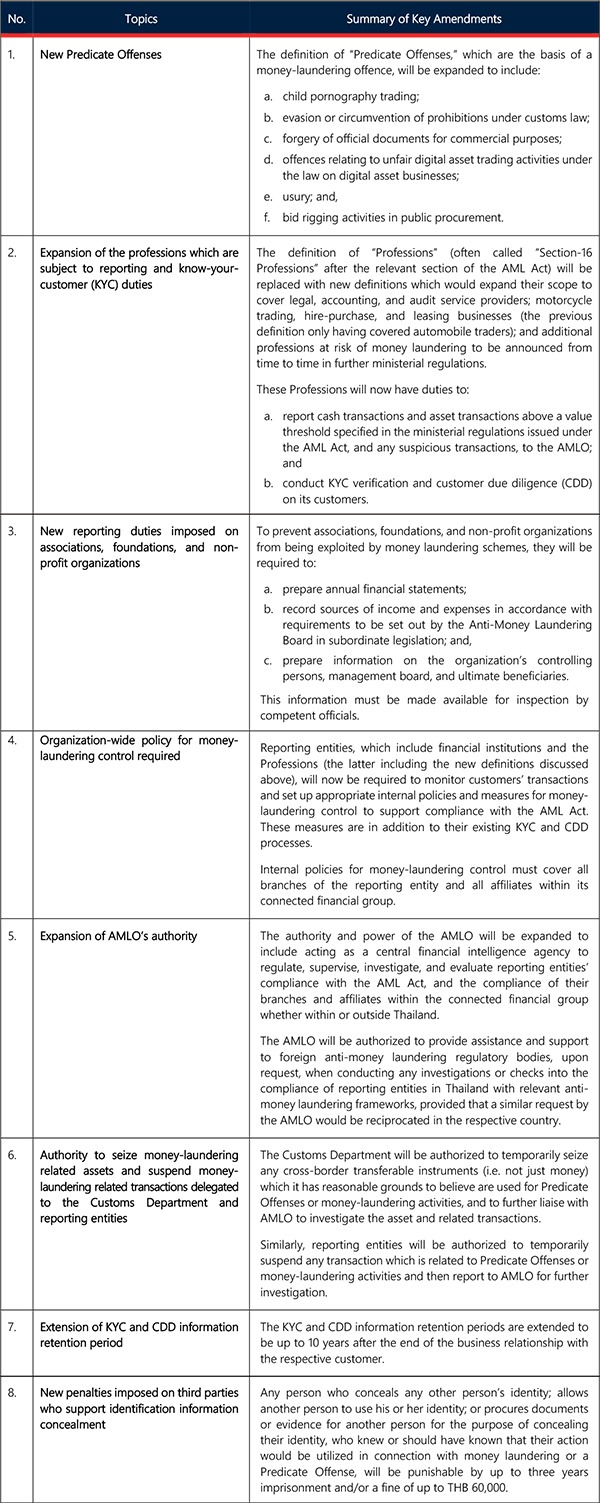
These amendments would allow for more robust regulation and investigation processes to better combat increasingly complex money laundering schemes, and would also be an important step for Thailand to satisfy one of the key qualifications for becoming an FATF member.

At the date of this publication, the Draft Amendment Act is currently under an additional public hearing process which will continue until the end of January 2022. We will closely monitor the legislation process of this Draft Amendment Act and will continue to report on any significant developments as they become available.

For more information on anti-money laundering law in Thailand, please contact Mr. Kobkit Thienpreecha at [email protected] or +66 2056 5534, Mr. Niti Muangkote at [email protected] or +66 2056 5542, and Ms. Chutikarn Boonnark at [email protected] or +66 2056 5536.

RELATED INSIGHTS​ 

February 4, 2026
On November 18, 2025, Vietnam’s Ministry of Finance released for public consultation a draft decree on administrative sanctions in the field of crypto assets and crypto asset markets (the “Draft Decree”), intended to implement Resolution No. 05/2025/NQ-CP dated September 9, 2025, on the pilot crypto asset market in Vietnam (“Resolution 05”). While Resolution 05 sets out who may participate and under what conditions, the Draft Decree addresses a more practical question for market participants, i.e., what happens if those conditions are not met. In doing so, the Draft Decree offers important insight into how Vietnamese regulators intend to supervise, discipline, and ultimately shape the crypto market during the pilot phase. Regulatory Scope and Overall Sanctions Architecture The Draft Decree applies to both domestic and foreign organizations and individuals engaging in crypto-related activities in Vietnam’s market. Covered entities include: (i) crypto asset issuers; (ii) crypto asset service providers, including trading platforms and market operators; (iii) Vietnamese and foreign investors participating in the pilot market; and (iv) other organizations involved in the offering, issuance, or provision of crypto-related services in Vietnam. The breadth of this scope is deliberate. It appears to reflect a regulatory view that cross-border structures, offshore platforms, and indirect participation may not necessarily insulate market actors from compliance obligations once they operate within the pilot framework. For the crypto industry, this may mark a shift from regulatory ambiguity toward a more explicit articulation of jurisdictional reach. At first glance, the Draft Decree’s monetary penalties appear restrained. The maximum fine per administrative violation is capped at VND 200 million (approx. USD 7,700) for organizations and VND 100 million (approx. USD 3,800) for individuals. However, focusing solely on fine levels risks missing the point. The Draft Decree also places great regulatory weight on supplementary sanctions and corrective measures, including: (i)
January 23, 2026
On December 31, 2025, the State Bank of Vietnam (SBV) issued Circular No. 72/2025/TT-NHNN (Circular 72), establishing a streamlined foreign exchange framework for Vietnam’s International Financial Center (IFC). Circular 72, which took effect on the same day, implements core provisions of Decree No. 329/2025/ND-CP and marks a fundamental shift from ex ante licensing to ex post supervision for IFC member enterprises and foreign investors. These changes are designed to accelerate capital flows, reduce compliance costs, and position Vietnam as a competitive regional financial hub by granting IFC members substantially greater autonomy in currency transactions, borrowing, lending, and investment activities. Key provisions for IFC members to note are discussed below. Use of Foreign Currency and Payments within the IFC Vietnam generally requires the use of Vietnamese dong for transactions within the country, with limited exceptions. This can be burdensome for foreign investors, who may be unfamiliar with all the foreign exchange rules they must comply with. Under the new regulation, IFC member enterprises and foreign investors gain the ability to transact, list prices, and settle obligations in foreign currency when dealing with other IFC members or offshore counterparties, avoiding currency risk and conversion friction. With respect to individuals and organizations located within Vietnam who are not IFC members, the use of foreign currency must continue to comply with general restrictions on foreign exchange usage within Vietnam. Dual-Track Account System for IFC Members The new regulation introduces a two-tier account structure that differentiates transactions by purpose and counterparty. IFC member enterprises must use a designated foreign currency capital account at an IFC member bank for four specified activities: Borrowing from offshore individuals and organizations Lending to offshore entities and domestic borrowers Outbound investing from the IFC Investing elsewhere in Vietnam from the IFC All other foreign exchange transactions—including operational receipts, vendor
January 22, 2026
On January 20, 2026, Vietnam’s Ministry of Finance (MOF) issued Decision No. 96/QD-BTC to formally launch pilot administrative procedures for licensing crypto asset trading market services in Vietnam. The decision took immediate effect and implements the government’s pilot crypto asset market program under Resolution No. 05/2025/NQ-CP. Notably, competent authorities have now begun accepting license applications, marking the first time Vietnam has operationalized a licensing pathway for crypto trading market operators. Administrative Procedures and Applications The decision stipulates procedures for (i) granting, (ii) adjusting, and (iii) revoking licenses to provide services for organizing crypto asset trading markets. It provides detailed, step-by-step guidance for each procedure, including dossier composition, internal review stages, coordination mechanisms, and statutory timelines. These procedures apply specifically to entities seeking to organize and operate crypto asset trading markets within Vietnam’s pilot regulatory framework. The MOF is the authority responsible for reviewing and deciding on the above procedures, with the State Securities Commission acting as the receiving, coordinating, and procedural focal point. For licensing applications, the MOF will coordinate with multiple authorities, including the State Bank of Vietnam and the Ministry of Public Security, particularly in relation to anti-money laundering, cybersecurity, system safety, and risk control requirements. Applications may be submitted in person, by post, or electronically via the National Public Service Portal or the administrative procedure information system, in line with applicable regulations. Statutory processing timelines vary depending on the specific procedure and stage involved. For applications to obtain a license to organize a crypto asset trading market, the process is conducted in multiple phases: The MOF will issue an initial written response within 20 working days from receipt of a complete and valid initial dossier, following which, upon submission of the full set of required documents, the MOF will complete substantive review and issue the license
January 9, 2026
On January 7, 2026, the Central Bank of Myanmar (CBM) announced a further relaxation of foreign exchange regulations through Notification No. 2/2026, with an effective date of January 1, 2026. This notification reduces the mandatory conversion requirement for exporters’ earnings in foreign currency into Myanmar kyat (MMK). Under the new notification, exporters are required to convert only 15 percent of their foreign currency export earnings into MMK at official CBM reference exchange rates, down from the previous required minimum conversion level of 25 percent. The adjustment provides exporters with more flexibility to manage foreign currency, improving liquidity for international transactions and reducing cash flow pressure. However, companies must still comply with the foreign currency conversion procedures and timelines set out in the CBM’s Notification No. 12/2022.