You are using an outdated browser and your browsing experience will not be optimal. Please update to the latest version of Microsoft Edge, Google Chrome or Mozilla Firefox. Install Microsoft Edge

December 28, 2021

Thai Cabinet Approves New Draft Amendments to the Anti-Money Laundering Act

Since 2017, Thailand’s Anti-Money Laundering Office (AMLO) has been developing an amendment to the Anti-Money Laundering Act B.E. 2452 (1999) (AML Act) to improve Thailand’s anti-money laundering framework and make it more consistent with the internationally accepted anti-money laundering policies and practices recommended by the Financial Action Task Force (FATF). The most recent development came on November 4, 2021, when the Thai Cabinet approved, in principle, a draft amendment to the existing AML Act.

The key amendments under this latest draft amendment to the AML Act are summarized below.
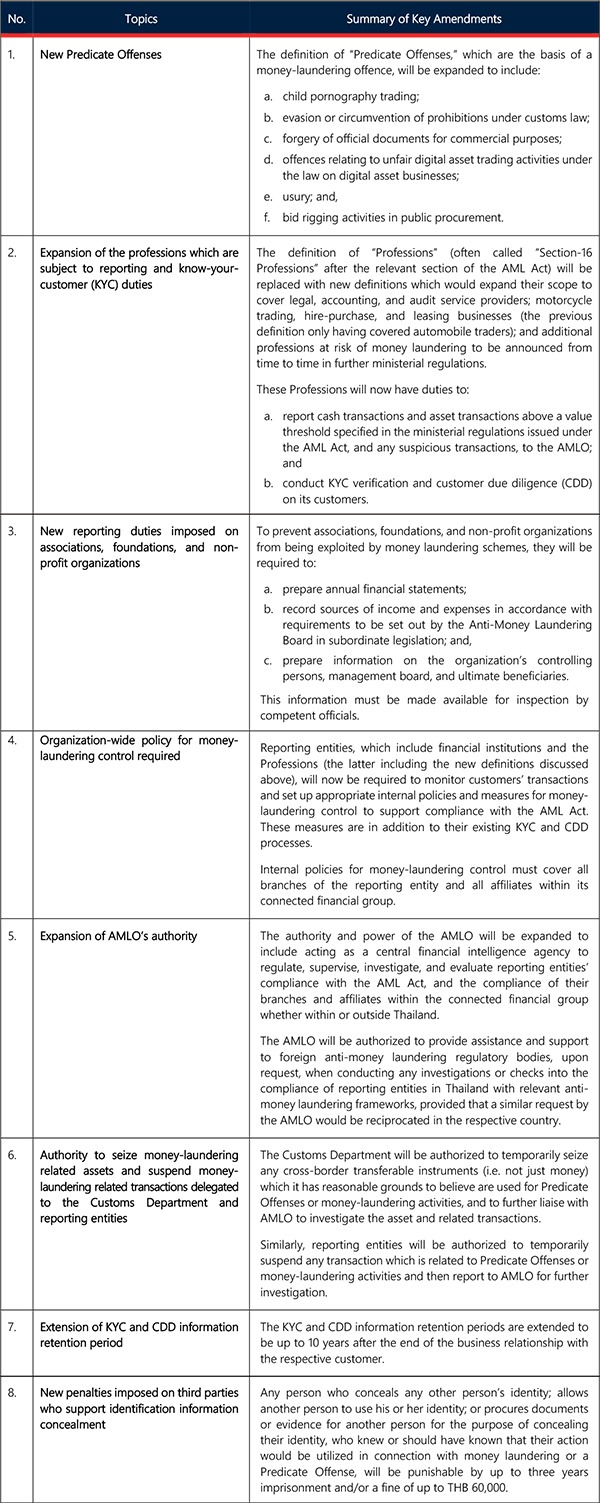
These amendments would allow for more robust regulation and investigation processes to better combat increasingly complex money laundering schemes, and would also be an important step for Thailand to satisfy one of the key qualifications for becoming an FATF member.

At the date of this publication, the Draft Amendment Act is currently under an additional public hearing process which will continue until the end of January 2022. We will closely monitor the legislation process of this Draft Amendment Act and will continue to report on any significant developments as they become available.

For more information on anti-money laundering law in Thailand, please contact Mr. Kobkit Thienpreecha at [email protected] or +66 2056 5534, Mr. Niti Muangkote at [email protected] or +66 2056 5542, and Ms. Chutikarn Boonnark at [email protected] or +66 2056 5536.

RELATED INSIGHTS​ 

January 8, 2026
Doing business in Thailand means operating under a strict regulatory framework. From time to time, companies may receive unexpected administrative orders from government authorities that restrict their operations, impose new compliance obligations, or levy fines and penalties. When this happens, a business may challenge the order under Thailand’s administrative law system. The primary concern in pursuing administrative litigation is timing, as strict statutory deadlines apply and missing them can permanently affect a company’s rights. First Step: Administrative Appeal Many companies assume the first step is to immediately bring the matter before the Administrative Court to seek revocation or suspension of the order. Some even attempt to request an interim injunction to stop the order from taking effect. However, Thai law generally requires that the company first challenge the order through an administrative appeal with the same agency that issued it. Only after this process is complete can the matter be taken to court. Seeking an interim injunction at this stage is also not possible. This is because Thai law does not allow a standalone application for an interim injunction; an injunction can only be requested together with the underlying complaint filed with the Administrative Court. Since a court complaint cannot be filed until the administrative appeal process has been exhausted, an injunction is usually not available at the early stage. What Are the Timeframes for Administrative Appeal? Thailand applies a two-stage administrative appeal process. The appeal must first be submitted to the same authority that issued the order, which will review its own decision. If that authority affirms its decision, the appeal is then escalated to the relevant higher authority for further review. In most cases, both stages must be completed before a company is allowed to proceed to court. The timeframe for filing an administrative appeal is very
January 6, 2026
Among the eight implementing decrees issued on December 18, 2025, to provide the legal framework for Vietnam’s new International Financial Centers (IFC), Decree No. 323/2025/ND‑CP serves the core function of officially establishing the IFC as a unified entity in two locations—Ho Chi Minh City and Da Nang—and setting out a plan for its development and governance. The key contents of the decree are summarized below. Location and Focus of IFCs The Vietnam International Financial Center in Ho Chi Minh City (VIFC‑HCMC) and the Vietnam International Financial Center in Da Nang (VIFC‑DN) are designed to attract capital, fintech, and international market participants under a dedicated regulatory framework. The IFCs will host functional zones for financial trading, banking, securities and commodities exchanges, offices, dispute resolution (via specialized court and international arbitration center), and related activities as set by the executive authority of each IFC. VIFC-HCMC, with a total area of 898 hectares in central Ho Chi Minh City, is oriented to develop a comprehensive and diverse financial ecosystem, providing traditional and specialized financial services, and leveraging synergies between financial services such as capital mobilization, investment, payment services, issuance and trading of financial products, asset management, fintech, and green financial services. VIFC-DN, with a total area of 300 hectares, is oriented to develop as a modern IFC, closely integrated with the innovation ecosystem, digital technology, and sustainable finance. VIFC-DN will establish a controlled testing platform for new financial models, taking the lead in the deployment and scaling of digital-asset products, digital payments, and specialized trading platforms and exchanges, while promoting supply chain finance, third-party services, and non-bank financial intermediaries to complement and support the traditional financial market, developing specialized, flexible, and innovative financial products. Near‑Term Priorities and Review Timeline In 2026, the government will prioritize completing the essential infrastructure and ensuring adequate
January 5, 2026
Resolution No. 222/2025/QH15 dated June 27, 2025, of the National Assembly of Vietnam (the “IFC Resolution” – see our previous article) set out the foundational legal framework for the establishment and development of Vietnam’s first-ever International Financial Centers (IFC). In furtherance of this framework, on December 18, 2025, the government of Vietnam issued eight implementing decrees to provide detailed regulatory guidance and to operationalize the IFC Resolution in practice. The Eight Implementing Decrees: An Integrated Regulatory Ecosystem The new decrees governing the IFC include the following: Decree No. 323/2025/ND-CP on the establishment of the IFC. Decree No. 324/2025/ND-CP on financial policies applicable within the IFC. Decree No. 325/2025/ND-CP on labor, employment, and social security within the IFC. Decree No. 326/2025/ND-CP on land and environmental matters within the IFC. Decree No. 327/2025/ND-CP on entry, exit, and residence of foreign nationals in the IFC. Decree No. 328/2025/ND-CP on the International Arbitration Center of the IFC. Decree No. 329/2025/ND-CP on banking licensing, foreign exchange management, and anti-money laundering and combating the financing of terrorism (AML/CFT) within the IFC. Decree No. 330/2025/ND-CP on the establishment and operation of commodity exchanges within the IFC. Taken as a whole, these eight decrees translate the IFC Resolution into a coherent and fully operational legal regime governing the establishment, organization, and functioning of Vietnam’s IFC. Collectively, they demonstrate that Vietnam’s IFC framework is best understood not as a collection of isolated incentives, but as a deliberately designed and integrated regulatory system. The Legal Architecture of the IFC: Four Interlocking Pillars Read together, the decrees seem to be designed to address four core regulatory questions from the outset: (i) what the IFC is, from a legal and institutional perspective; (ii) who may participate in the IFC and what activities are permitted; (iii) how people, capital, and projects operate
December 26, 2025
The Bank of Thailand (BOT) has released the Guidelines for Digital Fraud Management, which took effect on December 17, 2025, incorporating certain amendments to the draft guidelines issued in March 2025. These official guidelines aim for end-to-end digital fraud prevention, with a particular focus on mule accounts, to enhance trust and security in Thailand’s financial system. The guidelines apply to “financial service providers,” including: Financial institutions and special financial institutions under the Financial Institution Business Act; and Operators of Inter-institutional Fund Transfer System e-money services and e-fund transfer services under the Payment Systems Act. Besides commercial banks and e-money operators that offer fund-transfer services, other providers may adopt requirements based on risk proportionality and baseline standards set out in the guidelines (for instance, an e-money operator that does not offer e-fund transfer services could consider implementing a fraud monitoring and detection system according to the risk level of its service). The guidelines establish the following key requirements: Policy and oversight. Directors and senior executives of financial service providers must adopt appropriate “end-to-end” fraud management policies and KPIs to manage digital fraud, covering prevention, monitoring, detection, management, resolution, and support for affected customers. The fraud management policy must be regularly reviewed, and whenever there is a situation or change that significantly affects the efficiency of the fraud management. Any significant update to the policy must first be approved by the board of the financial service provider. The BOT also encourages providers to collaborate in establishing industry standards aligned with applicable laws and regulations to ensure consistency and best practices across the sector. Fraud management processes. Financial service providers must establish a clear framework for managing digital fraud throughout the customer lifecycle—from customer onboarding to service termination—covering at least the following processes: Know your customer (KYC) and customer due diligence (CDD):