You are using an outdated browser and your browsing experience will not be optimal. Please update to the latest version of Microsoft Edge, Google Chrome or Mozilla Firefox. Install Microsoft Edge

December 28, 2021

Thai Cabinet Approves New Draft Amendments to the Anti-Money Laundering Act

Since 2017, Thailand’s Anti-Money Laundering Office (AMLO) has been developing an amendment to the Anti-Money Laundering Act B.E. 2452 (1999) (AML Act) to improve Thailand’s anti-money laundering framework and make it more consistent with the internationally accepted anti-money laundering policies and practices recommended by the Financial Action Task Force (FATF). The most recent development came on November 4, 2021, when the Thai Cabinet approved, in principle, a draft amendment to the existing AML Act.

The key amendments under this latest draft amendment to the AML Act are summarized below.
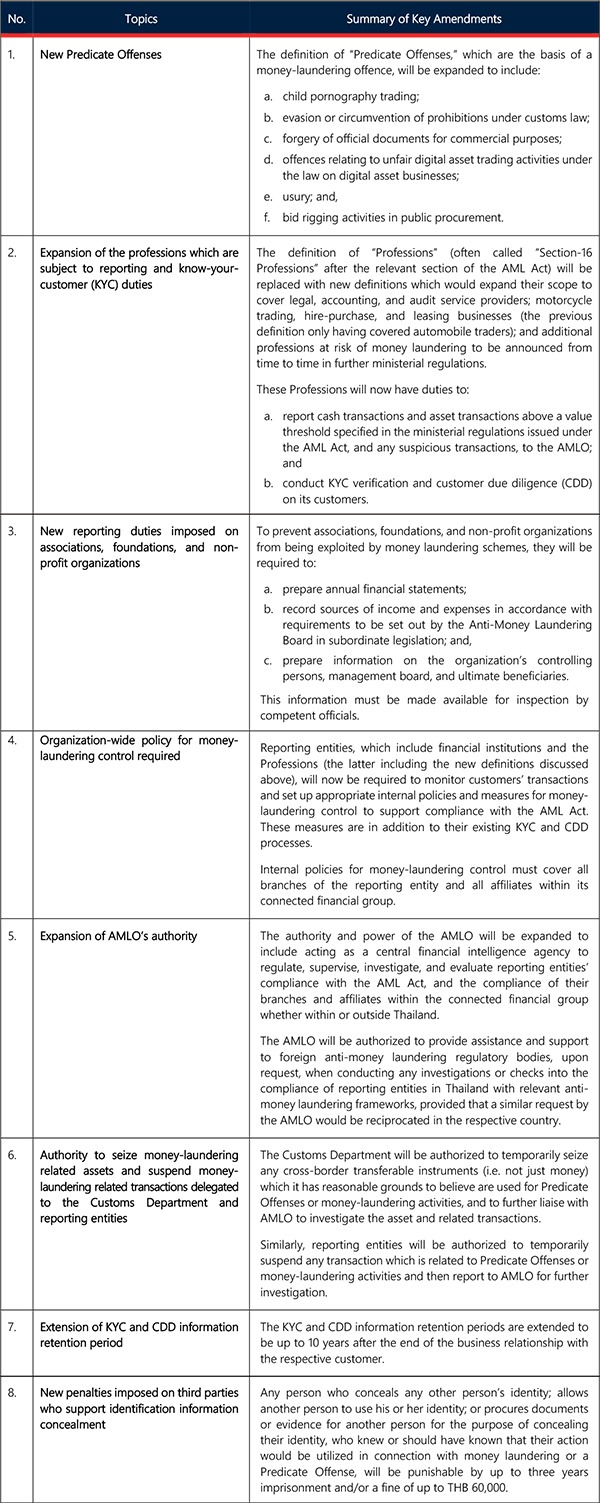
These amendments would allow for more robust regulation and investigation processes to better combat increasingly complex money laundering schemes, and would also be an important step for Thailand to satisfy one of the key qualifications for becoming an FATF member.

At the date of this publication, the Draft Amendment Act is currently under an additional public hearing process which will continue until the end of January 2022. We will closely monitor the legislation process of this Draft Amendment Act and will continue to report on any significant developments as they become available.

For more information on anti-money laundering law in Thailand, please contact Mr. Kobkit Thienpreecha at [email protected] or +66 2056 5534, Mr. Niti Muangkote at [email protected] or +66 2056 5542, and Ms. Chutikarn Boonnark at [email protected] or +66 2056 5536.

RELATED INSIGHTS​ 

July 14, 2026
Tilleke & Gibbins has contributed the Thailand and Vietnam chapters to Investigations in Southeast Asia, a comprehensive guide published by Drew Network Asia (DNA). The resource provides a practical overview of anticorruption laws, corporate investigations, and compliance frameworks across six key Southeast Asian jurisdictions. Designed for in-house counsel, compliance officers, and risk management professionals, the guide offers actionable insights for navigating complex cross-border regulatory challenges and establishing effective, regionally coordinated compliance and investigation strategies. The guide begins with a regional perspective on enforcement trends and cross-border cooperation initiatives. Jurisdiction-specific chapters follow a standardized structure—covering primary corruption offenses, enforcement authorities, corporate liability, investigation procedures and dawn raids, whistleblower protections, and recommended compliance measures. In addition to country-by-country analysis, the publication highlights best practices for conducting internal investigations, managing digital evidence, and handling parallel proceedings involving multiple regional or international regulators. The guide serves as a practical reference for organizations operating in Southeast Asia. Because legal and regulatory risks depend on specific industry sectors and operational contexts, readers seeking tailored advice are encouraged to contact the authors listed in each chapter. The full guide is available for download through the button below or directly from the DNA website.
June 23, 2026
On May 14, 2026, Thailand published a ministerial regulation in the Government Gazette to prescribe measures for prevention and suppression of technology crimes. The regulation creates a comprehensive procedural framework for returning money and digital assets to victims of technology crimes. It will take effect 90 days after publication (in mid-August 2026), giving affected entities a limited window to prepare. Mandatory Reporting Obligations for Financial Institutions When a deposit account, e-money account, or digital asset wallet is frozen in connection with a technology crime, the relevant financial institution or business operator must report transaction data to the Anti-Money Laundering Office (AMLO) via AMLO’s designated electronic system. Required data elements include account numbers (sender and receiver), names, identification or passport numbers, legal entity registration numbers, phone numbers, remaining balance, damage amount, transaction reference numbers, and the bank case ID. Institutions that already share data through the information-sharing system under the emergency decree are deemed to have satisfied this reporting obligation, creating an incentive for platform participation. When the Royal Thai Police or the Department of Special Investigation seize or freeze assets related to technology crimes, they must provide AMLO with investigation reports, complaint evidence, money-trail data, and account statements. Notification and Claims Process Once the AMLO secretary-general approves verified reports of a technology crime, the account information of persons connected to the crime will be published in the Government Gazette, triggering a 90-day window for victims to file claims and for related persons to file objections. Officers will also publish details on AMLO’s electronic media and send registered mail to identified victims, which will be deemed received after 7 days domestically or 15 days internationally. Victims have 90 days from the date the crime is published in the Government Gazette to file claims through AMLO’s electronic system. Claims must include
June 9, 2026
On April 28, 2026, the Central Bank of Myanmar (CBM) issued Notification No. 18/2026 introducing the new Foreign Remittance Business Regulations. The new regulations apply to companies intending to operate foreign remittance businesses in Myanmar that are not licensed banks, non-bank financial institutions, or other financial institutions. The regulations supersede and replace the previous regulatory framework governing foreign remittance businesses under CBM Notification No. 21/2019. While the overall structure remains familiar, the new regulations introduce more detailed requirements for licensing, operations, reporting, and compliance, with a stronger focus on transparency and regulatory oversight. Broader Licensing Requirements Under the new regulations, applicants must submit detailed business plans describing the use of information technology and mobile platforms, along with clear plans for handling remittances from workers abroad and resolving customer complaints. Financial Thresholds and Reporting Requirements The baseline financial thresholds remain unchanged. Licensees must maintain a security deposit of MMK 100 million in an escrow account, along with a separate revolving fund dedicated solely to remittance operations. The new regulations introduce more structured reporting obligations. Licensees are now required to submit daily remittance transaction data by the next business day before noon, in addition to monthly and periodic reporting requirements. Foreign bank account statements must also be submitted regularly, and licensees must provide updates on business operations every six months. Strengthened AML and CFT Framework The new regulations place a greater emphasis on anti-money laundering (AML) and counter financing of terrorism (CFT), with tighter controls over management changes. Any changes in shareholding, share transfers, or the appointment of key management personnel such as the managing director require prior approval from the CBM. Licensing Fees and Validity The new regulations increase licensing costs, while maintaining the same validity period of three years. The new regulations provide more detailed grounds for suspension and
May 25, 2026
After several years of policy discussion and continued efforts led by the Ministry of Commerce (MOC) to relax the list of reserved businesses under the Foreign Business Act B.E. 2542 (1999) (FBA), the reform process has now reached a significant milestone. On May 12, 2026, the Thai cabinet approved in principle two draft subordinate legislative instruments aimed at delisting certain reserved business activities under the FBA and reducing licensing requirements for foreign business operators. These developments signal a renewed and concrete effort by the government to modernize Thailand’s business regulatory framework in order to attract foreign investment and boost Thailand’s competitiveness in the global market. Nine Businesses Set for FBA Delisting Below is a list of the nine businesses that are being targeted for delisting from the FBA’s restrictions. A draft ministerial regulation would delist the first eight reserved businesses, while a royal decree has been drafted to delist the ninth business: Telecommunications services (Type 1 license only, covering operators without their own telecommunications infrastructure), under the supervision of the Office of the National Broadcasting and Telecommunications Commission. Treasury center services subject to the Foreign Exchange Control Act B.E. 2485 and under the supervision of the Bank of Thailand. Securities-collateralized lending, pursuant to the laws governing securities and exchange and derivatives regulated by the Securities and Exchange Commission. Agency, dealer, advisory, or fund management services relating to derivatives where the underlying assets fall outside the scope of the Derivatives Act B.E. 2546 (2003) Intra-group shared services, including administrative, human resources, and IT functions Intra-group domestic debt guarantee services Leasing of partial space for installation of financial service machines and automatic vending machines for employee use Petroleum drilling services Trading of agricultural product derivatives through a futures exchange, with physical delivery or receipt of agricultural products at a futures exchange–designated