You are using an outdated browser and your browsing experience will not be optimal. Please update to the latest version of Microsoft Edge, Google Chrome or Mozilla Firefox. Install Microsoft Edge

December 28, 2021

Thai Cabinet Approves New Draft Amendments to the Anti-Money Laundering Act

Since 2017, Thailand’s Anti-Money Laundering Office (AMLO) has been developing an amendment to the Anti-Money Laundering Act B.E. 2452 (1999) (AML Act) to improve Thailand’s anti-money laundering framework and make it more consistent with the internationally accepted anti-money laundering policies and practices recommended by the Financial Action Task Force (FATF). The most recent development came on November 4, 2021, when the Thai Cabinet approved, in principle, a draft amendment to the existing AML Act.

The key amendments under this latest draft amendment to the AML Act are summarized below.
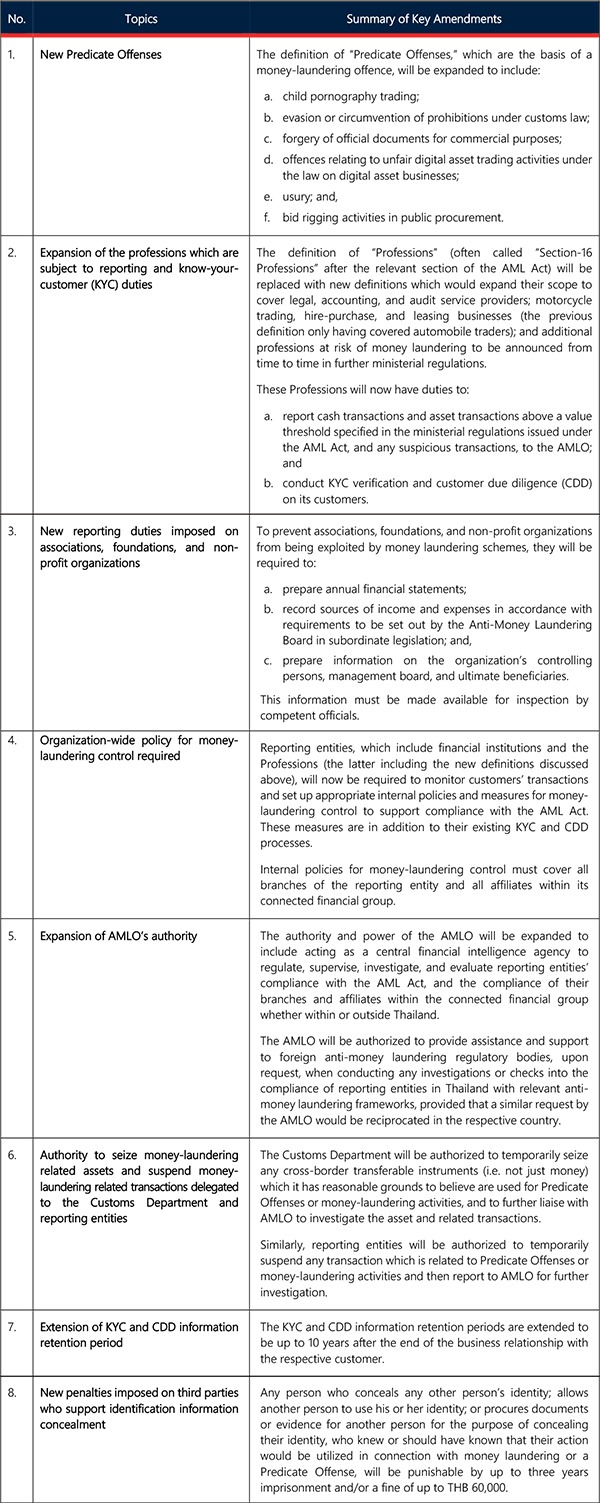
These amendments would allow for more robust regulation and investigation processes to better combat increasingly complex money laundering schemes, and would also be an important step for Thailand to satisfy one of the key qualifications for becoming an FATF member.

At the date of this publication, the Draft Amendment Act is currently under an additional public hearing process which will continue until the end of January 2022. We will closely monitor the legislation process of this Draft Amendment Act and will continue to report on any significant developments as they become available.

For more information on anti-money laundering law in Thailand, please contact Mr. Kobkit Thienpreecha at [email protected] or +66 2056 5534, Mr. Niti Muangkote at [email protected] or +66 2056 5542, and Ms. Chutikarn Boonnark at [email protected] or +66 2056 5536.

RELATED INSIGHTS​ 

February 24, 2025
On January 31, 2025, the Bank of Thailand (BOT) announced a new Notification re: Responsible Lending, replacing a similar notification from 2023. This new notification provides updated measures to assist debtors in different circumstances and clear implementation guidelines for lenders, with the aim of resolving household debt issues. Scope The service providers covered by the notification include banks and nonbanks (e.g., credit card companies, asset management companies, licensed personal loan providers, and nano finance operators) that conduct lending business. New Requirements The notification’s core focus remains loan management throughout the lifecycle of a loan—from credit product development to legal proceedings and debt transfers to other creditors—but with further clarification and detail compared to the 2023 notification. The key revisions in the new notification are summarized below. Advertising standards: The notification tightens requirements in some areas and relaxes them in others. Stricter requirements: It is now clearly stipulated that the BOT oversees taglines that may encourage excessive borrowing. More examples of noncompliant statements are also added (e.g., “Elevate your lifestyle now, pay later”; “Get approved, even with credit challenges”). In addition, advertising material that contains multiple credit products should provide clear minimum and maximum interest rates, especially when there are significant differences in the interest rates of each product. Relaxed requirements: The required information for some marketing activities is now reduced. For example, in marketing events with staff promoting loan products and offering free giveaways, service providers have the discretion to provide effective interest rate information in the manner they deem appropriate, and the advertisement material can display only the mandatory warning statements without providing interest rate details. Encouraging customer financial discipline: The notification requires service providers to implement more elaborate and extensive tools to influence customer behavior (termed “nudging” by the BOT) at every stage of the lending cycle. This
February 19, 2025
On January 3, 2025, the Bank of the Lao PDR (BOL) issued Decision No. 11/BOL on the Use of Foreign Currency in Lao PDR, taking effect on the same date. This decision sets out the rules for using foreign currency in Laos and ensures the Lao kip (LAK) remains the primary currency while allowing flexibility for international transactions. Key points in the decision are outlined below. Permissible Activities for Foreign Currency The decision provides that authorized entities can use foreign currency as a secondary currency to LAK in the setting of cost and pricing structures, announcing and advertising prices, and making or receiving payments for goods and services that are imported or have manufacturing inputs imported from other countries. Otherwise, LAK is the only permitted currency. The decision also stipulates that foreign exchange must be conducted only via authorized commercial banks or foreign exchange markets. The exchange rate for setting costs, pricing structures, announcing and advertising prices, and making and receiving payments for goods and services in foreign currency must match the exchange rate announced by commercial banks from time to time. Businesses Allowed to Use Foreign Currency The decision allows certain businesses and organizations to use foreign currency. These entities are divided into two groups: those that need approval before using foreign currency, and those that can use it immediately. Enterprises that can use foreign currency with BOL approval include: Businesses that export goods or services and entities that lease or obtain concessions from the government, generating revenue in foreign currency through commercial banks. Enterprises that provide international freight and passenger transportation services. Enterprises that provide services related to cross-border logistics and warehousing. Enterprises located at international borders and airports, such as duty-free shops and restaurants. Enterprises that have obligations to make payments in foreign currency to other
February 17, 2025
Thailand’s draft Emergency Decree on Technology Crimes Suppression, which we covered in a client alert in January 2025 primarily addressed to telecom operators and financial institutions, is expected to have significant implications for a wide range of business operators.  The draft emergency decree has already been approved by the cabinet but may undergo further developments as it continues in the legislative process. In this article, we will highlight the material impacts of the draft emergency decree on overseas and local fintech operators. Expanded Definition of “Technology Crimes” The definition of “technology crimes” now includes the following acts of forgery or alteration: Forging or altering the identity of individuals and biometric characteristics by utilizing computer or communication systems or other electronic means to commit offenses. Forging or altering symbols, trademarks, or seals of groups (e.g., foundations, community enterprises) or juristic persons, including acts by juristic persons using individuals or juristic persons as nominal directors or shareholders, regardless of whether such individuals or legal juristic persons reside in Thailand. Forging or altering digital or online platforms, regardless of the platform’s location or legal status. Individuals who conspire, utilize, assist, or support the commission of these offenses will face the same penalties as the principal offender. Business Operator Definition The scope of “business operators” is now expanded to cover various fintech and digital asset operators beyond those under the Payment Systems Act (PSA). The draft emergency decree now includes the following operators, whether they are legally authorized or not: Business operators under the PSA and business operators who operate “as if” they are payment system operators Business operators under the Royal Decree on Digital Asset Businesses or business operators who operate “as if” they are digital asset business operators. Foreign exchange business operators. Disclosure and Exchange of Information Business operators must disclose
February 12, 2025
Tilleke & Gibbins’ anticorruption team in Bangkok has authored the Thailand chapter of the newly released Anti-Bribery & Corruption 2026, published by Lexology Panoramic. This global guide provides a comparative overview of antibribery and anticorruption regimes across multiple jurisdictions. The Thailand chapter addresses the following key areas: Relevant international and domestic law: International anticorruption conventions, foreign and domestic bribery laws, successor liability, civil and criminal enforcement, out-of-court resolution and leniency mechanisms Foreign bribery: Legal framework, definition of foreign public officials, gifts, travel and entertainment, facilitating payments, payments through intermediaries, individual and corporate liability, private commercial bribery, defenses, enforcement authorities, enforcement trends, prosecution of foreign companies, sanctions, recent decisions and investigations Financial record-keeping and reporting: Applicable laws and regulations, disclosure of violations or irregularities, prosecution under accounting legislation, penalties for record-keeping violations, and tax deductibility of domestic or foreign bribes Domestic bribery: Legal framework, scope of prohibitions, definition of domestic public officials, gifts, travel and entertainment, facilitating payments, public official participation in commercial activities, payments through intermediaries or third parties, individual and corporate liability, private commercial bribery, defenses, enforcement authorities, enforcement trends, prosecution of foreign companies, sanctions, recent decisions and investigations Updates and trends: Key developments over the past year The Thailand chapter outlines recent developments in anticorruption enforcement, including significant cases involving multinational corporations and continued operations targeting transnational fraud networks along the Myanmar border. It also provides an overview of Thailand’s legal framework for addressing domestic and foreign bribery, including the Organic Act on Anti-Corruption B.E. 2561 (2017). The full Thailand chapter is available as a PDF through the button below. Readers may also register for 30 days of complimentary access to the complete Anti-Bribery & Corruption 2026 guide and other Lexology Panoramic publications through this link.