You are using an outdated browser and your browsing experience will not be optimal. Please update to the latest version of Microsoft Edge, Google Chrome or Mozilla Firefox. Install Microsoft Edge

December 28, 2021

Thai Cabinet Approves New Draft Amendments to the Anti-Money Laundering Act

Since 2017, Thailand’s Anti-Money Laundering Office (AMLO) has been developing an amendment to the Anti-Money Laundering Act B.E. 2452 (1999) (AML Act) to improve Thailand’s anti-money laundering framework and make it more consistent with the internationally accepted anti-money laundering policies and practices recommended by the Financial Action Task Force (FATF). The most recent development came on November 4, 2021, when the Thai Cabinet approved, in principle, a draft amendment to the existing AML Act.

The key amendments under this latest draft amendment to the AML Act are summarized below.
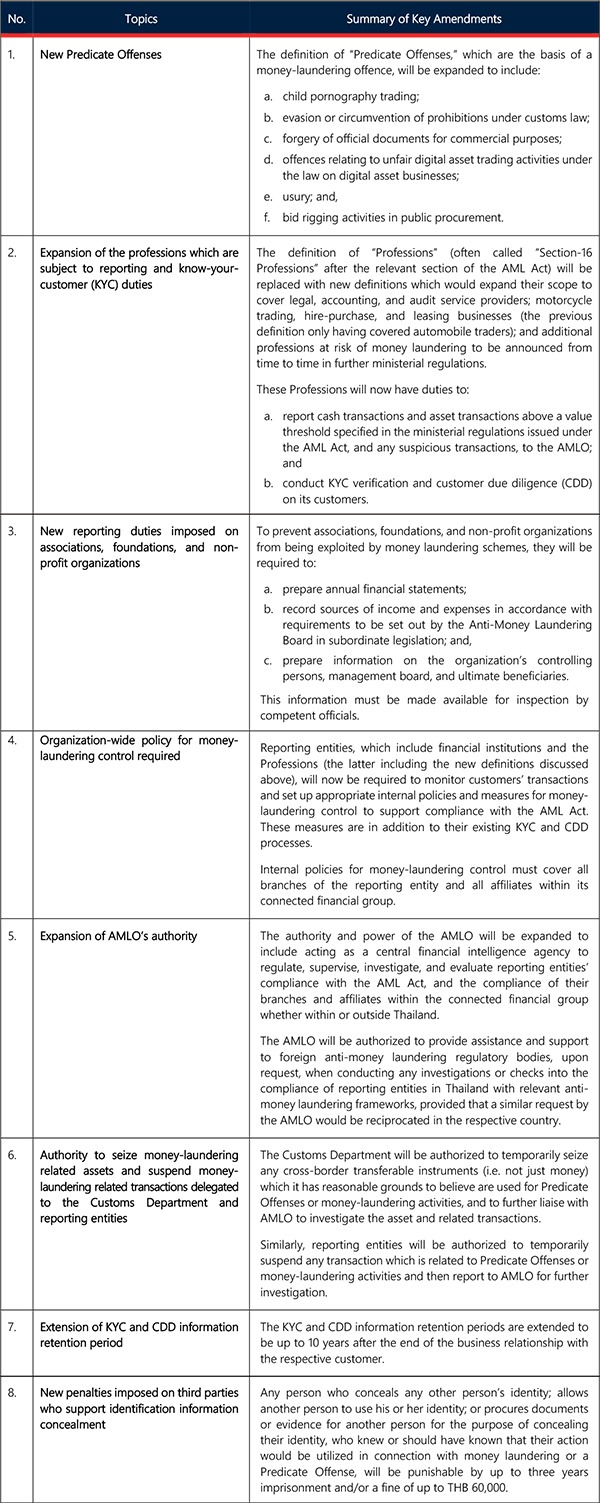
These amendments would allow for more robust regulation and investigation processes to better combat increasingly complex money laundering schemes, and would also be an important step for Thailand to satisfy one of the key qualifications for becoming an FATF member.

At the date of this publication, the Draft Amendment Act is currently under an additional public hearing process which will continue until the end of January 2022. We will closely monitor the legislation process of this Draft Amendment Act and will continue to report on any significant developments as they become available.

For more information on anti-money laundering law in Thailand, please contact Mr. Kobkit Thienpreecha at [email protected] or +66 2056 5534, Mr. Niti Muangkote at [email protected] or +66 2056 5542, and Ms. Chutikarn Boonnark at [email protected] or +66 2056 5536.

RELATED INSIGHTS​ 

September 30, 2026
On September 15, 2026, Vietnam’s Ministry of Finance (MOF) released for public consultation a draft circular on reporting and information disclosure in the pilot crypto asset market. The draft implements Resolution No. 05/2025/NQ-CP on the Pilot Implementation of the Crypto Asset Market in Vietnam and provides further detail on how licensed crypto asset service providers (“CASPs”) will be supervised once the market becomes operational. The draft indicates a data-intensive supervisory model, with licensed CASPs serving as the first line of market oversight. Public Disclosure Requirements The draft imposes detailed public disclosure requirements on CASPs, aimed primarily at market transparency. CASPs and crypto asset issuers must make disclosures in both Vietnamese and English, retain reported and disclosed information for at least 10 years, and keep information published on their websites accessible for at least five years. For CASPs, disclosure obligations arise both periodically and when specific events occur. A CASP must announce any crypto asset to be admitted to trading on its website at least seven days before trading begins and publish periodic financial statements. Certain extraordinary events and information requested by the MOF must generally be disclosed within 24 hours. CASPs must also provide ongoing market information. During trading hours, they must publish key trading data, including prices and volumes, daily highs and lows, average prices, the three best bid and offer levels, and transactions by foreign investors. By 9:00 a.m. each trading day, they must publish specified information on the previous day’s trading activity. Regulatory Reporting Requirements Separate from public disclosure, the draft requires CASPs to provide regulators with detailed information enabling ongoing supervision of their operations and the market. For market activity, CASPs must report decisions to admit or remove a crypto asset from trading within 24 hours, submit previous-day trading data to the State Securities Commission
September 28, 2026
On July 22, 2026, the government of Vietnam issued Decree No. 292/2026/ND-CP detailing the implementation of the Law on Foreign Trade Management (Decree 292). Decree 292 came into effect on September 5, 2026, replacing Decree No. 69/2018/NND-CP, and introduces several important changes to Vietnam’s foreign trade regime. Of particular relevance is the addition to the list of goods prohibited from importation of “products and goods extracted, produced, or manufactured wholly or partly through forced labor by enterprises, countries, or territories in accordance with relevant international treaties to which the Socialist Republic of Vietnam is a party.” This new prohibition introduces forced-labor considerations into Vietnam’s import compliance framework and may have practical implications for how businesses manage related risks across their operations and supply chains. Implementation of the New Prohibition According to Decree 292, the minister or head of the relevant ministerial-level agency is responsible for publishing the detailed list and corresponding harmonized system (HS) codes for each category of goods prohibited from export or import under its purview. Goods involving forced labor fall under the purview of the Ministry of Home Affairs. However, as of the date of this article, no corresponding list has been published specifying the goods to which the forced-labor prohibition applies, leaving businesses without official guidance on how the prohibition will be applied or enforced in practice. Nevertheless, this absence does not suspend the prohibition’s application. As Decree 292 has already taken effect, goods involving forced labor remain subject to the general legal framework applicable to goods prohibited from importation. In particular, Decree 169/2026/ND-CP provides for administrative penalties for the importation or transportation of prohibited goods into Vietnam. Depending on the nature and circumstances of the violation, criminal liability may also arise under the Criminal Code. In practice, enforcement is likely to depend on the
August 27, 2026
The Bank of Thailand (BOT) is seeking public feedback on a proposed overhaul of the regulatory framework for licensed money changers authorized by the finance minister, under the Exchange Control Act, to buy and sell foreign banknotes separately from commercial banks and specialized financial institutions. The BOT published the draft principles on August 19, 2026, for public consultation, with comments accepted through September 18, 2026. If adopted in its current form, the new framework would substantially raise licensing standards, require existing licensees to undergo a review and upgrade process, temporarily freeze new applications in 2027, and reduce application intake rounds from 2028 onward, with significant implications for both existing operators and prospective new entrants. The overhaul initiative stems from the BOT’s recognition of a need to prevent the use of licensed money changers as channels for financial crime. The stated objectives are to build public confidence, ensure the safety of financial service users, and align the supervisory framework with the current risk profile of the business and evolving market conditions. Upgraded Licensing Standards The BOT intends to significantly revise the licensing framework, including requirements relating to registered capital, branch management, operational standards, and customer transaction limits. Detailed criteria have not yet been released and are expected to be subject to further consultation. All existing licensees will be required to upgrade to meet the new standards and submit evidence of compliance for BOT review on a case-by-case basis. Existing licensees that are unable to satisfy the upgraded requirements may face regulatory consequences, subject to the final framework and BOT review process. Freeze and Reopening The BOT will temporarily stop accepting new license applications throughout 2027 to focus resources on inspecting and upgrading existing money changers. Any party wishing to obtain a new money changer license must submit its application by
August 20, 2026
As part of its membership in Lex Mundi, Tilleke & Gibbins has released the latest edition of its Guide to Doing Business in Thailand, providing an overview of the legal, regulatory, and commercial considerations for companies establishing or expanding operations in Thailand. The 2026 edition offers practical insight into the country’s business environment, investment framework, and operational requirements. The guide covers a wide range of topics relevant to foreign and domestic investors, including: Investment incentives and promotion schemes Financial facilities and banking regulations Exchange controls and money transfers Import and export regulations Business structures and incorporation options Requirements for establishing a business Operational and compliance considerations Business cessation and insolvency procedures Employment and labor laws Taxation Immigration and visa requirements Prepared by Tilleke & Gibbins lawyers across multiple practice areas, the publication outlines key aspects of doing business in Thailand, including foreign investment restrictions, regulatory compliance obligations, corporate structures, employment requirements, and recent legal and economic developments affecting investors. The publication forms part of Lex Mundi’s Country Guides series, a global collection of jurisdiction-specific reference materials prepared by member firms around the world. Together, these guides help companies evaluate opportunities, compare regulatory environments, and plan international business activities across multiple markets. The full Guide to Doing Business in Thailand 2026 is available through the button below.