
You are using an outdated browser and your browsing experience will not be optimal. Please update to the latest version of Microsoft Edge, Google Chrome or Mozilla Firefox. Install Microsoft Edge

March 24, 2020

Tax Incentives for Investment in Thailand’s Super Savings Fund Scheme

On March 13, 2020, the Revenue Department of Thailand issued Notification of the Director General of Revenue Concerning Income Tax (No. 369) Re: Criteria, Methods and Conditions for Income Tax Exemption on the Purchase of Investment Units of Super Savings Funds (SSFs).

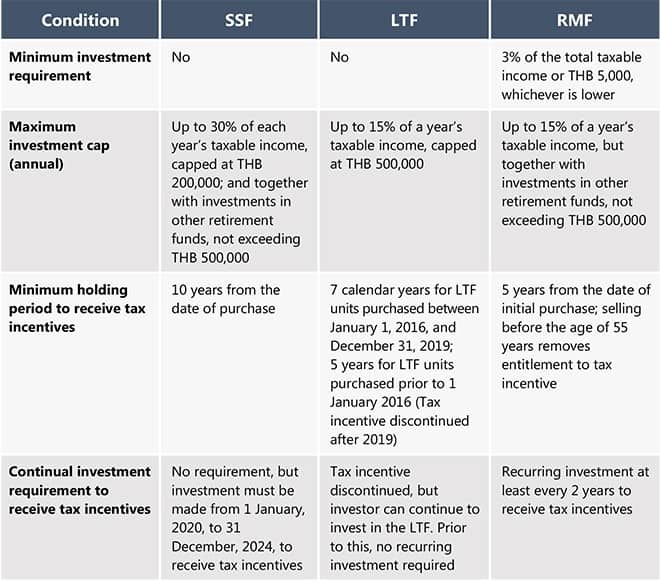
The tax incentives for investment in SSFs are intended as a substitute for the tax incentives for investment in Long-Term Equity Funds (LTFs), which were discontinued at the end of last year. The criteria and conditions for tax exemption under the SSF scheme are summarized below:

  • In any tax year, a taxpayer may not make SSF investments in excess of 30% of their total taxable income for that year, capped at THB 200,000.
  • The taxpayer’s total SSF, Provident Fund, Government Pension Fund, Private Teacher Aid Fund, Retirement Mutual Fund (RMF), Annuity Insurance Premium, and National Savings Fund investments and contributions must not exceed THB 500,000 in a single tax year.
  • Taxpayers may invest in an SSF from January 1, 2020, to December 31, 2024 (5 years). There is no requirement for continual purchase of SSF units, unlike the rules for LTF or RMF investments. Taxpayers are eligible to receive tax incentives in any year that they invest in an SSF.
  • There is no restriction on the holding period for SSF units. However, to enjoy tax benefits, the taxpayer must hold SSF units for a continual period of not less than 10 years from the date of purchase (except where the taxpayer becomes incompetent or deceased). If a taxpayer sells the SSF units before 10 years have elapsed, they will have to file an amended personal income tax return for the period that the tax exemption was claimed and pay additional tax with a surcharge of 1.5% per month (capped at the additional tax payment amount). Capital gains derived from the sale of SSF units will also be subject to tax in the year that they are sold.
  • The taxpayer must retain the certificate of investment in the SSF issued by the asset management company to support the tax exemption.
  • The taxpayer may transfer an investment in one SSF to another SSF. The transfer must be made within five working days of the SSF receiving an order to transfer from the taxpayer; otherwise, the investment period of 10 years will not be continued.

The major differences in the tax incentive conditions of SSF, LTF, and RMF investments are summarized in the table below.
RELATED INSIGHTS​ 

March 21, 2023
Thailand has issued a royal decree officially reducing the land and building tax due in 2023. The Royal Decree on Land and Building Tax Reduction (No. 3) B.E. 2566 (2023), which was announced and published in Thailand’s Government Gazette on March 19, 2023, and came into effect the following day, will effectively reduce land and building tax payments by 15% in 2023 for the following types of land and buildings: Land or buildings used for agricultural purposes; Land or buildings used for residential purposes; Land or buildings used for other purposes; and Vacant or unused land or buildings. Owners of these types of land or buildings are therefore only required to pay 85% of the land and building tax normally owed for 2023. Furthermore, owners of certain types of land or buildings that were eligible for tax reduction of 50% or 90% under the Royal Decree on Land and Building Tax Reduction B.E. 2563 (2020) will enjoy an additional 15% reduction of the tax amount that was reduced by 50% or a continuation of the 90% tax reduction, depending on the circumstances. For more details on these measures, or on any aspect relating to Thailand’s land and building tax, please contact Chaiwat Keratisuthisathorn at [email protected] or +66 2056 5507.
December 30, 2022
Thailand’s cabinet has approved draft legislation to impose a financial transactions tax (FTT) on securities trading in the Stock Exchange of Thailand (SET). The cabinet’s decision, which came on November 29, 2022, sets Thailand on a path to repeal a tax exemption that has been in place for over 30 years. If the legislation is ultimately passed, the FTT will be applied to transactions starting in April 2023. The sale of securities on the SET has been exempt from specific business tax (SBT) since December 1991 in an effort to promote trading on the secondary market and boost the domestic economy. The draft legislation approved by the cabinet in November 2022 aims to repeal the SBT exemption on securities trading on the SET and impose an FTT, which is a kind of SBT imposed on a specific commercial transaction. It is an indirect and transactional tax (similar to a sales tax) and is imposed on gross receipts, not on value added at each stage of manufacturing, trading, or service like VAT. Generally, securities sellers are the ones liable for FTT. However, the draft law stipulates that securities brokers are to withhold FTT from the gross share sales income and remit it to the Revenue Department on behalf of the securities seller within the 15th (or 23rd, depending on circumstances) day of the next month through the Revenue Department’s e-filing platform. Under this arrangement, securities sellers and investors do not have any duty to remit SBT, and sellers have no reporting obligations regarding sale transactions. Under the current draft, the imposition of FTT will be implemented in two phases, with an initial reduced rate as detailed in the table below. The securities subject to FTT include shares (both ordinary and preference), warrants, derivative warrants, exchange traded funds, depositary receipts, mutual
December 29, 2022
On December 20, 2022, Thailand’s cabinet approved draft legislation providing further Land and Building Tax reductions of 15% in 2023, on top of current reductions in tax rates, on some types of taxable property. When enacted, the legislation will provide further tax reductions only for the property types in the table below. Moreover, in early December, Thailand’s Ministry of Interior promulgated an announcement extending the deadline for tax assessment notification and tax payment (including by scheduled installments) by another two months from the previous statutory deadline of December 20, 2022. The key deadline extensions are shown in the table below. The Land and Building Tax is a property tax collected annually, with rates varying based on the purpose of use—agricultural, commercial, industrial, or residential. Owners or possessors of land or buildings are liable for Land and Building Tax, which is computed based on the officially appraised value of the property. For more information on Thailand’s Land and Building Tax, please contact Auaychai Sukawong at [email protected] or Chaiwat Keratisuthisathorn at [email protected].
December 28, 2022
Introduction This article provides a summary of Myanmar’s tax and tariff updates in 2022. Perhaps most prominent are the commercial tax, special goods tax, and tariff rate exemptions for battery electric vehicles (BEVs) and an increase in special commercial income tax for companies engaging in oil and gas exploration and production in Myanmar. This is good news for environmental protection efforts through taxation law. Additionally, Myanmar announced its updated Customs Tariff of Myanmar 2022, which covers internationally classified harmonized system (HS) codes and the HS codes of the ASEAN Harmonized Tariff Nomenclature. Furthermore, Myanmar’s Internal Revenue Department (IRD) also issued clarifications on tax avoidance, negligent underpayment of tax, misrepresentation of tax information, tax evasion, withholding tax on services, and tax refunds. Union Taxation Law 2022 and Amendment On March 30, 2022, the Union Taxation Law 2022 was enacted by the State Administration Council (SAC) with the SAC Law No. 6 of 2022; the law was further amended on November 17, 2022 by SAC Law No. 48 of 2022. The amended law exempts BEVs and their batteries from commercial tax and special goods tax, effective from October 1, 2022 to March 31, 2023. The amendment also provides that companies engaging in oil and gas exploration and production in Myanmar are subject to a special commercial income tax rate of 25% on their total net profit from April 1, 2022, to March 31, 2023. Tax Avoidance, Underpayment of Tax, Misrepresentation of Tax Information, and Tax Evasion The IRD issued a public ruling on November 16, 2022, to address tax avoidance, underpayment of tax, misrepresentation of tax information, and tax evasion. This public ruling was brought under the Tax Administration Law 2019 and concerns relevant provisions in that law. Tax avoidance is interpreted as occurring when a person who understands the tax