
You are using an outdated browser and your browsing experience will not be optimal. Please update to the latest version of Microsoft Edge, Google Chrome or Mozilla Firefox. Install Microsoft Edge

March 24, 2020

Tax Incentives for Investment in Thailand’s Super Savings Fund Scheme

On March 13, 2020, the Revenue Department of Thailand issued Notification of the Director General of Revenue Concerning Income Tax (No. 369) Re: Criteria, Methods and Conditions for Income Tax Exemption on the Purchase of Investment Units of Super Savings Funds (SSFs).

The tax incentives for investment in SSFs are intended as a substitute for the tax incentives for investment in Long-Term Equity Funds (LTFs), which were discontinued at the end of last year. The criteria and conditions for tax exemption under the SSF scheme are summarized below:

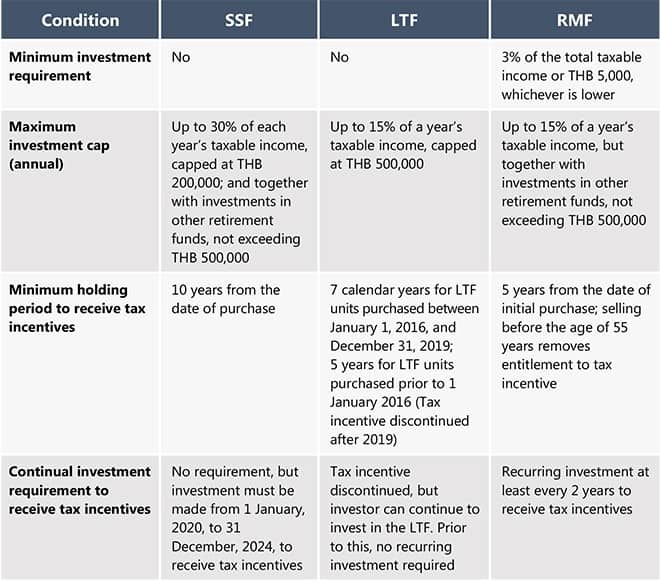
  • In any tax year, a taxpayer may not make SSF investments in excess of 30% of their total taxable income for that year, capped at THB 200,000.
  • The taxpayer’s total SSF, Provident Fund, Government Pension Fund, Private Teacher Aid Fund, Retirement Mutual Fund (RMF), Annuity Insurance Premium, and National Savings Fund investments and contributions must not exceed THB 500,000 in a single tax year.
  • Taxpayers may invest in an SSF from January 1, 2020, to December 31, 2024 (5 years). There is no requirement for continual purchase of SSF units, unlike the rules for LTF or RMF investments. Taxpayers are eligible to receive tax incentives in any year that they invest in an SSF.
  • There is no restriction on the holding period for SSF units. However, to enjoy tax benefits, the taxpayer must hold SSF units for a continual period of not less than 10 years from the date of purchase (except where the taxpayer becomes incompetent or deceased). If a taxpayer sells the SSF units before 10 years have elapsed, they will have to file an amended personal income tax return for the period that the tax exemption was claimed and pay additional tax with a surcharge of 1.5% per month (capped at the additional tax payment amount). Capital gains derived from the sale of SSF units will also be subject to tax in the year that they are sold.
  • The taxpayer must retain the certificate of investment in the SSF issued by the asset management company to support the tax exemption.
  • The taxpayer may transfer an investment in one SSF to another SSF. The transfer must be made within five working days of the SSF receiving an order to transfer from the taxpayer; otherwise, the investment period of 10 years will not be continued.

The major differences in the tax incentive conditions of SSF, LTF, and RMF investments are summarized in the table below.
RELATED INSIGHTS​ 

December 8, 2023
Thailand’s Ministry of Interior has extended the deadlines for payment of the 2024 land and building tax and related procedures by two months. The announcement was published in the Government Gazette on November 30, 2023. According to the new timeline in the ministry’s announcement, the official land and building tax assessment forms will be sent to taxpayers by the end of April 2024 (extended from February 2024) while the deadline for payment of land and building tax has been extended to June 30, 2024 (from April 30, 2024). For payments made in installments, the announcement also extended the deadline for each installment as follows: For more details on these measures, or any aspect of Thailand’s land and building tax, please contact Chaiwat Keratisuthisathorn at [email protected] or Supranee Arjjit at [email protected].
November 23, 2023
Thailand’s Revenue Department has issued an order clarifying its recent order imposing personal income tax (PIT) on the offshore-sourced income of Thailand tax residents whenever it is brought into Thailand. The clarifying order, which was issued on November 20, 2023, confirms that the new rule will not apply to offshore-sourced income earned before January 1, 2024, which is the date the order comes into effect. This means that offshore-sourced income earned before January 1, 2024, will not be subject to PIT if it is brought into Thailand after the year 2023. This grandfather protection means that Thai tax residents will not have to pay PIT on offshore-sourced income earned before 2024 and brought into Thailand at any time after 2023. This is favorable to many who have earned income from offshore sources but may not have had sufficient time to revise their tax planning in response to the new rule. For more details on Thailand’s taxation of tax residents’ offshore-sourced income, or on any aspect of tax laws and regulations in Thailand, please contact Tilleke & Gibbins at [email protected].
October 30, 2023
On October 9, 2023, Laos issued Presidential Decree No. 003, which raised excise tax rates for certain goods, effective immediately. The move to increase excise tax rates comes amid the marked depreciation of the Lao kip (LAK). The Lao government is trying to monitor and discourage imports of non-essential products in order to reduce the outflow of foreign currency from the country. Increasing the tax rate for some of these products is part of these efforts. The specific products and excise tax rates are listed in the table below.   This new rate policy is also in line with recent government efforts to encourage avoiding payment in foreign currency to prevent the depletion of foreign currency reserves in Laos. In this regard, commercial banks have already taken action to ration the supply of foreign currency by prioritizing imports of essential goods, such as fuel. The products listed above formalize this impetus to prioritize certain imports and discourage others deemed not essential. In addition, the increased excise tax rates on fuel-powered vehicles show the commitment of the Lao government to move toward electric vehicles, which would also lessen the country’s dependence on fuel imports. For more information on these excise tax changes, or on any aspect of Laos’ international trade regulations, please contact Tilleke & Gibbins at [email protected].
October 16, 2023
On September 15, Revenue Departmental Order No. Por. 161/2566 was published, fundamentally changing how Thailand tax residents’ offshore-sourced income will be taxed. Under the order, starting from January 1, 2024, the offshore-sourced income of tax residents will be subject to Thai personal income tax (PIT) in any year that it is brought into Thailand. The purpose of this new rule is to ensure consistent tax collection practices among tax officers and to tackle tax avoidance strategies commonly used by individual taxpayers. PIT on Offshore-Sourced Income According to the resident rule in Thailand’s Revenue Code, Thailand tax residents (i.e., persons who reside in Thailand for at least 180 days in a calendar year) are subject to PIT on their domestic-sourced and offshore-sourced income. “Offshore-sourced income” is broadly defined to include income from work, business, or assets outside Thailand. Existing Practice Currently, Thailand tax residents’ offshore-sourced income is exempted from PIT if it is brought into Thailand after the calendar year in which it was earned. This exemption was adopted 28 years ago in the Revenue Department’s interpretation stated in a resolution from February 1985. This exemption by interpretation has led some Thailand tax residents to avoid PIT by simply holding their newly earned offshore-sourced income abroad temporarily and then bringing it into Thailand at a later time. Through the years, a number of tax rulings have affirmed this practice. New PIT Collection Rules for Offshore-Sourced Income Revenue Departmental Order No. Por. 161/2566 simply revokes the favorable exemption adopted under the February 1985 resolution so that the delay tactic is no longer able to succeed in avoiding tax. Starting from January 1, 2024, the offshore-sourced income of Thailand tax residents will be subject to PIT whenever it is brought into Thailand, at which time the offshore-sourced income must be declared to