
You are using an outdated browser and your browsing experience will not be optimal. Please update to the latest version of Microsoft Edge, Google Chrome or Mozilla Firefox. Install Microsoft Edge

December 6, 2018

Successful Online-to-Offline Enforcement Action Leads to Huge Seizure of Counterfeits

Informed Counsel

The ease with which counterfeiters are able to hide their identity online, simply by hiding behind a username, can often complicate the protection of IP rights. However, if an infringer’s anonymity can be pierced, it can yield huge seizures of counterfeit products, make great strides in protecting valuable intellectual assets, and close major distribution channels.

In a recent example, Panasonic Corporation successfully uncovered the identity of a Chinese infringer operating in Thailand, raided the infringer’s physical location, and seized more than 30,000 counterfeit Panasonic products (primarily bat- teries). The raid has had a deep impact on the market, disrupting the distribution channels for these counterfeit goods, removing the fake goods from online marketplaces, and protecting the Thai public from dangerous counterfeit goods.

Identifying the Online Infringers

Many e-commerce websites are open to anyone wanting to sell their goods, creating a platform for fake goods to be easily offered for sale by infringers. Using anonymous usernames, infringers can create store pages containing enticing and convincing statements, luring end-users into believing that the cheaper goods are genuine.
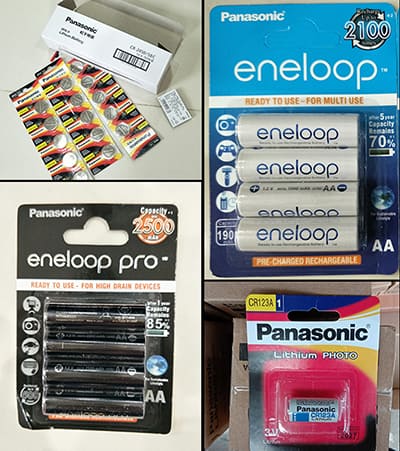
In this case, three such pages were found to be selling counterfeit Panasonic batteries on one of Thailand’s most popular online marketplaces. After contacting the online marketplace operators to request that the advertisements be taken down, two pages closed but one remained active.

An in-depth private investigation into the remaining online shop uncovered that all three pages were owned by the same entity—a Chinese national with two houses in Bangkok, from which he actively sold various types of fake Panasonic batteries in large quantities.

Warning Letter vs. Raid Action   

Sending a warning letter is usually the preferred enforce- ment action against small-scale online infringers. If the dispute can be settled after sending the warning letter, this option is more time- and cost-efficient than other legal actions.    

However, infringers with large inventories may be less receptive to this approach, either ignoring warning letters entirely, or only ceasing sales temporarily. Either way, infringers with large inventories are very likely to continue sales eventually, as they need to clear out their stock.   

In addition, attempts to negotiate with foreign nationals operating in Thailand often backfire, as they are not usually permanently established in Thailand. It is common for such infringers to simply move to another location upon receipt of a warning letter.   

In this instance the targeted infringer clearly had a large stock, was a foreign national, and was quite cautious in his activities, using the marketplace platform to hide his identity and not disclosing his name on his shop pages. A warning letter was therefore considered to pose a high risk, and a strong raid action against the target in order to seize the fake goods was considered a better solution. In addition, such action would penalize the infringers and spread the message that Panasonic takes serious legal action against infringers in order to protect its consumers.    

A criminal raid action was therefore initiated at the identified houses in order to seize the products.

Search and Seizure    

Based on investigation reports, strong evidence, and coordination with a police raid team, the court granted search warrants to gain entry to the suspect’s houses. No counterfeit Panasonic products were found at the first house, although other branded mobile phone chargers, earphones, mobile phone holders, and various unbranded products were on site. The police seized those goods for non-payment of import taxes.
The suspect and one of his staff (a Thai citizen) were found inside the second house, and they granted entry when presented with the search warrant. The search confirmed that the residential property was being used as a warehouse for commercial purposes. Batteries, chargers, watches, and other products were stored in every room, including the living room, kitchen, bedrooms, and even bathrooms. A large number of fake Panasonic products were found, along with other branded products.    

The police seized more than 30,000 counterfeit Panasonic products, including stickers labeled “Panasonic” that were obviously going to be attached to infringing products before sale. 

Arresting the Counterfeiters

The police filed charges of trademark infringement and importation tax evasion under the Customs Act against both people found in the house. In respect of the stickers labelled “Panasonic,” intended to convince the public that counterfeit goods were genuine Panasonic goods, the infringers were charged with using a mark without authorization in order to mislead the public, under the Thai Penal Code. In addition, the foreign national was charged with working without a work permit under Thailand’s immigration regime.   

This successful raid action prevented the distribution of fake goods to end-users, and will serve as a deterrent to other potential infringers in the market in accordance with Panasonic’s anticounterfeiting and customer protection policies.    

This raid is a prime example of the level of commitment necessary in order to protect Thai consumers from dangerous counterfeit products. Actions like these are rarely a one-off, and typically form part of a broader anticounterfeiting campaign. In that context, raids can also help to identify the sources of fake batteries being distributed in Thailand, and ultimately eliminate the counterfeit products once and for all.

RELATED INSIGHTS​ 

June 2, 2023
Thailand’s labeling requirements have new rules on product label font size and readability following the issuance of Announcement of the Label Committee Re: Characteristics of the Label for Label-Controlled Goods No. 3, which is a bylaw of the Consumer Protection Act (CPA). The announcement takes effect on June 18, 2023, and applies to all “label-controlled goods,” which are described under the CPA and its bylaws as goods either produced by factories in Thailand or imported into Thailand for sale. The labels of these goods must meet current labeling requirements, such as having information about the product name, quantity, intended use, cautions, and expiry date. Label readability—specifically in terms of the size of text on labels—is also a mandatory requirement, and is the focus of this latest announcement. Text size requirements are an important part of ensuring that consumers are fully aware of the details of a product before deciding to purchase the goods. According to the announcement, any statement or text displayed on a label must be easily visible and readable. The size of the text must be proportional to the label area. Specifically, the text height must not be less than 2 millimeters (or 1.5 millimeters for labels with an area of less than 35 square millimeters). The announcement does not clarify exactly how the height of the text will be determined. Some companies have expressed concern that these requirements are too strict and will be challenging to meet, especially for small businesses. The text size requirements may be expensive to implement, as the larger text requires more space on the label, potentially leading to larger labels or packages, higher production costs, or even expensive recalls to affix new labels. In some cases, text size requirements may even make it impossible to fit all the required information on
April 20, 2023
Food safety is one important area of focus as Cambodia continues to improve its regulatory framework surrounding consumer protection. Last year, the new Law on Food Safety set out the main principles to regulate the food sector, providing general rights and obligations of food businesses and requirements for food products traded in Cambodia. Then in the first months of 2023, two implementing regulations were issued to clarify the overarching principles of the Law on Food Safety, as well as its enforcement mechanisms. The adoption of these enforcement-related regulations is once again a clear signal to the market that the Cambodian government is taking the enforcement of consumer protection laws seriously. Food Surveillance, Seizure, and Recalls The first of these implementing regulations was Sub-Decree No. 13 on the Conditions, Formalities and Procedures for Food Surveillance and Seizure, dated January 6, 2023 (SD 13), followed the next month by Prakas No. 080 on the Forms and Procedures to Seize Unsafe Foods or Foods Not Complying with Technical Regulations, dated February 22, 2023 (Prakas 80). These implementing regulations give clarity on how the authorities will monitor and inspect the food sector, and in what cases the authorities may resort to recalls or seizure of foods. Prakas 80 also provides the necessary paperwork for both inspecting officers and companies to use when reporting on unsafe foods to authorities and the public. Lastly, the regulations further clarify the obligations for food businesses and the penalties for noncompliance. The Consumer Protection, Competition, and Fraud Repression Directorate-General (CCF) of the Ministry of Commerce takes a key role as the main enforcement authority under the regulations. The CCF receives reports on unsafe foods, manages voluntary recalls, publishes warnings to the public regarding unsafe foods, seizes unsafe or otherwise noncompliant goods, and applies the administrative fines and penalties
March 7, 2023
Intellectual property experts from Tilleke & Gibbins’ Hanoi office have written the Vietnam chapter of Practical Law Company’s Copyright Litigation Global Guide 2023, a high-level comparative overview of laws and regulations related to copyright law presented in an easy to read Q&A format. The Vietnam chapter, which includes changes introduced by the latest amendment of Vietnam’s Intellectual Property Law, covers the following topics and more: Sources of law and the court system Types of works that can be protected by copyright Acts that constitute copyright infringement Parties to litigation Enforcement options Procedure in civil courts To read the Vietnam chapter, please visit the Practical Law website or click on the link below.
March 1, 2023
In Cambodia, the Ministry of Commerce takes the lead on many consumer protection matters, issuing and enforcing regulations that contribute greatly to a fairer and more transparent legal framework. The regulations protect consumers while simultaneously creating a more a level playing field for businesses. On September 2, 2022, the ministry issued a new regulation concerning household chemical products. The regulation, named Prakas No. 192 on the Requirements for the Labeling of Household Chemical Products, is another big leap forward in light of the consumer protection framework that the Cambodian government has been rapidly updating in recent years. Interesting issues in the regulation include household chemical product classification, labeling and language requirements, product storage requirements, recall requirements, and obligations for companies engaging in business activities related to household chemicals. In addition, the regulation reminds household chemicals businesses operating online of the need to obtain additional e-commerce licensing. Cambodia’s consumer protection authority, the Consumer Protection, Competition and Fraud Repression Directorate-General—commonly known as the CCF—has already started to enforce the new regulation, as the three-month transition period under the regulation has now passed. Classifying and Defining Household Chemicals The regulation classifies household chemicals into three groups based on the product’s purpose—namely detergents, pesticides, and substances for home and garden protection. There is also a separate list of household chemicals identified as “chemicals not allowed for use in food.” This list is just a reminder, as existing legislation already prohibits the use of the identified chemicals in food. The regulation defines household chemicals as finished chemical products, or chemical additives to products, that can be harmful to health and that have one of the three purposes mentioned above. The regulation further states that the products are for use in “normal life,” such as in homes, workshops, or gardens, or for other public use.