
You are using an outdated browser and your browsing experience will not be optimal. Please update to the latest version of Microsoft Edge, Google Chrome or Mozilla Firefox. Install Microsoft Edge

December 6, 2018

Successful Online-to-Offline Enforcement Action Leads to Huge Seizure of Counterfeits

Informed Counsel

The ease with which counterfeiters are able to hide their identity online, simply by hiding behind a username, can often complicate the protection of IP rights. However, if an infringer’s anonymity can be pierced, it can yield huge seizures of counterfeit products, make great strides in protecting valuable intellectual assets, and close major distribution channels.

In a recent example, Panasonic Corporation successfully uncovered the identity of a Chinese infringer operating in Thailand, raided the infringer’s physical location, and seized more than 30,000 counterfeit Panasonic products (primarily bat- teries). The raid has had a deep impact on the market, disrupting the distribution channels for these counterfeit goods, removing the fake goods from online marketplaces, and protecting the Thai public from dangerous counterfeit goods.

Identifying the Online Infringers

Many e-commerce websites are open to anyone wanting to sell their goods, creating a platform for fake goods to be easily offered for sale by infringers. Using anonymous usernames, infringers can create store pages containing enticing and convincing statements, luring end-users into believing that the cheaper goods are genuine.
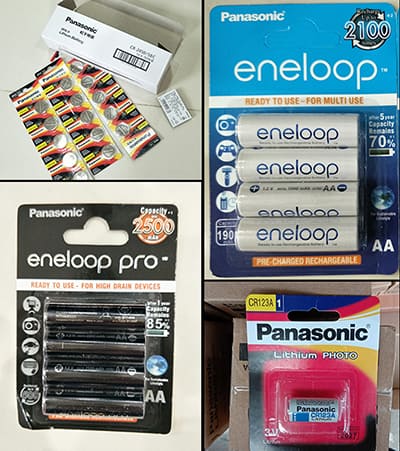
In this case, three such pages were found to be selling counterfeit Panasonic batteries on one of Thailand’s most popular online marketplaces. After contacting the online marketplace operators to request that the advertisements be taken down, two pages closed but one remained active.

An in-depth private investigation into the remaining online shop uncovered that all three pages were owned by the same entity—a Chinese national with two houses in Bangkok, from which he actively sold various types of fake Panasonic batteries in large quantities.

Warning Letter vs. Raid Action   

Sending a warning letter is usually the preferred enforce- ment action against small-scale online infringers. If the dispute can be settled after sending the warning letter, this option is more time- and cost-efficient than other legal actions.    

However, infringers with large inventories may be less receptive to this approach, either ignoring warning letters entirely, or only ceasing sales temporarily. Either way, infringers with large inventories are very likely to continue sales eventually, as they need to clear out their stock.   

In addition, attempts to negotiate with foreign nationals operating in Thailand often backfire, as they are not usually permanently established in Thailand. It is common for such infringers to simply move to another location upon receipt of a warning letter.   

In this instance the targeted infringer clearly had a large stock, was a foreign national, and was quite cautious in his activities, using the marketplace platform to hide his identity and not disclosing his name on his shop pages. A warning letter was therefore considered to pose a high risk, and a strong raid action against the target in order to seize the fake goods was considered a better solution. In addition, such action would penalize the infringers and spread the message that Panasonic takes serious legal action against infringers in order to protect its consumers.    

A criminal raid action was therefore initiated at the identified houses in order to seize the products.

Search and Seizure    

Based on investigation reports, strong evidence, and coordination with a police raid team, the court granted search warrants to gain entry to the suspect’s houses. No counterfeit Panasonic products were found at the first house, although other branded mobile phone chargers, earphones, mobile phone holders, and various unbranded products were on site. The police seized those goods for non-payment of import taxes.
The suspect and one of his staff (a Thai citizen) were found inside the second house, and they granted entry when presented with the search warrant. The search confirmed that the residential property was being used as a warehouse for commercial purposes. Batteries, chargers, watches, and other products were stored in every room, including the living room, kitchen, bedrooms, and even bathrooms. A large number of fake Panasonic products were found, along with other branded products.    

The police seized more than 30,000 counterfeit Panasonic products, including stickers labeled “Panasonic” that were obviously going to be attached to infringing products before sale. 

Arresting the Counterfeiters

The police filed charges of trademark infringement and importation tax evasion under the Customs Act against both people found in the house. In respect of the stickers labelled “Panasonic,” intended to convince the public that counterfeit goods were genuine Panasonic goods, the infringers were charged with using a mark without authorization in order to mislead the public, under the Thai Penal Code. In addition, the foreign national was charged with working without a work permit under Thailand’s immigration regime.   

This successful raid action prevented the distribution of fake goods to end-users, and will serve as a deterrent to other potential infringers in the market in accordance with Panasonic’s anticounterfeiting and customer protection policies.    

This raid is a prime example of the level of commitment necessary in order to protect Thai consumers from dangerous counterfeit products. Actions like these are rarely a one-off, and typically form part of a broader anticounterfeiting campaign. In that context, raids can also help to identify the sources of fake batteries being distributed in Thailand, and ultimately eliminate the counterfeit products once and for all.

RELATED INSIGHTS​ 

February 28, 2023
Influencer marketing and the creation of sponsored content is an increasingly popular way for brands to reach their target audience. Although there is no universal definition of an “influencer,” the term is broadly used to describe people who are able to affect purchasing decisions of others through their relationship with their audience. In the context of social media and the creator economy, influencers are usually people with significant followings on platforms such as Instagram, TikTok, Twitch, or YouTube who are viewed as celebrities, opinion leaders, trendsetters, or experts in their respective field. Based on a study conducted by Nielsen in 2022, 80% of social media users in Asia who follow influencers are likely to purchase products recommended by the influencers. Brand owners should be aware of five key legal considerations when entering into influencer marketing agreements. 1. Making informed decisions through due diligence Every collaboration with an influencer is a business relationship. Brands must conduct thorough due diligence on potential influencers prior to engaging them. This may include deep dives into the individual’s old social media posts, as well as requests for disclosure of prior controversial incidents and existing brand associations. For example, a health and fitness brand may not want—for both legal and commercial reasons—to be publicly associated with an influencer who is a brand ambassador of electronic cigarettes, no matter how impressive the latter’s Instagram following or deadlift record is. Brands should also ensure that their influencer marketing agreements include relevant representations and warranties that the influencer has not and will not commit a crime or act in a way that may cause negative publicity for the brand. This may include racist, extremist, homophobic, violent, or misogynistic acts, or any other acts that are obscene or against public order. 2. Clearly defining the scope of engagement Brands
February 21, 2023
On December 28, 2022, the Ministry of Health of Laos issued Decision No. 3789/MOH on the Control of Hemp for Medication and Products (the “Decision”). The Decision approves the regulated cultivation, extraction, production, processing, storage, distribution, utilization, import-export, and transport of hemp. The Decision also authorizes the use of hemp and hemp-related products by the general population, although use of certain products is limited to those with medical prescriptions. Background In 2019, the Lao government established an ad hoc committee to consider the legalization of cannabis, as reported previously. The government permitted certain local companies to grow cannabis in specific zones under pilot programs, although it continued to strictly prohibit the use and commercialization, as well as consumption, of cannabis-related products, regardless of the level of psychoactive tetrahydrocannabinol (THC) in the products. Overview of the Decision The Decision was issued by the Ministry of Health (which led the ad hoc committee) and permits authorized companies to engage in certain activities involving the use of hemp and the consumption of hemp and hemp-related products. The Decision defines hemp (“porkeo” in Lao) as a “plant that belongs to the same family as ganja and bears the scientific name Cannabis Sativa L. (Cannabis sativa L. subsp. sativa var. sativa) which is a subspecies of ganja (Cannabis Sativa L.).” This definition aims at differentiating hemp from the general definition of ganja or marijuana, which continues to be listed as a prohibited narcotic in Laos. The Law on Narcotics (2007) and the Penal Code (2017) still prohibit the production, trade and use of all types of cannabis. These laws will need to be amended to ensure that they are aligned with changes set out in the Decision.  Authorized Hemp Activities The Decision allows approved companies to engage in the cultivation, extraction, production, processing, storage,
February 9, 2023
Vietnam’s Ministry of Finance is drafting a circular on determining the origin of imported and exported goods. This circular, a draft version of which has been released for public comment (“Draft Circular”), consolidates prevailing regulations and guidelines on determining the origin of imported and exported goods that are stipulated in the following legal documents, which the Draft Circular would replace when it comes into effect: Circular No. 38/2018/TT-BTC dated April 20, 2018, of the Ministry of Finance regulating the determination of origin of imported and exported goods, as amended by Circular No. 62/2019/TT-BTC dated September 5, 2019, of the Ministry of Finance; Circular No. 47/2020/TT-BTC dated May 27, 2020, regulating the time to submit documents proving the origin of goods and form of the documents proving the origin of imported goods applied during the Covid-19 pandemic; and Circular No. 07/2021/TT-BTC dated January 25, 2021, regulating the time to submit documents proving the origin of imported goods under the EU-Vietnam Free Trade Agreement (EVFTA). Generally speaking, the Draft Circular does not increase the administrative procedures for importers and exporters, but rather seeks to codify the recent practices implemented by the customs authorities. The Draft Circular focuses on providing comprehensive guidance for importing/exporting companies when carrying out administrative procedures to certify the origins of imported and exported goods to be in line with current trade practices and international commitments under new-generation free trade agreements. In particular, the Draft Circular supplements guidelines on declaring origins and submitting Certificates of Origin (C/Os) of imported goods under the EVFTA and the Regional Comprehensive Economic Partnership Agreement (RCEP). The Draft Circular also provides some new guidelines to facilitate exports (and imports) and overcome some obstacles and issues when implementing the prevailing regulations. For example, the submission of C/Os online, which was only applicable during the
January 31, 2023
Thailand has issued a regulation on advertising content—including language-related requirements—securing the right of consumers to clear and fair advertising. The Committee on Advertisement, a subcommittee of the Consumer Protection Board under the Consumer Protection Act B.E. 2560 (2017) (the CPA), laid out the rules in Notification Re: Guidelines on Use of Advertisement Statements by Confirming Facts that are Difficult to Prove and Guidelines on Proof of Advertisement Statements B.E. 2565 (2022). The notification, which repeals and replaces two previous guidelines on the same subject matter, was published in the Government Gazette on January 13, 2023, and took effect the following day. Under the CPA, advertisements must not be false or exaggerative. If the Committee on Advertisement suspects an advertisement of breaching this restriction, the business operator may have to provide proof of the claims in their advertisement. This new notification clarifies the criteria for determining whether advertisements are false, exaggerative, or unfair to consumers, and also outlines the procedure and evidence for proof of the advertisement at issue. Mandated Content The notification requires that advertisements fulfill several requirements: Advertising statements must be in Thai; must be easily seen, heard, or read; and must not be misleading. If the advertisement is in a foreign language, the Thai translation must also be made available. The notification additionally sets detailed requirements for different types of advertisement media. The primary purpose of the advertisement must be to give consumers clear and sufficient understanding. For example, if an advertisement claims that services will be provided free, the services must not be conditional on any fees, so consumers understand correctly that they do not have to pay any fee for the services. Descriptions mentioned in advertisements—such as quantity, volume, size, number, or ingredients or elements—must reflect the actual products or services sold to the consumers.