
You are using an outdated browser and your browsing experience will not be optimal. Please update to the latest version of Microsoft Edge, Google Chrome or Mozilla Firefox. Install Microsoft Edge

December 6, 2018

Successful Online-to-Offline Enforcement Action Leads to Huge Seizure of Counterfeits

Informed Counsel

The ease with which counterfeiters are able to hide their identity online, simply by hiding behind a username, can often complicate the protection of IP rights. However, if an infringer’s anonymity can be pierced, it can yield huge seizures of counterfeit products, make great strides in protecting valuable intellectual assets, and close major distribution channels.

In a recent example, Panasonic Corporation successfully uncovered the identity of a Chinese infringer operating in Thailand, raided the infringer’s physical location, and seized more than 30,000 counterfeit Panasonic products (primarily bat- teries). The raid has had a deep impact on the market, disrupting the distribution channels for these counterfeit goods, removing the fake goods from online marketplaces, and protecting the Thai public from dangerous counterfeit goods.

Identifying the Online Infringers

Many e-commerce websites are open to anyone wanting to sell their goods, creating a platform for fake goods to be easily offered for sale by infringers. Using anonymous usernames, infringers can create store pages containing enticing and convincing statements, luring end-users into believing that the cheaper goods are genuine.
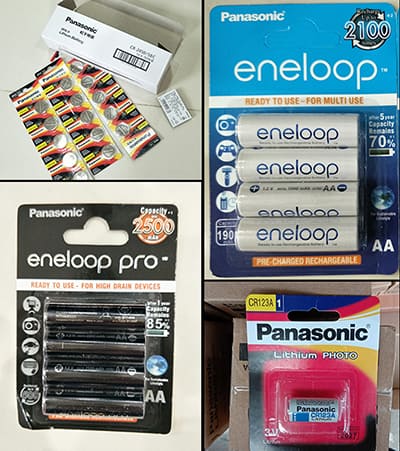
In this case, three such pages were found to be selling counterfeit Panasonic batteries on one of Thailand’s most popular online marketplaces. After contacting the online marketplace operators to request that the advertisements be taken down, two pages closed but one remained active.

An in-depth private investigation into the remaining online shop uncovered that all three pages were owned by the same entity—a Chinese national with two houses in Bangkok, from which he actively sold various types of fake Panasonic batteries in large quantities.

Warning Letter vs. Raid Action   

Sending a warning letter is usually the preferred enforce- ment action against small-scale online infringers. If the dispute can be settled after sending the warning letter, this option is more time- and cost-efficient than other legal actions.    

However, infringers with large inventories may be less receptive to this approach, either ignoring warning letters entirely, or only ceasing sales temporarily. Either way, infringers with large inventories are very likely to continue sales eventually, as they need to clear out their stock.   

In addition, attempts to negotiate with foreign nationals operating in Thailand often backfire, as they are not usually permanently established in Thailand. It is common for such infringers to simply move to another location upon receipt of a warning letter.   

In this instance the targeted infringer clearly had a large stock, was a foreign national, and was quite cautious in his activities, using the marketplace platform to hide his identity and not disclosing his name on his shop pages. A warning letter was therefore considered to pose a high risk, and a strong raid action against the target in order to seize the fake goods was considered a better solution. In addition, such action would penalize the infringers and spread the message that Panasonic takes serious legal action against infringers in order to protect its consumers.    

A criminal raid action was therefore initiated at the identified houses in order to seize the products.

Search and Seizure    

Based on investigation reports, strong evidence, and coordination with a police raid team, the court granted search warrants to gain entry to the suspect’s houses. No counterfeit Panasonic products were found at the first house, although other branded mobile phone chargers, earphones, mobile phone holders, and various unbranded products were on site. The police seized those goods for non-payment of import taxes.
The suspect and one of his staff (a Thai citizen) were found inside the second house, and they granted entry when presented with the search warrant. The search confirmed that the residential property was being used as a warehouse for commercial purposes. Batteries, chargers, watches, and other products were stored in every room, including the living room, kitchen, bedrooms, and even bathrooms. A large number of fake Panasonic products were found, along with other branded products.    

The police seized more than 30,000 counterfeit Panasonic products, including stickers labeled “Panasonic” that were obviously going to be attached to infringing products before sale. 

Arresting the Counterfeiters

The police filed charges of trademark infringement and importation tax evasion under the Customs Act against both people found in the house. In respect of the stickers labelled “Panasonic,” intended to convince the public that counterfeit goods were genuine Panasonic goods, the infringers were charged with using a mark without authorization in order to mislead the public, under the Thai Penal Code. In addition, the foreign national was charged with working without a work permit under Thailand’s immigration regime.   

This successful raid action prevented the distribution of fake goods to end-users, and will serve as a deterrent to other potential infringers in the market in accordance with Panasonic’s anticounterfeiting and customer protection policies.    

This raid is a prime example of the level of commitment necessary in order to protect Thai consumers from dangerous counterfeit products. Actions like these are rarely a one-off, and typically form part of a broader anticounterfeiting campaign. In that context, raids can also help to identify the sources of fake batteries being distributed in Thailand, and ultimately eliminate the counterfeit products once and for all.

RELATED INSIGHTS​ 

September 21, 2023
Myanmar’s Ministry of Commerce has announced its E-commerce Guidelines to regulate stakeholders engaging in e-commerce. The guidelines—which were issued on September 5, 2023, and took immediate effect—are mandatory for e-commerce business operators (both entities and individuals), and failure to comply with the guidelines’ requirements may result in penalties under relevant laws. The E-commerce Guidelines come as Myanmar seeks to increase its regulation of e-commerce activities. The guidelines were preceded by a July 2023 notification requiring e-commerce business operators to register their activities with the Ministry of Commerce by January 21, 2024. Definitions “E-commerce” is defined as the sale of goods or services on the internet or other digital platforms. The term also covers sales promotions, marketing, logistics, ordering, and delivery. An “e-commerce platform entrepreneur” is a person who manages an e-commerce platform where two or more entrepreneurs can conduct e-commerce. An “e-commerce business operator” is a person operating or authorized to operate e-commerce activities. This includes e-commerce platform entrepreneurs, entrepreneurs selling on e-commerce platforms, and sellers through social media platforms. Electronic Contracts Acceptable forms of electronic contracts, which must comply with the Electronic Transactions Law, Contract Act, and other relevant laws, include: Click-wrap, click-through, and web-wrap contracts; Browse-wrap contracts; and Agreements between seller and buyer on social media platforms, such as by accepting or rejecting an offer via direct message. Samples of contract forms are appended to the guidelines. Consumer Protection Disclosure notices for consumers must be comprehensible, correct, consistent, simple, accessible, and visible. They can be written in Myanmar language, English, or Myanmar language and another language. They must also comply with the relevant provisions of the Consumer Protection Law. The guidelines provide that if the agreed delivery date is eclipsed by more than 15 days, the consumer may terminate the contract and request a full refund of
August 9, 2023
Cambodia imports a substantial amount of food products to meet its domestic demand. Most of these imported products are from nearby ASEAN countries, with Thailand, Malaysia, and Vietnam providing the bulk of these food imports. However, food products from markets further away are becoming more popular each year, including brands from Australia, Japan, China, the EU, South-Korea, and the US. Many food product owners and distributors do not realize that all types of prepackaged food products, including imports, require product registration before they are permitted to be sold in Cambodia. This usually requires an assessment against mandatory Cambodian Standards and local technical regulations. There are general Cambodian Standards that cover all types of prepackaged food products, as well as product-specific standards and regulations that may be applicable. Furthermore, any type of prepackaged food product sold in Cambodia must bear a Khmer language label that meets the minimum consumer information standards, and the Cambodian Standards. This label requirement is often overlooked, with many products on the market bearing only a foreign language label. Product Registration & Labeling Requirements Back in 2000, a Cambodian Standard on prepackaged food labeling was adopted, clearly mandating Khmer language labeling for all types of prepackaged foods. Unfortunately, this labeling standard was not widely adopted by the industry, and even today compliance is low. Low compliance, combined with a lack of widespread enforcement efforts, led to a misguided understanding that imported food products were not subject to any standards, did not require product registration, and were not required to bear Khmer language labeling. Recent legal developments related to consumer protection and food safety clarified several of these misunderstandings. For example, the regulations clearly state that all types of food product must meet the applicable standards and technical regulations, which is assessed through registration. The new Law
July 28, 2023
Myanmar’s Ministry of Commerce (MOC) issued three notifications related to e-commerce on July 21, 2023, classifying online retail businesses as essential services, requiring them to register with the relevant authorities, and setting the criteria for their registration. Under Notification No. 49/2023 the MOC authorized the Department of Trade (DOT) to issue notifications, orders, and directives relating to online retail businesses. This was followed by Notification No. 50/2023, which classifies online retail businesses as essential services under the Essential Supplies and Services Law and requires them to register with the DOT within six months of the issuance of the notification (i.e., by January 21, 2024). Failure to register within the specified period will be punishable by imprisonment for six months to three years and a fine of up to MMK 500,000 (approx. USD 238). Finally, under Notification No. 51/2023, the MOC set out the criteria and requirements for the registration of online retail businesses by entities, business institutions, and individuals, as well as the duties and liabilities of sellers and consumers. Pursuant to this notification, registration should be completed via the DOT’s online system, fees must be paid digitally, and electronic registration certificates will be issued. Certificates are initially valid for two years, and can be renewed. The MOC will provide information at a later time on the prescribed forms, certificate format, registration and online fees, and online registration portal. In applying for registration, an entity or business institution established under the Myanmar Companies Law, Special Company Act, Co-operative Society Law, or any other existing Myanmar laws must have a website with its own domain name or an online channel with an exact address that is used for online sales and a registered business address within Myanmar. Individual applicants must be at least 18 years old, reside in Myanmar, and
June 5, 2023
Vietnam’s Law on the Protection of Consumer Rights (“Consumer Protection Law” or “CPL”) was passed in 2010 and has been effective since July 1, 2011, providing a legal framework for protecting the rights of consumers in Vietnam. Over the past 12 years of implementation and application, however, the CPL has revealed its shortcomings and limitations. For example, there are issues related to inconsistency between the CPL and other laws such as the Civil Code, Law on Competition, Enterprise Law, and Cybersecurity Law. The current CPL also has not kept pace with modern consumption practices, especially the rapid changes and emerging trends in e-commerce, cross-border transactions, and services via digital platforms. The government of Vietnam has therefore entrusted the Ministry of Industry and Trade (MOIT) to take the lead in drafting a new amended CPL to replace the old one, to improve the policies and legislation on consumer protection, and protect the vulnerabilities of consumers in transactions with businesses. During the 5th session of the National Assembly at the end of May 2023, the National Assembly discussed and reviewed the latest draft of the CPL (“Draft CPL”), which is expected to be approved on June 21, 2023. The following are some key contents of the Draft CPL: 1. Revised Subjects of Application Unlike the current CPL, which applies only to consumers; traders of goods and services; and agencies, organizations and individuals involved in consumer protection activities within the territory of Vietnam, the Draft CPL adds “the Vietnamese Fatherland Front, socio-political organizations and social organizations participating in protecting consumers’ interests” as new subjects of its application, and clarifies that “agencies, organizations, and individuals” include both domestic and offshore agencies, organizations, and individuals involved in activities of consumer rights protection. The Draft CPL also removes “within the territory of Vietnam” from the