
You are using an outdated browser and your browsing experience will not be optimal. Please update to the latest version of Microsoft Edge, Google Chrome or Mozilla Firefox. Install Microsoft Edge

March 2, 2021

Resolving Domain Name Disputes in Indonesia

Informed Counsel

Since 2014, Indonesia’s domain name registry (PANDI) has overseen the registration of .id domain names, following the earlier country code top-level domains (ccTLDs), such as .co.id, .or.id, and .go.id. PANDI has recently reported on the growth of .id domain names in 2019, which saw an increase in registrations of about 45%, reaching a total of 135,000 registrants.

An Indonesian Internet Providers Association (APJII) nationwide survey found that the number of internet users in Indonesia increased by 14.6 percent to 196 million people in the period between 2019 and Q2 2020, up from 171 million in 2018. The survey also revealed that Indonesia’s internet penetration rate has gone up to 73.7 percent. This means that the country is catching up with neighboring Brunei, Singapore, and Thailand, whose internet penetration rates exceeded 70 percent last year. Part of this increase seems to be related to the limitation of in-person activity in the wake of the COVID-19 outbreak.

This internet usage growth has also meant a higher incidence of cybercrimes and online disputes, including over domain names. According to the domain name dispute statistics from WIPO, there have been 274 generic top-level domain name disputes involving Indonesian respondents to date. Meanwhile, 18 cases have so far been decided by PANDI’s Domain Name Dispute Resolution (PPND) in fights against Indonesian ccTLD cybersquatters, third parties who attempt to register domain names using the trademarks of others. PPND, a non-litigation dispute settlement body for disputes over Indonesian internet domain names, handles domain name disputes related to trademarks, registered names or regarding matters of decency. The examination of such disputes is conducted by PPND panel(s).

PANDI’s Domain Name General Policy version 6.0, dated February 25, 2019, explains the five categories of.id domain names: normative, trademark-related, product- or service-related, distributorship-related, or institutional.

Ministry of Communication Regulation No. 23 of 2013 regarding Domain Name Management stipulates that a registered trademark holder is entitled to register, use, and benefit from Indonesian ccTLDs. Based on PANDI’s naming guidelines, a trademark registration or application is required if the applicant claims that the domain name is related to their trademark. However, in practice, the registrar typically only requires a copy of the registrant’s ID card to proceed with the .id domain name registration, because the registrar may choose another naming criterion that does not require a trademark or other IP ownership. This may lead to the registration of .id domains by cybersquatters.

Procedures

PPND welcomes any trademark holder to file a complaint regarding domain names violating their registered trademark, before filing litigation with the court.

The current PPND policy (version 7.0) requires that every claimant file a pre-objection as the first step. The pre-objection phase includes a request for the whois data, which reveals the owner of a domain. Obtaining the results takes around three days after the pre-objection documents are completed and accepted by PPND. Upon receiving the pre-objection result, the next step is filing an objection laying out pertinent arguments. PPND may then proceed to mediation, followed by examination of the objection.

The simplified timeline below shows the key steps in the process.
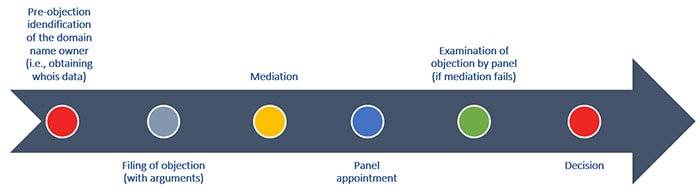
Under normal circumstances, the whole process may take around 2–3 months to be decided. An unsatisfied party that disagrees with the PPND decision may file a lawsuit with the court.

Possible Arguments

A claimant requesting a domain name take-down or transfer in accordance with the PPND policy must prove all of the following conditions:

  • The domain name is identical or confusingly similar to a trademark;
  • The registrant has no rights or legitimate interests in the domain name; and
  • The domain name has been registered and is being used in bad faith.

Of these three concurrent claims, the most challenging one to prove is the bad-faith intent. Nonetheless, it is essential. Even if a claimant can show valid trademark ownership and prove that the domain name in question was filed by an unauthorized entity, the PPND panels will refuse the claim if evidence of bad faith is lacking.

The strongest evidence of bad faith is any request (e.g. text message, email, etc.) by the registrant for compensation for transferring the domain name. Such evidence is straightforward proof that the registrant intended to sell, lease, or transfer the domain name for his or her financial benefit. However, of the 18 cases decided by the PPND since its inception, only seven were able to prove the registrant’s intent to sell the domain name for financial benefit.

There are other types of actions that are considered bad faith as well. For example, bad faith can be proven by showing that the registrant intends to prevent the trademark owner to use the contested domain name (i.e., parked domain), or by showing that the registrant intended to damage the trademark owner’s business activities. In addition, a domain name registrant intending to attract the internet user to another online location for illegal financial benefit would be another clear indication of bad faith.

Case Study

When the well-known video streaming service Netflix found that neflix.id had been registered by an unauthorized Indonesian citizen using their well-known trademark, they brought the matter before the PPND.

As the company had already registered their trademark in Indonesia, Netflix was able to prove that netflix.id was filed by an unauthorized party. However, no proof of intent to sell was forthcoming, so Netflix made the accusation that netflix.id was a parked domain, with the registrant trying to prevent Netflix from registering and using the domain name in Indonesia.

In his reply, the registrant pointed out that Netflix had not secured netflix.id before, and argued that in light of the “first to file” domain name registration principle, Netflix should have registered the domain name as soon as they were eligible to do so. The PPND, however, disagreed, deciding that the claim had in fact proved the three necessary conditions simultaneously. Hence, netflix.id was transferred to Netflix’s ownership.

Conclusion

Just as well-known brands are targeted by intellectual property infringers, these brands can also be targeted by parties wishing to benefit from their reputation or name recognition through a domain name. The process of acting against this in Indonesia is not simply a matter of trademark enforcement, but is a separate process governed by a different set of laws and regulations. Brand owners should be aware that having a trademark portfolio and strategy is often not enough; rather, they need a comprehensive and strategic awareness of how to manage all of their current and potential assets, including virtual properties such as domain names.

RELATED INSIGHTS​ 

February 28, 2023
Influencer marketing and the creation of sponsored content is an increasingly popular way for brands to reach their target audience. Although there is no universal definition of an “influencer,” the term is broadly used to describe people who are able to affect purchasing decisions of others through their relationship with their audience. In the context of social media and the creator economy, influencers are usually people with significant followings on platforms such as Instagram, TikTok, Twitch, or YouTube who are viewed as celebrities, opinion leaders, trendsetters, or experts in their respective field. Based on a study conducted by Nielsen in 2022, 80% of social media users in Asia who follow influencers are likely to purchase products recommended by the influencers. Brand owners should be aware of five key legal considerations when entering into influencer marketing agreements. 1. Making informed decisions through due diligence Every collaboration with an influencer is a business relationship. Brands must conduct thorough due diligence on potential influencers prior to engaging them. This may include deep dives into the individual’s old social media posts, as well as requests for disclosure of prior controversial incidents and existing brand associations. For example, a health and fitness brand may not want—for both legal and commercial reasons—to be publicly associated with an influencer who is a brand ambassador of electronic cigarettes, no matter how impressive the latter’s Instagram following or deadlift record is. Brands should also ensure that their influencer marketing agreements include relevant representations and warranties that the influencer has not and will not commit a crime or act in a way that may cause negative publicity for the brand. This may include racist, extremist, homophobic, violent, or misogynistic acts, or any other acts that are obscene or against public order. 2. Clearly defining the scope of engagement Brands
February 24, 2023
On February 20, 2023, the Supreme People’s Court of Vietnam submitted a Practical Report on the Implementation of the Law on Organization of People’s Courts, as well as a Draft Amendment of the Law on Organization of People’s Courts to seek online comment from interested parties. Notably, the Supreme People’s Court has expressed a desire to establish specialized courts such as an IP court and a bankruptcy court. Practical Report on the Implementation of the Law on Organization of People’s Courts The Supreme People’s Court reviewed the implementation over the past eight years of the Law on Organization of People’s Courts (“LOPC”), which took effect in 2015. Some highlights of the implementation process, as set out in the Supreme People’s Court’s practical report, are as follows: Re-systematization of all levels of courts: The LOPC systematized the court system in Vietnam, including four levels: Supreme People’s Court Three Superior People’s Courts 765 first-instance trial courts (including 702 district courts and 63 provincial courts) 66 appellate courts (including 63 provincial people’s courts and the three Superior People’s Courts) In addition, the Supreme People’s Court established four adjudicating agencies for cassation and reopening (including three Judicial Committees of the Superior People’s Court and the Council of Judges of the Supreme People’s Court). Support departments for the court have been strengthened, and policies have been developed to train judges. Trial results: From June 1, 2015, to April 30, 2022, the courts have settled 3,187,285 cases of all kinds out of a total of 3,334,915 cases handled (95.57%). Most of the remaining cases are newly accepted and still within the time limit for settlement as prescribed by law. On average, the courts have had to deal with about 476,416 cases each year. Draft Amendment of Law on Organization of People’s Courts Despite the notable
February 15, 2023
To improve its patent application processing capacity, the Intellectual Property Office of Vietnam (IP Office), with the support of the Japan International Cooperation Agency (JICA), is continuing to develop a draft amendment to the patent application examination guidelines for inventions related to computer programs. After issuing Annex I to the patent application examination guidelines in 2021, which covered subject-matters related to computer programs that are protected as inventions, the IP Office’s Patent Examination Center, with the support of experts from the JICA, has now developed a draft of Annex II. This draft provides guidance on examination related to a sufficient disclosure of the substance of claimed subject-matters and an assessment of the protection criteria (novelty and inventive step) of subject-matters related to computer programs, along with illustrative examples. In addition, the draft introduces the concepts of “sub-combination inventions” and “mixed-type inventions”, an assessment of the clarity of sub-combination inventions, and the assessment of novelty and inventive step of mixed-type inventions. To evaluate the amendments in the draft, in conformity with the legal regulations and the examination practice, the Patent Examination Center organized a discussion of the draft on February 4, 2023, with the contribution of opinions and comments from IP representatives, organizations, schools, institutes, and individuals. The Patent Examination Center announced that it wishes to receive further constructive opinions from interested parties to improve the amendments of the guidelines. In the context that inventions related to computer programs are closely related to new technologies such as artificial intelligence (AI), and noting the many difficulties arising in the examination process, we hope that the amendments to the guidelines, specifically as outlined in the draft of Annex II, will soon be finalized and officially released. This annex will certainly facilitate the examination of inventions related to computer programs, as well as
February 6, 2023
The available options for enforcing intellectual property (IP) in Cambodia have steadily increased over the past years, and both enforcement authorities and IP owners have gained valuable experience in enforcement operations. This experience, alongside new legal developments, has contributed to an increase in successful IP enforcement cases—most notably those involving the police or the courts in Cambodia. Targeted government policies have further fostered a more robust IP enforcement framework in Cambodia for both local and foreign IP owners alike. These owners collaborate with government actors in a bid to protect their IP in Cambodia and ensure that quality goods reach Cambodia’s consumers. Cambodia’s obligations under the Regional Comprehensive Economic Partnership (RCEP) related to IP and especially IP enforcement will lead to even more positive developments. Customs Enforcement Recently, many IP owners have shown particular interest in enforcement opportunities involving Customs in Cambodia, as these IP owners recognize Customs as a key authority in fighting the inflow and outflow of infringing goods. Customs (officially named the General Department of Customs and Excise) is responsible for monitoring the import and export of goods at border checkpoints, and levying duties and taxes on imports and exports. They facilitate trade, which is key for the private sector and government alike, and they collect taxes that can be used for the government and the public good. In this role, Customs is an important agency in fighting infringement, either by stopping imports so that the infringing goods do not reach consumers in Cambodia, or by taking action against exports, thereby making Cambodia less desirable as a manufacturing or transit hub for infringing goods. Besides improving the reputation of the country as a destination for investment and business, it can benefit the public as well, because infringing goods are often smuggled or misdeclared to avoid duties