
You are using an outdated browser and your browsing experience will not be optimal. Please update to the latest version of Microsoft Edge, Google Chrome or Mozilla Firefox. Install Microsoft Edge

March 2, 2021

Resolving Domain Name Disputes in Indonesia

Informed Counsel

Since 2014, Indonesia’s domain name registry (PANDI) has overseen the registration of .id domain names, following the earlier country code top-level domains (ccTLDs), such as .co.id, .or.id, and .go.id. PANDI has recently reported on the growth of .id domain names in 2019, which saw an increase in registrations of about 45%, reaching a total of 135,000 registrants.

An Indonesian Internet Providers Association (APJII) nationwide survey found that the number of internet users in Indonesia increased by 14.6 percent to 196 million people in the period between 2019 and Q2 2020, up from 171 million in 2018. The survey also revealed that Indonesia’s internet penetration rate has gone up to 73.7 percent. This means that the country is catching up with neighboring Brunei, Singapore, and Thailand, whose internet penetration rates exceeded 70 percent last year. Part of this increase seems to be related to the limitation of in-person activity in the wake of the COVID-19 outbreak.

This internet usage growth has also meant a higher incidence of cybercrimes and online disputes, including over domain names. According to the domain name dispute statistics from WIPO, there have been 274 generic top-level domain name disputes involving Indonesian respondents to date. Meanwhile, 18 cases have so far been decided by PANDI’s Domain Name Dispute Resolution (PPND) in fights against Indonesian ccTLD cybersquatters, third parties who attempt to register domain names using the trademarks of others. PPND, a non-litigation dispute settlement body for disputes over Indonesian internet domain names, handles domain name disputes related to trademarks, registered names or regarding matters of decency. The examination of such disputes is conducted by PPND panel(s).

PANDI’s Domain Name General Policy version 6.0, dated February 25, 2019, explains the five categories of.id domain names: normative, trademark-related, product- or service-related, distributorship-related, or institutional.

Ministry of Communication Regulation No. 23 of 2013 regarding Domain Name Management stipulates that a registered trademark holder is entitled to register, use, and benefit from Indonesian ccTLDs. Based on PANDI’s naming guidelines, a trademark registration or application is required if the applicant claims that the domain name is related to their trademark. However, in practice, the registrar typically only requires a copy of the registrant’s ID card to proceed with the .id domain name registration, because the registrar may choose another naming criterion that does not require a trademark or other IP ownership. This may lead to the registration of .id domains by cybersquatters.

Procedures

PPND welcomes any trademark holder to file a complaint regarding domain names violating their registered trademark, before filing litigation with the court.

The current PPND policy (version 7.0) requires that every claimant file a pre-objection as the first step. The pre-objection phase includes a request for the whois data, which reveals the owner of a domain. Obtaining the results takes around three days after the pre-objection documents are completed and accepted by PPND. Upon receiving the pre-objection result, the next step is filing an objection laying out pertinent arguments. PPND may then proceed to mediation, followed by examination of the objection.

The simplified timeline below shows the key steps in the process.
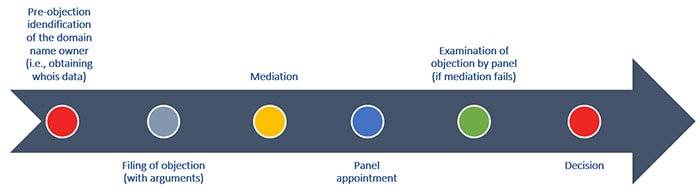
Under normal circumstances, the whole process may take around 2–3 months to be decided. An unsatisfied party that disagrees with the PPND decision may file a lawsuit with the court.

Possible Arguments

A claimant requesting a domain name take-down or transfer in accordance with the PPND policy must prove all of the following conditions:

  • The domain name is identical or confusingly similar to a trademark;
  • The registrant has no rights or legitimate interests in the domain name; and
  • The domain name has been registered and is being used in bad faith.

Of these three concurrent claims, the most challenging one to prove is the bad-faith intent. Nonetheless, it is essential. Even if a claimant can show valid trademark ownership and prove that the domain name in question was filed by an unauthorized entity, the PPND panels will refuse the claim if evidence of bad faith is lacking.

The strongest evidence of bad faith is any request (e.g. text message, email, etc.) by the registrant for compensation for transferring the domain name. Such evidence is straightforward proof that the registrant intended to sell, lease, or transfer the domain name for his or her financial benefit. However, of the 18 cases decided by the PPND since its inception, only seven were able to prove the registrant’s intent to sell the domain name for financial benefit.

There are other types of actions that are considered bad faith as well. For example, bad faith can be proven by showing that the registrant intends to prevent the trademark owner to use the contested domain name (i.e., parked domain), or by showing that the registrant intended to damage the trademark owner’s business activities. In addition, a domain name registrant intending to attract the internet user to another online location for illegal financial benefit would be another clear indication of bad faith.

Case Study

When the well-known video streaming service Netflix found that neflix.id had been registered by an unauthorized Indonesian citizen using their well-known trademark, they brought the matter before the PPND.

As the company had already registered their trademark in Indonesia, Netflix was able to prove that netflix.id was filed by an unauthorized party. However, no proof of intent to sell was forthcoming, so Netflix made the accusation that netflix.id was a parked domain, with the registrant trying to prevent Netflix from registering and using the domain name in Indonesia.

In his reply, the registrant pointed out that Netflix had not secured netflix.id before, and argued that in light of the “first to file” domain name registration principle, Netflix should have registered the domain name as soon as they were eligible to do so. The PPND, however, disagreed, deciding that the claim had in fact proved the three necessary conditions simultaneously. Hence, netflix.id was transferred to Netflix’s ownership.

Conclusion

Just as well-known brands are targeted by intellectual property infringers, these brands can also be targeted by parties wishing to benefit from their reputation or name recognition through a domain name. The process of acting against this in Indonesia is not simply a matter of trademark enforcement, but is a separate process governed by a different set of laws and regulations. Brand owners should be aware that having a trademark portfolio and strategy is often not enough; rather, they need a comprehensive and strategic awareness of how to manage all of their current and potential assets, including virtual properties such as domain names.

RELATED INSIGHTS​ 

May 8, 2023
Myanmar’s long-awaited first-to-file trademark registration system came into full effect on April 26, 2023, with the “grand opening” of the country’s Intellectual Property Department (IPD). This followed the issuance of the Trademark Rules and other related notifications at the beginning of April, in conjunction with the Trademark Law coming into force. Full enforcement of this law is a milestone in Myanmar’s long quest to establish a functioning, modern framework for trademarks in particular and for IP in general. The Trademark Law was passed in 2019 as part of suite of laws meant to modernize the country’s treatment of IP rights. Previously, IP rights holders in Myanmar relied on outdated systems based largely on laws from the colonial period under British rule. For example, brand owners could achieve some measure of protection through establishing use in the country and recording their marks with the Office of Registration of Deeds (ORD). However, these protections were limited and did not provide the same level of security and legal recourse as a comprehensive trademark registration system. Without a proper system in place, businesses were vulnerable to infringement and counterfeiting, which could be detrimental to their reputation and bottom line. The new Trademark Law will provide much-needed protection to brand owners and encourage innovation and investment in Myanmar, bringing the country in line with other Southeast Asian nations that have already implemented modern IP laws and systems, such as Thailand and Vietnam. Features of the Trademark Law In addition to the increased protection and streamlined filing procedures, the Trademark Law offers a range of other salient features: Administration: The core government ministry administering the new Trademark Law is the Ministry of Commerce. Four other ministries—the Ministry of Information; the Ministry of Industry; the Ministry of Agriculture, Livestock and Irrigation; and the Ministry of Education—are
April 25, 2023
As in many countries around the world, IP laws in Southeast Asia do not currently specify whether works generated by artificial intelligence (AI) are protected by copyright, and there is also uncertainty surrounding the issue of ownership with respect to works created by AI. While changes to the IP legal framework are expected to respond to the rapid development of AI technologies, existing copyright laws of most countries in Southeast Asia explicitly impose the requirement of a human author for copyright protection to arise. AI-Generated Works and the Law This is similar to the position in the United States, where the US Copyright Office issued a policy statement in March 2023 reiterating the US Copyright Act’s requirement of human authorship to register copyright works. The policy document states that when an AI technology determines the expressive elements of the output, the generated materials do not fulfil the human authorship requirement. However, the US Copyright Office also clarified that certain works containing AI-generated materials may nonetheless contain sufficient human authorship for a copyright claim, such as when a human selects or arranges the AI-generated materials in a sufficiently creative way for the resulting work as a whole to constitute an original work of authorship, or when an artist modifies material originally generated by AI technology to a degree that meets the standard for copyright protection. This is distinguishable from the position in countries such as the UK and Hong Kong, where absent specific provisions addressing AI-generated works, such works may arguably be considered by some as computer-generated works, with authorship assigned to the person who arranges for creation of the work. New Challenges from Generative AI The ongoing legal uncertainties surrounding the ownership and protection of AI-generated works create practical challenges for businesses that use or develop generative AI tools.
April 5, 2023
The director-general of Myanmar’s Intellectual Property Department (IPD) has written a newspaper article stating that the country’s trademark registration will come into full effect with the “grand opening” of the IPD on April 26, 2023. This announcement comes days after the IPD issued the Trademark Rules and other related notifications in conjunction with the Trademark Law coming into force. While an official notification confirming the date is still pending, the anticipated grand opening means that as of April 26, marks filed during the IPD’s current “soft opening” period—and for which all fees have been fully paid—will be officially accorded the first filing date, which is the date of the IPD’s grand opening. Accordingly, mark owners who submitted marks during the soft opening period need to pay the official filing fees before April 26 in order to secure the earliest possible filing date (i.e., April 26) under the Trademark Law’s new first-to-file system. Mark owners also need to submit a notarized Appointment of Representative (TM-2) form to the IPD to enable their trademark representative in Myanmar to carry out this step. Moreover, the trademark system coming into full effect with the IPD’s grand opening will enable mark owners to file registration applications for new marks—which has not been permitted during the soft opening. To expedite this process, these mark owners should now start preparing all necessary documents for filing their new trademark applications. For assistance ensuring that your existing mark secures the earliest possible filing date, or for assistance in processing new trademark applications, please contact Tilleke & Gibbins at [email protected].
April 3, 2023
As Myanmar’s long-awaited Trademark Law came into force on April 1, 2023, the government issued several pieces of implementing legislation, including the Trademark Rules. Together, this legislation gives shape to Myanmar’s new trademark system and paves the way for the eventual “grand opening” under the Trademark Law. The first piece of legislation, Notification 17/2023 of the Ministry of Commerce (MOC), set out the Trademark Rules. The rules contain detailed provisions on the registration and examination of marks, opposition to registration, priority claims, and criteria for well-known marks. The rules allow for substantive examination of trademark registration applications to begin. The second piece of legislation (MOC Notification 1/2023) established the Intellectual Property Agency (IP Agency). Made up of senior government figures, IP experts, and representatives of civil society, the IP Agency is responsible for implementing trademark policy and hearing administrative appeals against decisions by the trademark registrar. The IP Agency’s first notification set the official fees for requests and applications to the Intellectual Property Department (IPD), including a fee of MMK 150,000 (approx. USD 72) per class for filing a trademark application. Finally, the IPD issued two procedural announcements. Announcement No. 1/2023 confirmed that the second phase of the “soft opening” will commence on April 3, 2023. As explained in our previous update, during the second phase of the soft opening, mark owners who have already filed trademark applications with the IPD must pay the official filing fees. Announcement No. 2/2023 specified the ways in which these fees can be paid. Now that the Trademark Law has come into force and implementing legislation has been issued, mark owners should prepare to pay the necessary filing fees and submit their notarized Appointment of Representative (TM-2) forms to the IPD. We will continue to monitor developments related to the new trademark system. For more