
You are using an outdated browser and your browsing experience will not be optimal. Please update to the latest version of Microsoft Edge, Google Chrome or Mozilla Firefox. Install Microsoft Edge

March 2, 2021

Resolving Domain Name Disputes in Indonesia

Informed Counsel

Since 2014, Indonesia’s domain name registry (PANDI) has overseen the registration of .id domain names, following the earlier country code top-level domains (ccTLDs), such as .co.id, .or.id, and .go.id. PANDI has recently reported on the growth of .id domain names in 2019, which saw an increase in registrations of about 45%, reaching a total of 135,000 registrants.

An Indonesian Internet Providers Association (APJII) nationwide survey found that the number of internet users in Indonesia increased by 14.6 percent to 196 million people in the period between 2019 and Q2 2020, up from 171 million in 2018. The survey also revealed that Indonesia’s internet penetration rate has gone up to 73.7 percent. This means that the country is catching up with neighboring Brunei, Singapore, and Thailand, whose internet penetration rates exceeded 70 percent last year. Part of this increase seems to be related to the limitation of in-person activity in the wake of the COVID-19 outbreak.

This internet usage growth has also meant a higher incidence of cybercrimes and online disputes, including over domain names. According to the domain name dispute statistics from WIPO, there have been 274 generic top-level domain name disputes involving Indonesian respondents to date. Meanwhile, 18 cases have so far been decided by PANDI’s Domain Name Dispute Resolution (PPND) in fights against Indonesian ccTLD cybersquatters, third parties who attempt to register domain names using the trademarks of others. PPND, a non-litigation dispute settlement body for disputes over Indonesian internet domain names, handles domain name disputes related to trademarks, registered names or regarding matters of decency. The examination of such disputes is conducted by PPND panel(s).

PANDI’s Domain Name General Policy version 6.0, dated February 25, 2019, explains the five categories of.id domain names: normative, trademark-related, product- or service-related, distributorship-related, or institutional.

Ministry of Communication Regulation No. 23 of 2013 regarding Domain Name Management stipulates that a registered trademark holder is entitled to register, use, and benefit from Indonesian ccTLDs. Based on PANDI’s naming guidelines, a trademark registration or application is required if the applicant claims that the domain name is related to their trademark. However, in practice, the registrar typically only requires a copy of the registrant’s ID card to proceed with the .id domain name registration, because the registrar may choose another naming criterion that does not require a trademark or other IP ownership. This may lead to the registration of .id domains by cybersquatters.

Procedures

PPND welcomes any trademark holder to file a complaint regarding domain names violating their registered trademark, before filing litigation with the court.

The current PPND policy (version 7.0) requires that every claimant file a pre-objection as the first step. The pre-objection phase includes a request for the whois data, which reveals the owner of a domain. Obtaining the results takes around three days after the pre-objection documents are completed and accepted by PPND. Upon receiving the pre-objection result, the next step is filing an objection laying out pertinent arguments. PPND may then proceed to mediation, followed by examination of the objection.

The simplified timeline below shows the key steps in the process.
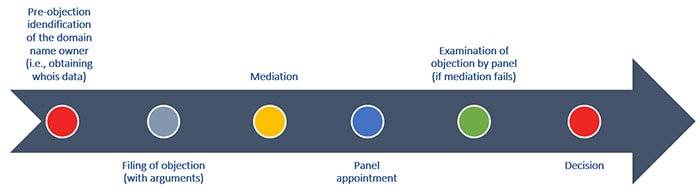
Under normal circumstances, the whole process may take around 2–3 months to be decided. An unsatisfied party that disagrees with the PPND decision may file a lawsuit with the court.

Possible Arguments

A claimant requesting a domain name take-down or transfer in accordance with the PPND policy must prove all of the following conditions:

  • The domain name is identical or confusingly similar to a trademark;
  • The registrant has no rights or legitimate interests in the domain name; and
  • The domain name has been registered and is being used in bad faith.

Of these three concurrent claims, the most challenging one to prove is the bad-faith intent. Nonetheless, it is essential. Even if a claimant can show valid trademark ownership and prove that the domain name in question was filed by an unauthorized entity, the PPND panels will refuse the claim if evidence of bad faith is lacking.

The strongest evidence of bad faith is any request (e.g. text message, email, etc.) by the registrant for compensation for transferring the domain name. Such evidence is straightforward proof that the registrant intended to sell, lease, or transfer the domain name for his or her financial benefit. However, of the 18 cases decided by the PPND since its inception, only seven were able to prove the registrant’s intent to sell the domain name for financial benefit.

There are other types of actions that are considered bad faith as well. For example, bad faith can be proven by showing that the registrant intends to prevent the trademark owner to use the contested domain name (i.e., parked domain), or by showing that the registrant intended to damage the trademark owner’s business activities. In addition, a domain name registrant intending to attract the internet user to another online location for illegal financial benefit would be another clear indication of bad faith.

Case Study

When the well-known video streaming service Netflix found that neflix.id had been registered by an unauthorized Indonesian citizen using their well-known trademark, they brought the matter before the PPND.

As the company had already registered their trademark in Indonesia, Netflix was able to prove that netflix.id was filed by an unauthorized party. However, no proof of intent to sell was forthcoming, so Netflix made the accusation that netflix.id was a parked domain, with the registrant trying to prevent Netflix from registering and using the domain name in Indonesia.

In his reply, the registrant pointed out that Netflix had not secured netflix.id before, and argued that in light of the “first to file” domain name registration principle, Netflix should have registered the domain name as soon as they were eligible to do so. The PPND, however, disagreed, deciding that the claim had in fact proved the three necessary conditions simultaneously. Hence, netflix.id was transferred to Netflix’s ownership.

Conclusion

Just as well-known brands are targeted by intellectual property infringers, these brands can also be targeted by parties wishing to benefit from their reputation or name recognition through a domain name. The process of acting against this in Indonesia is not simply a matter of trademark enforcement, but is a separate process governed by a different set of laws and regulations. Brand owners should be aware that having a trademark portfolio and strategy is often not enough; rather, they need a comprehensive and strategic awareness of how to manage all of their current and potential assets, including virtual properties such as domain names.

RELATED INSIGHTS​ 

March 31, 2023
With Myanmar’s new Trademark Law set to come into force on April 1, enabling legislation has now been issued to grant certain courts jurisdiction to hear claims under the law. This provides trademark owners with an avenue to file claims under the Trademark Law for the first time, and is a very positive indication that no further delays to implementation are likely. The Trademark Law grants the Supreme Court of Myanmar the power to establish an Intellectual Property Rights Court. The Supreme Court can also assign new jurisdiction to existing courts pending the establishment of the Intellectual Property Rights Court. The enabling legislation, which takes the form of five notifications issued by the Supreme Court, accordingly confers jurisdiction on several existing courts. This includes the jurisdiction to hear criminal and civil complaints and appeals against decisions of the trademark authorities. The High Court of Yangon Region and the High Court of the Regions and States are also given appellate jurisdiction to hear appeals against the orders, decisions and judgments of other appointed courts. No further information has been given on whether or when a separate Intellectual Property Rights Court will be established. This development confirms that brand owners—who previously had no recourse to specialized courts in Myanmar regarding the enforcement of their trademark rights—will soon be able to pursue cases. Moreover, the issuance of these notifications gave a strong confirmation that the Trademark Law would indeed take effect on April 1, as planned. As we explained in a previous update, a date for the “grand opening” has yet to be announced, meaning it will still be some time before marks that were refiled during the “soft opening” will be given a filing date and before applications for all other marks can be filed. However, it is expected that the
March 30, 2023
Myanmar’s State Administration Council has specified the enforcement date of the country’s 2019 Trademark Law as April 1, 2023—confirming a recent announcement from Myanmar’s Intellectual Property Department (IPD) to certified trademark representatives in the country. The official public announcement came in Notification No. 82/2023, which was dated March 10, 2023, and published in the government-owned daily newspaper the following day. The planned next step is the promulgation of the Trademark Rules to establish substantive procedures on trademark-related matters for trademark applications under the new system. The rules, which are necessary to establish procedures for collecting official fees, are expected to be issued in March 2023. Once the Trademark Rules are established and the Trademark Law comes into force, the second phase of the IPD’s “soft opening” period will commence—expected to occur on April 3, 2023, if there are no further changes. In this second phase, mark owners can pay the official fees for trademark applications filed within the first phase of the soft opening. According to IPD officials, marks recorded under Myanmar’s old system or used in the country can still be filed together with payment during the soft opening’s second phase, either in person by the mark owner or through a certified representative via the online system. Even if such a previously recorded mark is registered after April 1, 2023, the application during the second phase can still reserve the earliest possible filing date under the new first-to-file system. This second phase will continue until the “grand opening” of the IPD commences, unless officials make further announcements to the contrary. IPD officials have confirmed that the earliest possible filing date of the new system will be the date of the IPD’s grand opening. In light of the ongoing and planned developments, the grand opening is expected to occur
March 30, 2023
Vietnam’s Law on Intellectual Property was comprehensively amended in 2022 (“2022 IP Law”), and the amended law came into effect (with the exception of a few provisions) on 1 January 2023. Along with amendments of substantive matters, the revised version also touches upon the requirements for providing IP representation (agent) services, at both the organizational and individual level. Requirements for Organizations Article 154 of the previous IP Law provided the following conditions for organizations to act as IP representation service organizations: The organization is a lawfully established and operating law-practicing enterprise, cooperative or organization, or a scientific and technological service organization, except for foreign law-practicing organizations operating in Vietnam. The organization has the function of providing IP representation services stated in its business registration certificate or operation registration certificate. The head(s) of the organization or a person(s) authorized by the head(s) of the organization has a certificate for practicing IP representation services. While the first requirement remains unchanged, the 2022 IP Law has removed the second requirement, and revised the third requirement to be more relaxed. Specifically, the amended provision only requires that there must be at least one individual holding a certificate for practicing IP representation services in each IP representation service organization. (Regarding the second requirement, while it is no longer stated in the IP Law, this does not mean that any organization can practice IP representation services, because this is a conditional business line and only organizations who meet the conditions for providing such services, provided in other legislation, can do business in this field.) Requirements for Individuals At the individual level, the law both tightens and loosens the requirements. Under the former law, to be granted a certificate for practicing IP representation services, the individual must: Be a Vietnamese citizen with full capacity for civil
March 29, 2023
Vietnam’s amended Law on Intellectual Property of 2022 (“Amended IP Law”) took effect on January 1, 2023, with the exception of a few provisions. However, subordinate legal documents (bylaws) providing necessary details and guidance on the new law still have not been issued, leaving some aspects of the law’s implementation in a state of limbo. This has caused a particular challenge for applications for establishing industrial property rights that were filed before January 1, 2023, but remain pending at the Intellectual Property Office of Vietnam (“IP Office”). While waiting for the official bylaws to be promulgated, the IP Office has issued some internal protocols for handling applications in this interim period. Partial Grant of Protection Titles The Amended IP Law mentions, for the first time, the possibility of partial granting of protection titles for industrial property objects. Under the amended Article 118, the IP Office can issue a notice of its intention to grant partial protection to the allowable parts of a patent/design/trademark application. However, as an interim protocol, the intention to partially grant protection has been temporarily put on hold until further guidance is issued. Security Control on Patents For patent applications based on Vietnamese inventions, if there are any corresponding patent applications filed overseas, the IP Office will suspend the examination until the official new bylaws on security control are provided. Applications for Designs which Are Not Visible During Use The IP Office imposes a specific mechanism on design applications filed from August 1, 2020, until January 1, 2023, in which the designs are not visible during the exploitation of the utility of complex products. Accordingly, even if a notice of intention to grant was issued but there was no decision on granting by January 1, 2023, the IP Office will issue a new notice on the