
You are using an outdated browser and your browsing experience will not be optimal. Please update to the latest version of Microsoft Edge, Google Chrome or Mozilla Firefox. Install Microsoft Edge

March 2, 2021

Resolving Domain Name Disputes in Indonesia

Informed Counsel

Since 2014, Indonesia’s domain name registry (PANDI) has overseen the registration of .id domain names, following the earlier country code top-level domains (ccTLDs), such as .co.id, .or.id, and .go.id. PANDI has recently reported on the growth of .id domain names in 2019, which saw an increase in registrations of about 45%, reaching a total of 135,000 registrants.

An Indonesian Internet Providers Association (APJII) nationwide survey found that the number of internet users in Indonesia increased by 14.6 percent to 196 million people in the period between 2019 and Q2 2020, up from 171 million in 2018. The survey also revealed that Indonesia’s internet penetration rate has gone up to 73.7 percent. This means that the country is catching up with neighboring Brunei, Singapore, and Thailand, whose internet penetration rates exceeded 70 percent last year. Part of this increase seems to be related to the limitation of in-person activity in the wake of the COVID-19 outbreak.

This internet usage growth has also meant a higher incidence of cybercrimes and online disputes, including over domain names. According to the domain name dispute statistics from WIPO, there have been 274 generic top-level domain name disputes involving Indonesian respondents to date. Meanwhile, 18 cases have so far been decided by PANDI’s Domain Name Dispute Resolution (PPND) in fights against Indonesian ccTLD cybersquatters, third parties who attempt to register domain names using the trademarks of others. PPND, a non-litigation dispute settlement body for disputes over Indonesian internet domain names, handles domain name disputes related to trademarks, registered names or regarding matters of decency. The examination of such disputes is conducted by PPND panel(s).

PANDI’s Domain Name General Policy version 6.0, dated February 25, 2019, explains the five categories of.id domain names: normative, trademark-related, product- or service-related, distributorship-related, or institutional.

Ministry of Communication Regulation No. 23 of 2013 regarding Domain Name Management stipulates that a registered trademark holder is entitled to register, use, and benefit from Indonesian ccTLDs. Based on PANDI’s naming guidelines, a trademark registration or application is required if the applicant claims that the domain name is related to their trademark. However, in practice, the registrar typically only requires a copy of the registrant’s ID card to proceed with the .id domain name registration, because the registrar may choose another naming criterion that does not require a trademark or other IP ownership. This may lead to the registration of .id domains by cybersquatters.

Procedures

PPND welcomes any trademark holder to file a complaint regarding domain names violating their registered trademark, before filing litigation with the court.

The current PPND policy (version 7.0) requires that every claimant file a pre-objection as the first step. The pre-objection phase includes a request for the whois data, which reveals the owner of a domain. Obtaining the results takes around three days after the pre-objection documents are completed and accepted by PPND. Upon receiving the pre-objection result, the next step is filing an objection laying out pertinent arguments. PPND may then proceed to mediation, followed by examination of the objection.

The simplified timeline below shows the key steps in the process.
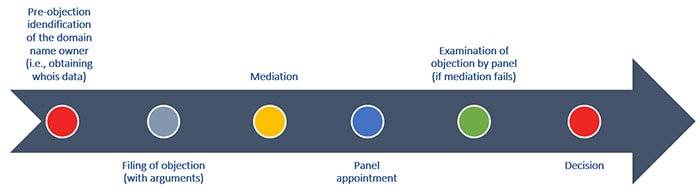
Under normal circumstances, the whole process may take around 2–3 months to be decided. An unsatisfied party that disagrees with the PPND decision may file a lawsuit with the court.

Possible Arguments

A claimant requesting a domain name take-down or transfer in accordance with the PPND policy must prove all of the following conditions:

  • The domain name is identical or confusingly similar to a trademark;
  • The registrant has no rights or legitimate interests in the domain name; and
  • The domain name has been registered and is being used in bad faith.

Of these three concurrent claims, the most challenging one to prove is the bad-faith intent. Nonetheless, it is essential. Even if a claimant can show valid trademark ownership and prove that the domain name in question was filed by an unauthorized entity, the PPND panels will refuse the claim if evidence of bad faith is lacking.

The strongest evidence of bad faith is any request (e.g. text message, email, etc.) by the registrant for compensation for transferring the domain name. Such evidence is straightforward proof that the registrant intended to sell, lease, or transfer the domain name for his or her financial benefit. However, of the 18 cases decided by the PPND since its inception, only seven were able to prove the registrant’s intent to sell the domain name for financial benefit.

There are other types of actions that are considered bad faith as well. For example, bad faith can be proven by showing that the registrant intends to prevent the trademark owner to use the contested domain name (i.e., parked domain), or by showing that the registrant intended to damage the trademark owner’s business activities. In addition, a domain name registrant intending to attract the internet user to another online location for illegal financial benefit would be another clear indication of bad faith.

Case Study

When the well-known video streaming service Netflix found that neflix.id had been registered by an unauthorized Indonesian citizen using their well-known trademark, they brought the matter before the PPND.

As the company had already registered their trademark in Indonesia, Netflix was able to prove that netflix.id was filed by an unauthorized party. However, no proof of intent to sell was forthcoming, so Netflix made the accusation that netflix.id was a parked domain, with the registrant trying to prevent Netflix from registering and using the domain name in Indonesia.

In his reply, the registrant pointed out that Netflix had not secured netflix.id before, and argued that in light of the “first to file” domain name registration principle, Netflix should have registered the domain name as soon as they were eligible to do so. The PPND, however, disagreed, deciding that the claim had in fact proved the three necessary conditions simultaneously. Hence, netflix.id was transferred to Netflix’s ownership.

Conclusion

Just as well-known brands are targeted by intellectual property infringers, these brands can also be targeted by parties wishing to benefit from their reputation or name recognition through a domain name. The process of acting against this in Indonesia is not simply a matter of trademark enforcement, but is a separate process governed by a different set of laws and regulations. Brand owners should be aware that having a trademark portfolio and strategy is often not enough; rather, they need a comprehensive and strategic awareness of how to manage all of their current and potential assets, including virtual properties such as domain names.

RELATED INSIGHTS​ 

December 21, 2023
Can rights holders record trademark and brand-related IP information with customs and, if so, how? Rights holders can record their registered marks with the Myanmar Customs Department to protect their intellectual property rights from cross-border trade in counterfeit goods bearing their registered marks under the Trademark Law, which came into force on April 1, 2023. Furthermore, regardless of whether they have filed a customs recordation, registered mark owners can request a suspension order to prevent the release of goods into free circulation if they have evidence giving reason to suspect that counterfeit goods are being—or will be—imported into the country, in accordance with Section 68 of the Trademark Law’s. According to Ministry of Planning and Finance (MOPF) Notification No. 50/2023, once a trademark is registered under the Trademark Law in Myanmar, the registered mark owner is entitled to apply for a customs recordation with the Customs Department directly or via a legal representative at no cost. Unless the mark is registered with the Intellectual Property Department (IPD) under the Trademark Law, a customs recordation or suspension order cannot be applied. A customs recordation is valid for two years from the date of the application’s acceptance. The recordation can be renewed every two years, 30 days before the expiration date. After the customs recordation is made, any information amended or withdrawn for the registered mark at the IPD must also be provided to the Customs Department within three working days, together with any necessary documentation reflecting the amendments or withdrawal. Customs recordation is not available for industrial designs. The Industrial Design Law and Industrial Design Rules do not provide the requirements and process for a customs recordation or suspension order in relation to industrial designs. Section 68 of the Industrial Design Law indicates that, upon a rights holder’s request, the
December 15, 2023
As part of its membership in Lex Mundi, Tilleke & Gibbins has published an updated edition of its Guide to Doing Business in Thailand for 2023. This guide outlines the key factors for starting and operating a business in the Thai market. Issues covered include: Investment incentives Financial facilities Exchange controls Import and export regulations Structures for doing business Requirements for the Establishment of a Business Operation of the Business Cessation or Termination of the Business Labor legislation, relations, and supply Tax Immigration requirements This publication is part of Lex Mundi’s Country Guides series prepared by member firms in more than 100 jurisdictions worldwide. The guides serve as a useful resource for planning international business strategy and researching new markets. The full Guide to Doing Business in Thailand is available through the button below.
December 11, 2023
On November 30, 2023, Vietnam’s Ministry of Science and Technology issued Circular No. 23/2023/TT-BKHCN detailing the implementation of some articles of the 2022 Intellectual Property Law (“IP Law”) and Decree No. 65/2023/ND-CP with respect to the establishment and protection of industrial property rights (“Circular 23”). Circular 23 took immediate effect upon issuance and provides further guidance and necessary clarifications for the implementation of the IP Law, which took effect on January 1, 2023. Some of the most critical provisions of Circular 23 related to the establishment of IP rights are discussed below. Common Procedures Circular 23 enumerates and details the cases where an application will be re-examined, as stipulated in various articles of the IP Law. The circular also adds the procedure in which a protection title can be partially granted, as newly stipulated in Article 118 of the IP Law. The procedure applies to patent, industrial design, and trademark applications. Grounds for IP rights invalidation are further detailed in the new circular. On the patent side, it provides a list of situations where claims are deemed to go beyond the scope of the specification. For trademark registrations, it specifically defines two conditions in which “bad faith” grounds can be used to cancel a registration. The circular sets out the procedure for opposing an application, as stipulated in the new Article 112a of the IP Law. Unlike previous regulations, Circular 23 sets out that the IP Office will inform the applicant of all oppositions (whether or not the opposition is grounded), except for obvious cases where the IP Office will consider the registrability of an opposed mark without informing the applicant. To facilitate applicants and related parties, some timeframes have been extended from one to two months. This includes, for example, the time limit for the applicant and the
December 7, 2023
The Hague Agreement Concerning the International Registration of Industrial Designs (the Hague Agreement) officially took effect in Vietnam on December 30, 2019. Since then the Hague Express Database reports that more than 1,300 international design applications have designated Vietnam, and many of them have been examined by Vietnam’s IP Office before a statement of grant of protection was issued. However, from the time the Hague Agreement took effect until the amended Intellectual Property Law took effect on January 1, 2023, there were no legal documents regulating the process and procedures for examining these applications in Vietnam. This caused some difficulties in the examination process and many applications filed from 2020 to date remain in limbo, with the applicants having submitted responses to refusals, but yet to receive further results on the grant or refusal of protection. The amended IP Law introduced Article 93.9 on the validity of international registrations of industrial designs according to the Hague Agreement. More recently, Decree 65/2023/ND-CP (Decree 65) introduced a new section on the filing and processing of Hague international design applications, with detailed regulations on the handling of Hague applications originating in Vietnam and Hague applications designating Vietnam. These new regulations have generally improved the international application process in Vietnam for both the IP Office and design applicants; however, they have not resolved some existing problems and in some cases have created more burdens for applicants. Submission of priority documents Article 24.8 of Decree 65 requires that within three months from the date of the International Bureau’s notification of the Hague Application designating Vietnam, applicants wishing to benefit from a priority must submit documents proving their priority right to the IP Office for approval. This is a completely new requirement that applies to all international design applications designating Vietnam starting from the effective