
You are using an outdated browser and your browsing experience will not be optimal. Please update to the latest version of Microsoft Edge, Google Chrome or Mozilla Firefox. Install Microsoft Edge

March 2, 2021

Resolving Domain Name Disputes in Indonesia

Informed Counsel

Since 2014, Indonesia’s domain name registry (PANDI) has overseen the registration of .id domain names, following the earlier country code top-level domains (ccTLDs), such as .co.id, .or.id, and .go.id. PANDI has recently reported on the growth of .id domain names in 2019, which saw an increase in registrations of about 45%, reaching a total of 135,000 registrants.

An Indonesian Internet Providers Association (APJII) nationwide survey found that the number of internet users in Indonesia increased by 14.6 percent to 196 million people in the period between 2019 and Q2 2020, up from 171 million in 2018. The survey also revealed that Indonesia’s internet penetration rate has gone up to 73.7 percent. This means that the country is catching up with neighboring Brunei, Singapore, and Thailand, whose internet penetration rates exceeded 70 percent last year. Part of this increase seems to be related to the limitation of in-person activity in the wake of the COVID-19 outbreak.

This internet usage growth has also meant a higher incidence of cybercrimes and online disputes, including over domain names. According to the domain name dispute statistics from WIPO, there have been 274 generic top-level domain name disputes involving Indonesian respondents to date. Meanwhile, 18 cases have so far been decided by PANDI’s Domain Name Dispute Resolution (PPND) in fights against Indonesian ccTLD cybersquatters, third parties who attempt to register domain names using the trademarks of others. PPND, a non-litigation dispute settlement body for disputes over Indonesian internet domain names, handles domain name disputes related to trademarks, registered names or regarding matters of decency. The examination of such disputes is conducted by PPND panel(s).

PANDI’s Domain Name General Policy version 6.0, dated February 25, 2019, explains the five categories of.id domain names: normative, trademark-related, product- or service-related, distributorship-related, or institutional.

Ministry of Communication Regulation No. 23 of 2013 regarding Domain Name Management stipulates that a registered trademark holder is entitled to register, use, and benefit from Indonesian ccTLDs. Based on PANDI’s naming guidelines, a trademark registration or application is required if the applicant claims that the domain name is related to their trademark. However, in practice, the registrar typically only requires a copy of the registrant’s ID card to proceed with the .id domain name registration, because the registrar may choose another naming criterion that does not require a trademark or other IP ownership. This may lead to the registration of .id domains by cybersquatters.

Procedures

PPND welcomes any trademark holder to file a complaint regarding domain names violating their registered trademark, before filing litigation with the court.

The current PPND policy (version 7.0) requires that every claimant file a pre-objection as the first step. The pre-objection phase includes a request for the whois data, which reveals the owner of a domain. Obtaining the results takes around three days after the pre-objection documents are completed and accepted by PPND. Upon receiving the pre-objection result, the next step is filing an objection laying out pertinent arguments. PPND may then proceed to mediation, followed by examination of the objection.

The simplified timeline below shows the key steps in the process.
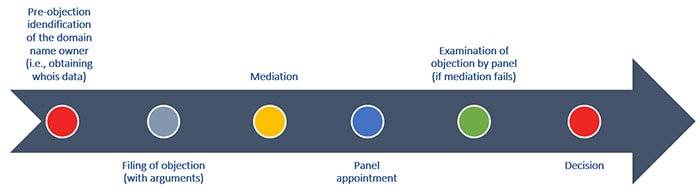
Under normal circumstances, the whole process may take around 2–3 months to be decided. An unsatisfied party that disagrees with the PPND decision may file a lawsuit with the court.

Possible Arguments

A claimant requesting a domain name take-down or transfer in accordance with the PPND policy must prove all of the following conditions:

  • The domain name is identical or confusingly similar to a trademark;
  • The registrant has no rights or legitimate interests in the domain name; and
  • The domain name has been registered and is being used in bad faith.

Of these three concurrent claims, the most challenging one to prove is the bad-faith intent. Nonetheless, it is essential. Even if a claimant can show valid trademark ownership and prove that the domain name in question was filed by an unauthorized entity, the PPND panels will refuse the claim if evidence of bad faith is lacking.

The strongest evidence of bad faith is any request (e.g. text message, email, etc.) by the registrant for compensation for transferring the domain name. Such evidence is straightforward proof that the registrant intended to sell, lease, or transfer the domain name for his or her financial benefit. However, of the 18 cases decided by the PPND since its inception, only seven were able to prove the registrant’s intent to sell the domain name for financial benefit.

There are other types of actions that are considered bad faith as well. For example, bad faith can be proven by showing that the registrant intends to prevent the trademark owner to use the contested domain name (i.e., parked domain), or by showing that the registrant intended to damage the trademark owner’s business activities. In addition, a domain name registrant intending to attract the internet user to another online location for illegal financial benefit would be another clear indication of bad faith.

Case Study

When the well-known video streaming service Netflix found that neflix.id had been registered by an unauthorized Indonesian citizen using their well-known trademark, they brought the matter before the PPND.

As the company had already registered their trademark in Indonesia, Netflix was able to prove that netflix.id was filed by an unauthorized party. However, no proof of intent to sell was forthcoming, so Netflix made the accusation that netflix.id was a parked domain, with the registrant trying to prevent Netflix from registering and using the domain name in Indonesia.

In his reply, the registrant pointed out that Netflix had not secured netflix.id before, and argued that in light of the “first to file” domain name registration principle, Netflix should have registered the domain name as soon as they were eligible to do so. The PPND, however, disagreed, deciding that the claim had in fact proved the three necessary conditions simultaneously. Hence, netflix.id was transferred to Netflix’s ownership.

Conclusion

Just as well-known brands are targeted by intellectual property infringers, these brands can also be targeted by parties wishing to benefit from their reputation or name recognition through a domain name. The process of acting against this in Indonesia is not simply a matter of trademark enforcement, but is a separate process governed by a different set of laws and regulations. Brand owners should be aware that having a trademark portfolio and strategy is often not enough; rather, they need a comprehensive and strategic awareness of how to manage all of their current and potential assets, including virtual properties such as domain names.

RELATED INSIGHTS​ 

December 7, 2023
Myanmar enacted its new Copyright Law on May 24, 2019, to replace the old Copyright Act of 1914. To implement the Copyright Law, the Ministry of Commerce (MOC) issued the Copyright Rules under Notification No. 70/2023 dated October 23, 2023, establishing procedures for registration of copyright and related rights. Both the new Copyright Law and the Copyright Rules finally came into force on October 31, 2023, in accordance with State Administration Council (SAC) Notification No. 218/2023. Subsequently, the MOC issued Notification No. 73/2023 on November 20, 2023, specifying the official forms for copyright and related rights matters to be filed with Myanmar’s Intellectual Property Department (IPD). An announcement specifying the government fees under the Copyright Law is still awaited. Once these fees are announced and the IPD opens voluntary registration, the new regime for copyright and related rights in Myanmar is finally expected to be fully functional. Overview The new Copyright Law gives copyright protection for eligible literary and artistic works and for the related rights of performers, phonogram producers, and broadcasting organizations. The law also enables the use of technological protection measures to protect copyright in literary or artistic works or related rights. The unauthorized removal or alteration of digital rights management information is also strictly prohibited. The law supports voluntary registration of copyright in literary and artistic works and related rights with the IPD. In addition, although Myanmar is not yet a contracting party to the Berne Convention (under which countries extend the same copyright protection to nationals and foreigners, regardless of publication in the country), the new Copyright Law extends copyright protection to foreign works created by noncitizens and nonresidents if they are first published in Myanmar or published in Myanmar within 30 days of first publication elsewhere. The Copyright Law grants the following copyright protection
December 7, 2023
On November 13, 2023, the Directorate General of Intellectual Property (DGIP) of Indonesia’s Ministry of Law and Human Rights held an offline workshop regarding intellectual property (IP).  One of the main discussion topics was the socialization of the proposed amendments to the Industrial Design Law. The proposed amendments to the Industrial Design Law contain a number of important changes, as outlined below. Industrial design definition The definition of an industrial design is clarified and emphasized in the draft law. An object protected through industrial design rights is “the outer appearance of a product,” gives an “aesthetic impression,” can be protected in whole or in part, and may be two- or three-dimensional. Registration system The protection period for industrial designs set by the draft law is 5 years, renewable for up to two additional five-year terms. This differs from the period provided under the current law, which is 10 years from the filing date, nonrenewable. Recordal system The draft law introduces a recordal system particularly for designs that have a relatively short commercial turnaround time, such as textile products. Recorded designs have a protection period of three years from the first publication. The recorded designs can become registered design applications by filing the design through the DGIP’s registration system no later than 12 months from its first publication. Details regarding the recordal system are not yet available. Nonregistrable industrial designs The draft law clarifies that the following are not registrable as industrial designs: Designs that do not give an aesthetic impression; Designs whose features are for purposes of technical functioning only; Folklore or traditional cultural expressions that have not been developed further; Designs contrary to the provisions of laws and regulations, public order, religion, or morality; and Designs filed in bad faith. International design applications The new law introduces a
November 27, 2023
The emergence of generative artificial intelligence (AI) has transformed the landscape for innovators and creators. As many legal practitioners have pointed out, it’s imperative for both developers of AI and artists using generative AI to understand the intricacies of intellectual property (IP) strategies so they can navigate this evolving terrain successfully. This article lays out some essential considerations relating to the major types of IP for both developers and creators in the realm of generative AI. IP Strategies for Developers of Generative AI Developers of generative AI technologies play a pivotal role in the innovation landscape. There are three overarching IP-related issues to consider: protecting their own intellectual property, mitigating the risk of violating other people’s IP rights, and IP commercialization. Key aspects of these concerns, along with suggested approaches for developers, are outlined below. Protecting IP Copyrights. One of the primary considerations for AI developers is the protection of AI-generated works, such as art and source code. The good news is that in most countries, these creations enjoy copyright protection without the need for registration. As a result, the works are automatically protected from the moment of creation. However, it’s crucial to maintain comprehensive records of your work to establish your ownership. Trademarks. Trademarks are vital for AI developers looking to establish and protect their brand. Pay close attention to Nice classifications, particularly class 9 (for software), class 35 (for business management and online marketing), and class 42 (for software design and development). Registering trademarks in these classes can provide robust protection for your brand and products. Patents. For truly innovative AI algorithms, techniques, or processes, consider the option of patenting. Patents offer strong protection, but they require a thorough application process and the documentation of your innovation, including evidence that the invention is novel, non-obvious, and practically
November 21, 2023
In this article originally published by World Trademark Review, Tilleke & Gibbins senior associate David Mol shares advice on how to collaborate effectively with customs officials at Cambodian border points and ports, offering a guide on how to successfully monitor for—and enforce against—counterfeit and grey market goods.   Can rights holders record trademark and brand-related IP information with Customs and, if so, how?   At present, there is no formal customs IP recordal system in place in Cambodia. However, rights holders may consider: a request letter to Customs; or recordal of an exclusive distributorship. Request letter to Customs A request letter to Customs would be an effective measure in cases where a rights holder is aware of a specific customs checkpoint that is being used to smuggle infringing goods. The rights holder may request to set up a meeting with Customs at the checkpoint to provide officials with: guidance on the issue; the IP rights involved; and information on product identification. The rights holder may further request the official’s assistance in monitoring shipments for certain goods. Customs has been open and cooperative in the past, setting up direct communication lines between rights holders and border officials. Officials then: monitor shipments; exchange sighting reports; and set up inspections where applicable. However, this option is not directly regulated under any laws or regulations, and can only be considered as an ad hoc approach in cases where the rights holder is aware of issues at a specific checkpoint. We usually do not recommend using this approach to alert all checkpoints in Cambodia, as it is rather time-intensive, requiring close cooperation and active liaison with officials. Instead, targeting specific checkpoints has proven to work in our experience. A request letter to Customs may apply to all types of intellectual property. However, a recently issued regulation that addresses suspensions