
You are using an outdated browser and your browsing experience will not be optimal. Please update to the latest version of Microsoft Edge, Google Chrome or Mozilla Firefox. Install Microsoft Edge

March 2, 2021

Resolving Domain Name Disputes in Indonesia

Informed Counsel

Since 2014, Indonesia’s domain name registry (PANDI) has overseen the registration of .id domain names, following the earlier country code top-level domains (ccTLDs), such as .co.id, .or.id, and .go.id. PANDI has recently reported on the growth of .id domain names in 2019, which saw an increase in registrations of about 45%, reaching a total of 135,000 registrants.

An Indonesian Internet Providers Association (APJII) nationwide survey found that the number of internet users in Indonesia increased by 14.6 percent to 196 million people in the period between 2019 and Q2 2020, up from 171 million in 2018. The survey also revealed that Indonesia’s internet penetration rate has gone up to 73.7 percent. This means that the country is catching up with neighboring Brunei, Singapore, and Thailand, whose internet penetration rates exceeded 70 percent last year. Part of this increase seems to be related to the limitation of in-person activity in the wake of the COVID-19 outbreak.

This internet usage growth has also meant a higher incidence of cybercrimes and online disputes, including over domain names. According to the domain name dispute statistics from WIPO, there have been 274 generic top-level domain name disputes involving Indonesian respondents to date. Meanwhile, 18 cases have so far been decided by PANDI’s Domain Name Dispute Resolution (PPND) in fights against Indonesian ccTLD cybersquatters, third parties who attempt to register domain names using the trademarks of others. PPND, a non-litigation dispute settlement body for disputes over Indonesian internet domain names, handles domain name disputes related to trademarks, registered names or regarding matters of decency. The examination of such disputes is conducted by PPND panel(s).

PANDI’s Domain Name General Policy version 6.0, dated February 25, 2019, explains the five categories of.id domain names: normative, trademark-related, product- or service-related, distributorship-related, or institutional.

Ministry of Communication Regulation No. 23 of 2013 regarding Domain Name Management stipulates that a registered trademark holder is entitled to register, use, and benefit from Indonesian ccTLDs. Based on PANDI’s naming guidelines, a trademark registration or application is required if the applicant claims that the domain name is related to their trademark. However, in practice, the registrar typically only requires a copy of the registrant’s ID card to proceed with the .id domain name registration, because the registrar may choose another naming criterion that does not require a trademark or other IP ownership. This may lead to the registration of .id domains by cybersquatters.

Procedures

PPND welcomes any trademark holder to file a complaint regarding domain names violating their registered trademark, before filing litigation with the court.

The current PPND policy (version 7.0) requires that every claimant file a pre-objection as the first step. The pre-objection phase includes a request for the whois data, which reveals the owner of a domain. Obtaining the results takes around three days after the pre-objection documents are completed and accepted by PPND. Upon receiving the pre-objection result, the next step is filing an objection laying out pertinent arguments. PPND may then proceed to mediation, followed by examination of the objection.

The simplified timeline below shows the key steps in the process.
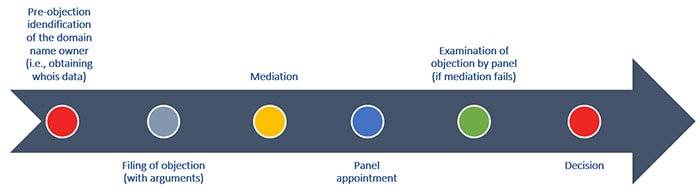
Under normal circumstances, the whole process may take around 2–3 months to be decided. An unsatisfied party that disagrees with the PPND decision may file a lawsuit with the court.

Possible Arguments

A claimant requesting a domain name take-down or transfer in accordance with the PPND policy must prove all of the following conditions:

  • The domain name is identical or confusingly similar to a trademark;
  • The registrant has no rights or legitimate interests in the domain name; and
  • The domain name has been registered and is being used in bad faith.

Of these three concurrent claims, the most challenging one to prove is the bad-faith intent. Nonetheless, it is essential. Even if a claimant can show valid trademark ownership and prove that the domain name in question was filed by an unauthorized entity, the PPND panels will refuse the claim if evidence of bad faith is lacking.

The strongest evidence of bad faith is any request (e.g. text message, email, etc.) by the registrant for compensation for transferring the domain name. Such evidence is straightforward proof that the registrant intended to sell, lease, or transfer the domain name for his or her financial benefit. However, of the 18 cases decided by the PPND since its inception, only seven were able to prove the registrant’s intent to sell the domain name for financial benefit.

There are other types of actions that are considered bad faith as well. For example, bad faith can be proven by showing that the registrant intends to prevent the trademark owner to use the contested domain name (i.e., parked domain), or by showing that the registrant intended to damage the trademark owner’s business activities. In addition, a domain name registrant intending to attract the internet user to another online location for illegal financial benefit would be another clear indication of bad faith.

Case Study

When the well-known video streaming service Netflix found that neflix.id had been registered by an unauthorized Indonesian citizen using their well-known trademark, they brought the matter before the PPND.

As the company had already registered their trademark in Indonesia, Netflix was able to prove that netflix.id was filed by an unauthorized party. However, no proof of intent to sell was forthcoming, so Netflix made the accusation that netflix.id was a parked domain, with the registrant trying to prevent Netflix from registering and using the domain name in Indonesia.

In his reply, the registrant pointed out that Netflix had not secured netflix.id before, and argued that in light of the “first to file” domain name registration principle, Netflix should have registered the domain name as soon as they were eligible to do so. The PPND, however, disagreed, deciding that the claim had in fact proved the three necessary conditions simultaneously. Hence, netflix.id was transferred to Netflix’s ownership.

Conclusion

Just as well-known brands are targeted by intellectual property infringers, these brands can also be targeted by parties wishing to benefit from their reputation or name recognition through a domain name. The process of acting against this in Indonesia is not simply a matter of trademark enforcement, but is a separate process governed by a different set of laws and regulations. Brand owners should be aware that having a trademark portfolio and strategy is often not enough; rather, they need a comprehensive and strategic awareness of how to manage all of their current and potential assets, including virtual properties such as domain names.

RELATED INSIGHTS​ 

June 25, 2024
Attorneys from Tilleke & Gibbins’ office in Jakarta have prepared Intellectual Property in Indonesia, a comprehensive resource for understanding, protecting, and commercializing intellectual property (IP) in the country. This guide provides detailed information on various aspects of IP rights, including: Trademarks: Procedures and requirements for registration, maintenance, and enforcement. Patents: Information on obtaining patent protection, including the application process and legal requirements. Industrial designs: Steps for registering and protecting design innovations. Utility models: Guidelines for securing protection for new technical solutions. Copyrights: Details on copyright protection, registration, and enforcement. Geographical indications: Information on protecting products with specific geographical origins. The guide is designed to offer practical insights into the registration processes, legal frameworks, and enforcement mechanisms relevant to IP in Indonesia. It aims to serve as a valuable tool for businesses, legal practitioners, and individuals involved in the creation and protection of intellectual property. For more details, access the full Intellectual Property in Indonesia guide by clicking the button below.
June 4, 2024
Myanmar’s Patent Law 2019—the country’s first legislation specifically addressing patent protection—took effect on May 31, 2024. The announcement that the law had taken effect came when the State Administration Council (SAC) issued Notification No. 106/2024 on June 1, 2024. This announcement is a key development moving toward full implementation of statutory patent protection in Myanmar. The next step will be the announcement of the Patent Rules, which will establish the requirements, official forms, and procedures related to the application and registration of patents and utility models. Another necessary announcement will be the official forms and fees for proceeding with patent-related matters at the Intellectual Property Department (IPD). Upon these forthcoming announcements, parties will be able to apply for patent registration in Myanmar. The Patent Law, which was enacted in 2019, allows for the registration of inventions that: Have not been disclosed to the public anywhere by any means before the filing date or priority date (if claimed); Involve an inventive step; and Are capable of use in any industry. Priority rights can be claimed within a year of the filing of an application with any member country of the World Trade Organization. In seeking protection for inventions internationally, priority rights cannot yet be claimed under the Paris Convention or the Patent Cooperation Treaty, as Myanmar’s ratification of these agreements is still pending. Nevertheless, the Patent Law includes provisions related to these two agreements; these provisions will take effect if the ratification process is completed. Rights owners interested in seeking protection of their inventions in Myanmar should begin evaluating their portfolios so that they can apply to register their inventions once the remaining necessary announcements have been issued. Recordation of inventions—including renewals of patents that had been recognized under Myanmar’s previously established practice—will no longer be accepted. Rights holders can
May 28, 2024
On March 1, 2024, the Lao official gazette published the newly amended Law on Intellectual Property No. 50/NA, dated November 20, 2023 (the “2023 Law on IP”). The timing of this update is consistent with Laos’ history of providing regular revisions to the country’s IP legislation since the enactment of the first Law on Intellectual Property by the National Assembly in 2007 (the “2007 Law on IP”). These revisions include amendments in 2011, 2017, and now 2023. Prior to 2007, intellectual property (IP) protection was granted through decrees issued by the prime minister’s office for selected types of IP: trademarks, patents, petty patents, and industrial designs. The 2007 Law on IP marked a significant shift by introducing comprehensive legislation to protect industrial property rights, new plant varieties, copyright, and related rights. It laid the foundations for IP legislation in Laos, with the primary objectives of promoting and protecting intellectual creativity and attracting foreign investment. Since 2007, the enactment of new IP laws has not always entailed significant amendments to the existing IP framework; however, it frequently serves as an opportunity to introduce long-considered mechanisms. For example, the amended Law on Intellectual Property No. 38/NA, dated November 15, 2017 (“2017 Law on IP”) introduced, among other provisions, the possibility of opposition by a third party after the formal examination of a trademark application by the examiner. The 2023 Law on IP brought additional changes and updates to the IP regulatory landscape in Laos. Some of the most notable of these are highlighted below. Trademarks While Laos already introduced a new mechanism for online trademark registration in November 2023—about a month before enacting the 2023 Law on IP—the new law did introduce some noteworthy changes. Well-Known Marks The 2023 Law on IP appears to ease the burden of proof for establishing
May 16, 2024
On May 4, 2024, the Vietnamese government issued Decree No. 46/2024/ND-CP (“Decree 46”) amending and supplementing certain articles of Decree No. 99/2013/ND-CP dated August 29, 2013, on administrative sanctions in industrial property, as amended and supplemented in 2021 (“Decree 99”). Decree 46, which will come into force on July 1, 2024, is designed to bring Decree 99 in line with the amended IP Law of 2022. Some of the notable amendments of Decree 46 are discussed below. New Infringing Acts Decree 46 added the following new infringing acts subject to sanctions, which had not been set out in the former decree: Use of patents, utility solutions, layout designs, or industrial designs without paying compensation according to the provisions on temporary rights specified in Article 131 of the amended IP Law. Accepting a trademark license not in the form of a written contract in the case of using the licensed trademark on goods or packaging. Failure to notify clients of costs, charges, and fees related to procedures for establishing and protecting industrial property rights. Deceiving clients in the course of entering into and performing industrial property representative service contracts, but not to the extent of criminal prosecution, or forcing customers to enter into and perform industrial property representative service contracts. Although these acts are not common occurrences, it is nevertheless important to have clear regulations in order to ensure consistency with the amended IP Law and overcome difficulties and obstacles if such acts are committed in practice. Amendments and Supplements Decree 46 adopted amendments and supplements to main sanctions, additional sanctions, and remedial measures, specifically: The monetary fine imposed for violations against trade secrets is VND 50 million to VND 100 million (approx. USD 2,000 – USD 4,000), a large increase compared to the VND 5 million to VND 15