
You are using an outdated browser and your browsing experience will not be optimal. Please update to the latest version of Microsoft Edge, Google Chrome or Mozilla Firefox. Install Microsoft Edge

May 19, 2020

Reinsurance Revolution in Myanmar

On May 12, 2020, Myanmar’s Insurance Business Regulatory Board (IBRB) issued Directive 4/2020—a game-changer for the insurance industry in Myanmar. Previously, reinsurance in Myanmar had only been available through the state-owned Myanma Insurance, without competition. However, when this directive comes into force on October 1, 2020, insurance companies (or cedants) will be able to obtain reinsurance from other insurers or reinsurers within Myanmar or abroad, with certain restrictions.

Reinsurance (and retrocession—the insurance or reinsurance of reinsurers) is a critical part of the insurance industry because it allows insurance companies to spread their risk and remain solvent in the event of large claims. It is expected that this new directive will result in Myanmar insurers—already undergoing tectonic shifts following the introduction of five foreign life insurer licenses and six foreign-Myanmar insurance joint ventures—seeking substantial reinsurance outside Myanmar. This greater spreading of insurance risk is a very positive development for the insurance market in Myanmar.

Reinsurance and Risk Retention

Under the directive, every insurer in Myanmar must retain risk up to the maximum amount commensurate with its financial strength, and must formulate a suitable retention policy for each insurance segment. In the case of life insurers and reinsurers transacting life insurance business, that must be a minimum of 20% of the sum at risk.

Every Myanmar insurer must also formulate a reinsurance program and retention policy and submit it to the IBRB at the beginning of each financial year.

Reinsurers and Licensing

Any reinsurer who wishes to operate within Myanmar must have a reinsurance license from the IBRB.

Foreign reinsurers or cross-border reinsurers who do not have a license to conduct insurance business in Myanmar will now also be permitted, subject to the following conditions:

  • They must have been licensed in their home country for at least the past three continuous years;
  • They must have a credit rating of at least BBB from S&P or equivalent for at least the past three continuous years;
  • They must have maintained a minimum solvency margin or capital adequacy as specified by their home country regulator for at least the past three continuous years;
  • Their past claims settlement must be satisfactory to the IBRB; and
  • They must comply with other requirements that may be stipulated by the IBRB.

Engaging a Reinsurer

Other than for life insurance, insurers must offer the best terms obtained to reinsurers in the following order:

  1. Myanma Insurance;
  2. Myanmar reinsurers or foreign reinsurers with representative offices in Myanmar; and
  3. Foreign reinsurers.

Insurers are obliged to follow this order of priority only if the terms offered are equaled (or bettered).

Again, other than life insurance, the IBRB has placed the following limits on cession to foreign reinsurers:
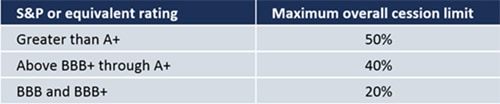
However, there is one catch that may prove frustrating. Section 20 of the directive provides that every Myanmar insurer, Myanmar reinsurer, and foreign reinsurer must cede a compulsory maximum of 10% of any insurance segment business to Myanma Insurance. Myanma Insurance is free to accept or reject the cession and will presumably be able to impose upon it such terms as it sees fit. Only if Myanma Insurance fails to offer such reinsurance is the insurer free to obtain cross border reinsurance from a foreign reinsurer for that original 10%. It seems probable that this provision will have a negative effect, because it will likely result in insurers being forced to comply with uncommercial terms from Myanma Insurance, despite better terms being available in Myanmar or abroad.

Insurance Pools

Insurance pools are another method by which smaller insurance companies can share risk. Insurance pools may now be formed in Myanmar, subject to a proposal being made to and approved by the IBRB.

Conclusion

Despite what some may see as the unwelcome involvement of Myanma Insurance, this directive is undoubtedly a giant step forward in the further liberalization and spreading of risk within the Myanmar insurance market, and is likely to herald large changes in reinsurance and retrocession both inside Myanmar and beyond.

For more information on this development, or on any aspect of doing business in Myanmar, please contact Tilleke & Gibbins’ Yangon office on [email protected]

RELATED INSIGHTS​ 

April 29, 2025
On April 11, 2025, Thailand’s Office of Insurance Commission (OIC) released draft principles for two notifications for public comment, open until the end of April. These aim to amend the OIC Notifications on Guidelines for Customer Personal Data Protection for life and non-life insurance businesses, which were issued in 2021. Key Principles Both life and non-life insurance companies will be required to obtain consent for the following processing activities: Processing of general personal data: When requesting the OIC to disclose information related to a customer’s insurance policy for the purpose of underwriting or claims consideration. Processing of sensitive personal data: When requesting the OIC to disclose information related to a customer’s insurance policy for the purpose of underwriting or claims consideration; and When requesting the OIC to disclose information about a customer’s insurance fraud behavior for fraud monitoring, fraud risk management, and assessing and preventing insurance fraud risk for underwriting or claims payment. The consent for the above processing activities must be in accordance with the consent requirements prescribed by the OIC, and the disclosure of personal data must also comply strictly with the conditions set by the OIC. Life insurance companies may obtain consent for other purposes as long as they comply with Thailand’s Personal Data Protection Act B.E. 2562 (2019), and companies will be liable in the event of a personal data breach. Additional Principles for Non-Life Insurance Businesses Non-life insurance companies will be required to provide a privacy notice and a summary of the privacy notice for each type of insurance policy in accordance with the form prescribed by the OIC. The privacy notice and its summary must be provided prior to or at the time of offering insurance policies, or together with the consent form for data processing through any channels used for offering insurance.
April 1, 2025
The collapse of a building under construction in Bangkok on March 28, 2025, following a powerful earthquake in Myanmar has sparked widespread public concern about the potential financial impact on local insurers and insurance implications. The construction site was insured under a contractors’ all risks (CAR) policy, and initial reports and market speculation suggest that the event could cause serious financial strain for the domestic insurance industry. Nevertheless, local insurers connected to the site of the collapse may face limited exposure for two main reasons: Reinsurance significantly mitigates local insurers’ exposure. According to market sources, 95% of the CAR coverage for the construction site was reinsured by foreign reinsurers. This is standard risk-management practice for large-scale infrastructure and construction projects, allowing local insurers to participate in underwriting while transferring most of the liability offshore. As a result, the direct financial impact on domestic insurers is expected to be minimal, subject to the reinsurance contracts and any potential claims disputes. Potential exclusions may apply. The Thai General Insurance Association has issued an interim public advisory noting that coverage under the CAR policy may be limited or excluded altogether, pending a full investigation. CAR policies often contain exclusions for certain events, depending on how the policy is worded and the actual cause of the incident. A thorough factual and forensic investigation will be necessary to determine the true cause and assess policy applicability. For further information or assistance in reviewing CAR or project insurance coverage in Thailand, please contact Athistha (Nop) Chitranukroh at [email protected], Witchupong Chittchang at [email protected], or Ajaree Trachukul at [email protected].
December 10, 2024
Thailand’s Ministry of Finance (MOF) has issued a new notification easing foreign shareholding and board limits for life insurers. This long-awaited update aligns with the draft notification that was previewed in May 2024, and reflects the MOF’s intention to enhance the stability and competitiveness of life insurers. Life Insurer Qualifications Life insurers may apply for permission to exceed 49% foreign shareholding or have a majority of foreign directors if: The life insurer operates in a manner that could harm the insured or the public, and either (1) the OIC has directed the company to improve its status or adjust its capital, or (2) the company’s actions may have a significant impact on the insurance industry, causing significant compensation burdens and affecting the company’s capital adequacy ratio (CAR); The life insurer’s shareholders are unable to increase capital; and The life insurer is unable to attract Thai investors to increase the capital necessary to ensure stability and the long-term operation of the business. Foreign Shareholder Qualifications To qualify, foreign shareholders must: Either be an insurance company or have at least 10 years of relevant experience in the insurance industry; Demonstrate financial stability and possess a credit rating (or have a parent company with a credit rating) of at least “A” from a reputable credit rating agency; Present a clear and comprehensive business plan to develop and promote the company’s efficiency and competitiveness in the industry; and Be able to make an investment that increases the company’s capital by at least THB 2 billion to maintain stability with a CAR of at least 250%. For more details on the MOF’s notification regarding criteria on foreign shareholding limits for life insurance companies, or on any issue concerning insurance regulations in Thailand, please contact Athistha (Nop) Chitranukroh at [email protected], Witchupong Chittchang at [email protected], Ajaree
December 6, 2024
Thailand’s Office of Insurance Commission (OIC) recently announced two Notifications regarding Timeframe Standards for Service Level Agreements, for both life and non-life insurance companies. Under these notifications, every insurance company is required to set out clear and specific timeframes in its service level agreement (SLA) for at least the following activities: Providing information about life and non-life insurance and offering insurance policies; Underwriting and providing after-sales services; Paying compensation under the insurance policy; and Handling complaints. The timeframes described in the SLA must not exceed those specified in the insurance policy or by the relevant laws, and the SLA (which must be published on the insurer’s website) must be continually updated to reflect any changes in the timeframes. Insurance companies are required to disclose the standard timeframes for SLAs on their website by January 1, 2025, and notify the OIC through the channels and methods specified by the OIC. For more details on the OIC’s notifications on SLA timeframe standards, or on any aspect of insurance regulations in Thailand, please contact Athistha (Nop) Chitranukroh at [email protected], Witchupong Chittchang at [email protected], Ajaree Trachukul at [email protected], Thammapas Chanpanich at [email protected], or Sireethorn Wijan at [email protected].