
You are using an outdated browser and your browsing experience will not be optimal. Please update to the latest version of Microsoft Edge, Google Chrome or Mozilla Firefox. Install Microsoft Edge

May 19, 2020

Reinsurance Revolution in Myanmar

On May 12, 2020, Myanmar’s Insurance Business Regulatory Board (IBRB) issued Directive 4/2020—a game-changer for the insurance industry in Myanmar. Previously, reinsurance in Myanmar had only been available through the state-owned Myanma Insurance, without competition. However, when this directive comes into force on October 1, 2020, insurance companies (or cedants) will be able to obtain reinsurance from other insurers or reinsurers within Myanmar or abroad, with certain restrictions.

Reinsurance (and retrocession—the insurance or reinsurance of reinsurers) is a critical part of the insurance industry because it allows insurance companies to spread their risk and remain solvent in the event of large claims. It is expected that this new directive will result in Myanmar insurers—already undergoing tectonic shifts following the introduction of five foreign life insurer licenses and six foreign-Myanmar insurance joint ventures—seeking substantial reinsurance outside Myanmar. This greater spreading of insurance risk is a very positive development for the insurance market in Myanmar.

Reinsurance and Risk Retention

Under the directive, every insurer in Myanmar must retain risk up to the maximum amount commensurate with its financial strength, and must formulate a suitable retention policy for each insurance segment. In the case of life insurers and reinsurers transacting life insurance business, that must be a minimum of 20% of the sum at risk.

Every Myanmar insurer must also formulate a reinsurance program and retention policy and submit it to the IBRB at the beginning of each financial year.

Reinsurers and Licensing

Any reinsurer who wishes to operate within Myanmar must have a reinsurance license from the IBRB.

Foreign reinsurers or cross-border reinsurers who do not have a license to conduct insurance business in Myanmar will now also be permitted, subject to the following conditions:

  • They must have been licensed in their home country for at least the past three continuous years;
  • They must have a credit rating of at least BBB from S&P or equivalent for at least the past three continuous years;
  • They must have maintained a minimum solvency margin or capital adequacy as specified by their home country regulator for at least the past three continuous years;
  • Their past claims settlement must be satisfactory to the IBRB; and
  • They must comply with other requirements that may be stipulated by the IBRB.

Engaging a Reinsurer

Other than for life insurance, insurers must offer the best terms obtained to reinsurers in the following order:

  1. Myanma Insurance;
  2. Myanmar reinsurers or foreign reinsurers with representative offices in Myanmar; and
  3. Foreign reinsurers.

Insurers are obliged to follow this order of priority only if the terms offered are equaled (or bettered).

Again, other than life insurance, the IBRB has placed the following limits on cession to foreign reinsurers:
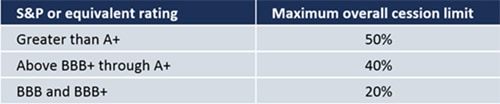
However, there is one catch that may prove frustrating. Section 20 of the directive provides that every Myanmar insurer, Myanmar reinsurer, and foreign reinsurer must cede a compulsory maximum of 10% of any insurance segment business to Myanma Insurance. Myanma Insurance is free to accept or reject the cession and will presumably be able to impose upon it such terms as it sees fit. Only if Myanma Insurance fails to offer such reinsurance is the insurer free to obtain cross border reinsurance from a foreign reinsurer for that original 10%. It seems probable that this provision will have a negative effect, because it will likely result in insurers being forced to comply with uncommercial terms from Myanma Insurance, despite better terms being available in Myanmar or abroad.

Insurance Pools

Insurance pools are another method by which smaller insurance companies can share risk. Insurance pools may now be formed in Myanmar, subject to a proposal being made to and approved by the IBRB.

Conclusion

Despite what some may see as the unwelcome involvement of Myanma Insurance, this directive is undoubtedly a giant step forward in the further liberalization and spreading of risk within the Myanmar insurance market, and is likely to herald large changes in reinsurance and retrocession both inside Myanmar and beyond.

For more information on this development, or on any aspect of doing business in Myanmar, please contact Tilleke & Gibbins’ Yangon office on [email protected]

RELATED INSIGHTS​ 

December 4, 2024
Thailand Legal Basics, a valuable primer for foreign investors, explores all aspects of living and doing business in Thailand. Written by specialists at Tilleke & Gibbins in Bangkok, it is the only comprehensive English-language guide to the Thai legal system with a focus on the concerns of foreign business and investment.
October 9, 2024
Thailand’s Anti-Money Laundering Office has released new guidelines on customer due diligence (CDD) for insurance companies to outline anti-money laundering and counter-terrorism financing measures based on the Anti-Money Laundering Act B.E. 2542 (1999). The previous guidelines were revoked and replaced by these guidelines. The guidelines include seven key measures: Anti-money laundering and counter-terrorism financing policy: Insurance companies must establish a policy in Thai that outlines the organization’s approach to assessing, managing, and mitigating risks related to money laundering, terrorism financing, and proliferation. Risk management framework: Insurance companies’ frameworks for risk management are to be divided into three stages: (1) internal risk management, (2) risk assessment before customer onboarding, and (3) ongoing customer risk management. CDD before engagement with customers: Insurance companies must implement a rigorous approval process to verify customers’ identities. Customer information review and transaction monitoring: Insurance companies must update customer information and the list of banned transactions to ensure compliance with current risk profiles. Enhanced CDD for high-risk clients: Insurance companies must apply a stricter level of verification and monitoring measures for high-risk clients, including reviews of financial transactions. Third-party reliance and subsidiary controls: Reliance on third parties is allowed only in processes for customer identification and verification of identity. Internal controls and policies for subsidiaries or affiliates must be updated regularly. Suspicious transaction reporting: Insurance companies must report any suspicious transactions, particularly whenever CDD is not available. For more details on the CDD guidelines, or on any aspect of insurance and anti-money laundering regulations in Thailand, please contact Athistha (Nop) Chitranukroh at [email protected], Witchupong Chittchang at [email protected], Ajaree Trachukul at [email protected], or Sireethorn Wijan at [email protected].
October 2, 2024
Thailand’s Office of Insurance Commission (OIC) has issued orders announcing the premium rates for insureds who purchase insurance policies directly from life and non-life insurance companies. The orders, which were issued on September 2, 2024, allow insurance companies to set lower premium rates for insureds who purchase insurance policies directly from them, compared to those approved earlier by the OIC. Under the orders, both life and non-life insurance companies selling insurance policies directly to insureds may set the premium rate below the premium rate earlier approved by the OIC, but the discount may not exceed: 30% of the insurance premium for all types of insurance policies; and 35% of the insurance premium for insurance policies that utilize innovation or are sold through electronic channels. Here, “insurance policies that utilize innovation” means insurance policies that are currently being tested or have successfully met the objectives of the Insurance Regulatory Sandbox or the Product Innovation and Tailor-Made Sandbox, as approved by the OIC. The insurance companies may set the above two premium rates under the following conditions: The insurance contract must be entered into between September 1, 2024, and November 15, 2024; and The coverage start date of the insurance policy must not be later than December 31, 2024. For more details on the OIC’s orders regarding premium rates for insureds who purchase insurance policies directly from life and non-life insurance companies, or on any issue concerning insurance regulations in Thailand, please contact Athistha (Nop) Chitranukroh at [email protected], Witchupong Chittchang at [email protected], Ajaree Trachukul at [email protected], or Sireethorn Wijan at [email protected].
July 23, 2024
Thailand’s Office of Insurance Commission (OIC) recently opened a public hearing on draft notifications regarding criteria, procedures, and conditions for naming life and non-life insurance brokerage businesses. The draft notifications aim to establish guidelines for naming and describing such brokerages. Key Principles Licensed insurance brokers must use “life insurance” or “non-life insurance” in their business name. When establishing an office, brokers must display a visible nameplate at the office front, starting out with the Thai words for “life insurance broker office” or “non-life insurance broker office” and the broker’s name; any signs indicating the office location must adhere to these same naming conventions. Inside, offices must display the insurance broker’s license and the power-of-attorney for receiving insurance premiums at the office. Noncompliance with these key principles may result in the OIC taking corrective action. Outlook After the draft notifications pass the public hearing stage, which closes on July 19, 2024, the OIC will consider the feedback and finalize the notifications. The duration of this process depends on the complexity of the notification and the public feedback. Normally, each notification takes at least 3–6 months before issuance. For more details on the OIC’s draft notifications or on any issue concerning insurance regulations in Thailand, please contact Athistha (Nop) Chitranukroh at [email protected], Witchupong Chittchang at [email protected], Ajaree Trachukul at [email protected], Thammapas Chanpanich at [email protected], or Sireethorn Wijan at [email protected].