
You are using an outdated browser and your browsing experience will not be optimal. Please update to the latest version of Microsoft Edge, Google Chrome or Mozilla Firefox. Install Microsoft Edge

August 29, 2018

Panasonic Wins Passing Off Case for Packaging and Product Designs

Informed Counsel

Although the Thai Trademark Act provides protection for passing off, filing a lawsuit to defend an IP owner’s unregistered rights can still pose certain challenges. This is especially true where two registered trademarks are different, but the product packaging designs of both marks are confusingly similar. In these circumstances, the court occasionally decides upon a mere comparison of the two marks and may determine that the similarities of their packaging designs are not likely to cause confusion among public consumers due to their dissimilarity.

Recently, the Supreme Court rendered a remarkable and highly significant judgment on the grounds of passing off, which should serve as a landmark trademark infringement case in Thailand. Panasonic, the plaintiff, owns various trademark registrations worldwide. Among those registered marks, the most eye-catching mark is the PANASONIC mark itself. Panasonic registered this mark for use with manganese and alkaline batteries in Class 9 in Thailand in 1985. Panasonic exerted huge efforts and much research in designing the unique colors used with its batteries and the labeling on the packaging to let consumers recognize its products immediately as belonging to Panasonic.

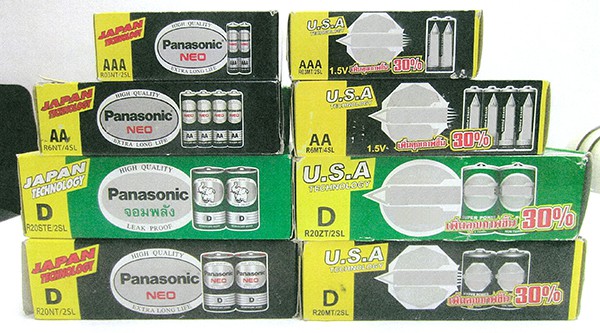
Approximately five years ago, a Thai manufacturing company (defendants) was discovered to be manufacturing different types of batteries that were found to be similar to those manufactured by Panasonic under its own trademark. The defendants’ batteries were closely similar to Panasonic’s battery colors and the text was positioned almost identically to Panasonic’s packaging.

After trying unsuccessfully to reach an amicable settlement, Panasonic decided to bring a civil lawsuit against the defendants on the grounds of trademark infringement and passing off.
IP&IT Court Decision   

At the Intellectual Property and International Trade (IP&IT) Court, Panasonic argued that the appearance of its packaging was immediately recognizable among Thai public consumers and distinguishable from the packaging of other battery manufacturers. To support its claim, Panasonic conducted a public survey opinion poll comparing the overall appearances of its packaging and that of other battery manufacturers’ packaging. The survey results revealed that the average consumer readily recognizes Panasonic’s packaging without seeing the PANASONIC mark, and that there is a likelihood of confusion when consumers see the defendant’s packaging. Unfortunately, these survey results were not convincing evidence to the court. Without considering the defendant’s bad faith in imitating the color, size, and word arrangement of its battery packaging, the court instead took into consideration the trademark itself, and therefore considered that the defendant’s batteries were distinguishable when considering pronunciation and overall appearance.    

Panasonic disagreed with the court’s opinion and decided to appeal the case to the Supreme Court, arguing that the IP&IT Court failed to elaborate on the legal point of the defendants’ bad faith, as it was using similar packaging, labeling, and colors to its own product designs and benefiting from Panasonic’s widespread reputation.

The Supreme Court Decision   

The Supreme Court confirmed the IP&IT Court decision with regard to the dissimilarity of the registered marks, when considering pronunciation and the shape of the Roman characters of the marks. However, the Supreme Court disagreed with most other aspects of the IP&IT Court’s reasoning, especially in its failure to determine whether the defendants, by using a similar packaging, label, and product design to that of Panasonic’s, acted in bad faith and thereby infringed Panasonic’s unregistered trademark rights.    

The Supreme Court emphasized the importance of the bad faith intention of the defendants by determining the manner in which the trademark is used on goods and packages. The court found that even though the registered mark in dispute was not confusingly similar to the PANASONIC trademark in either appearance or pronunciation, the court must compare the characteristics of the batteries and the packaging of the defendants with those aspects of Panasonic’s batteries to determine whether the two companies’ products are similar.    

With regard to the color scheme, the Supreme Court took an approach contrary to the IP&IT Court’s reasoning. Even though color is a common feature that anyone can freely use, a certain color combination (e.g., green and silver; black and silver; or red, white, black and yellow), together with the placement of the colors, text, and images, creates a visual design and pattern indicating that Panasonic’s goods are different from others’ goods.   

The Supreme Court further elaborated that the appearance of the defendants’ batteries and packaging, which appear to be closely similar to Panasonic’s, clearly reflect the bad-faith intention of the defendants to use their registered mark with batteries in order to deceive the relevant consumers into believing that the batteries belong to Panasonic. The court held that such tortious conduct can only have the result of causing injury to Panasonic and is thus unlawful.    

The Supreme Court ruled that the defendants must cease using their product designs and packaging designs of similar coloring and patterns to those of Panasonic, and must not pass off their products as those of Panasonic. Moreover, the court awarded Panasonic compensatory damages, together with its attorneys’ fees and court fees.

Conclusion   

The trademark owner’s victory in this case offers a valuable lesson in determining that trademark infringement should not only consider the mark itself but also the manner in which an alleged infringer uses its mark to imitate a brand owner’s unique product designs and packaging, which can now be considered to be unregistered trademarks. This Supreme Court judgment establishes an exemplary guideline for brand owners facing similar issues, whereby brand owners can protect themselves from others imitating their unique product designs and packaging.

RELATED INSIGHTS​ 

March 25, 2024
Tilleke & Gibbins has provided an updated Thailand chapter for Fashion Law 2024 from Global Legal Post. The guide covers 20 key jurisdictions in the global fashion industry, offering insights into local legal frameworks surrounding issues such as brand enforcement and protection, e-commerce and marketing, and sustainability considerations. The Thailand chapter of Fashion Law 2024 provides detailed information on the following topics: Main intellectual property rights for fashion products Contractual arrangements in manufacturing, distribution, and advertising Regulations and enforcement of online marketing Unfair competition rules and judicial interpretation Specific regulations on sustainability and ESG in fashion Special import and export rules for fashion products The full Thailand chapter is available for free through the button below and on the Global Legal Post website. Tilleke & Gibbins also contributed the Vietnam chapter to the guide.
March 22, 2024
Laos has returned its value-added tax rate to 10% from the 7% rate that had been observed for the last two years. The new rate was specified in Ordinance No. 003/PDT, dated March 19, 2024, and announced on the website of the Ministry of Trade and Commerce. Prior to this, the last announcement of an adjustment in the VAT rate came in the last week of December 2021, when the Ministry of Justice published the Law Amending Certain Provisions of the Laws on Tax No. 01/NA, dated August 7, 2021, in the Government Gazette. This law, which entered into force in January 2022, amended the VAT rate from 10% to 7%. Under Lao law, the ordinance is effective from its date of signing by the president of Laos (i.e., March 19, 2024). However, the tax authorities have indicated that the new rate will not be enforced immediately but will be implemented in the near future, such as when it is published in the Lao Official Gazette. This change of the VAT rate to 10% does not come as a surprise. Some international experts and organizations had been recommending that Laos adopt a 10% VAT rate given its current economic challenges, arguing that Laos should prioritize collecting tax and replenishing the state budget. This was, for instance, recommended by the World Bank in the November 2023 Lao PDR Economic Monitor. Tilleke & Gibbins will continue to monitor the situation to determine when the 10% VAT rate will be enforced. For more details on the rate changes, or on any aspect of tax law in Laos, please contact Tilleke & Gibbins at [email protected].
March 22, 2024
Indonesia’s Ministry of Industry (MOI) has issued a new regulation requiring importers of textiles, textile products, bags, and footwear to furnish applicable trademark certificates when applying for an import permit. This means that a letter of appointment to import from the trademark owner or authorized representative is no longer sufficient to obtain an import permit for these goods. The requirement is detailed in MOI Regulation No. 5 of 2024 concerning Procedures for Issuing Technical Considerations for Imports of Textiles, Textile Products, Bags and Footwear, which took effect on March 10, 2024. Affected Products The new regulation applies to the following products: Textiles: Fiber, thread, fabric Textile products: Carpets, other textile floor coverings, clothing, ready-made clothing accessories, other finished textile goods Bags: Suitcases, wallets, school bags, sports bags, handbags, other bags Footwear: Shoes, sandals, moccasins Import Permits In principle, businesses can import textiles, textile products, bags, and footwear as raw materials, auxiliary materials, or consumer goods (for trading) after obtaining the appropriate import permit from the Ministry of Trade (MOT). There are three categories of import permits: General import permits for consumption (API-U), which are required for parties that conduct import activities for the purpose of trading; Import permits for producers (API-P); and Import permits for suppliers of raw or auxiliary materials (PPBB). Applicants for an import permit must submit an application for general importer verification (VIU), the results of which will inform the MOI’s technical consideration process. If the MOI issues a recommendation or approval based on their technical consideration, applicants will be able to proceed with the submission of their import permit to the MOT. The process of applying for and obtaining an API-U import permit has several steps, as shown in the diagram below. New Trademark Certificate Requirement Under the MOI’s March 2024 regulation, when applying for
January 2, 2024
Myanmar’s Ministry of Commerce (MOC) has released updated information regarding the registration fees for online retail businesses. The fees and criteria, which are included in the MOC’s Export/Import Newsletter No. 17/2023 dated December 28, 2023, are laid out below. Registration Fees The official registration fees vary depending on the applicant type: Companies or other commercial organizations: MMK 70,000 (approx. USD 33.5) for registration and renewal; MMK 3,000 (approx. USD 1.5) for each amendment. Small and medium enterprises (SMEs): MMK 50,000 (approx. USD 24) for registration and renewal; MMK 3,000 (approx. USD 1.5) for each amendment. Individual applicants: 30,000 MMK (approx. USD 14.5) for registration and renewal; MMK 3,000 (approx. USD 1.5) for each amendment. Validity Period Registrations approved from January 1, 2024, will be valid for two years from the date of grant. The requirement for online retail businesses to register their operations was announced in July 2023. Based on statements from the MOC, online retail businesses need to complete their registration by late January 2024 to avoid potential enforcement actions. Regarding SMEs, the MOC will also evaluate their SME registration certificate issued by the Agency Office under the Small and Medium Enterprises Development Law 2015. For assistance completing the registration process, or for more details on any aspect of online retail operations in Myanmar, contact Tilleke & Gibbins at [email protected].