
You are using an outdated browser and your browsing experience will not be optimal. Please update to the latest version of Microsoft Edge, Google Chrome or Mozilla Firefox. Install Microsoft Edge

August 29, 2018

Panasonic Wins Passing Off Case for Packaging and Product Designs

Informed Counsel

Although the Thai Trademark Act provides protection for passing off, filing a lawsuit to defend an IP owner’s unregistered rights can still pose certain challenges. This is especially true where two registered trademarks are different, but the product packaging designs of both marks are confusingly similar. In these circumstances, the court occasionally decides upon a mere comparison of the two marks and may determine that the similarities of their packaging designs are not likely to cause confusion among public consumers due to their dissimilarity.

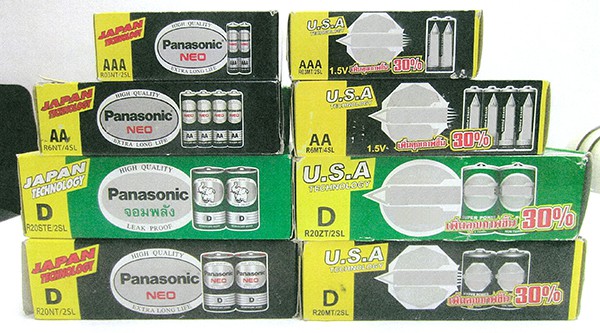
Recently, the Supreme Court rendered a remarkable and highly significant judgment on the grounds of passing off, which should serve as a landmark trademark infringement case in Thailand. Panasonic, the plaintiff, owns various trademark registrations worldwide. Among those registered marks, the most eye-catching mark is the PANASONIC mark itself. Panasonic registered this mark for use with manganese and alkaline batteries in Class 9 in Thailand in 1985. Panasonic exerted huge efforts and much research in designing the unique colors used with its batteries and the labeling on the packaging to let consumers recognize its products immediately as belonging to Panasonic.

Approximately five years ago, a Thai manufacturing company (defendants) was discovered to be manufacturing different types of batteries that were found to be similar to those manufactured by Panasonic under its own trademark. The defendants’ batteries were closely similar to Panasonic’s battery colors and the text was positioned almost identically to Panasonic’s packaging.

After trying unsuccessfully to reach an amicable settlement, Panasonic decided to bring a civil lawsuit against the defendants on the grounds of trademark infringement and passing off.
IP&IT Court Decision   

At the Intellectual Property and International Trade (IP&IT) Court, Panasonic argued that the appearance of its packaging was immediately recognizable among Thai public consumers and distinguishable from the packaging of other battery manufacturers. To support its claim, Panasonic conducted a public survey opinion poll comparing the overall appearances of its packaging and that of other battery manufacturers’ packaging. The survey results revealed that the average consumer readily recognizes Panasonic’s packaging without seeing the PANASONIC mark, and that there is a likelihood of confusion when consumers see the defendant’s packaging. Unfortunately, these survey results were not convincing evidence to the court. Without considering the defendant’s bad faith in imitating the color, size, and word arrangement of its battery packaging, the court instead took into consideration the trademark itself, and therefore considered that the defendant’s batteries were distinguishable when considering pronunciation and overall appearance.    

Panasonic disagreed with the court’s opinion and decided to appeal the case to the Supreme Court, arguing that the IP&IT Court failed to elaborate on the legal point of the defendants’ bad faith, as it was using similar packaging, labeling, and colors to its own product designs and benefiting from Panasonic’s widespread reputation.

The Supreme Court Decision   

The Supreme Court confirmed the IP&IT Court decision with regard to the dissimilarity of the registered marks, when considering pronunciation and the shape of the Roman characters of the marks. However, the Supreme Court disagreed with most other aspects of the IP&IT Court’s reasoning, especially in its failure to determine whether the defendants, by using a similar packaging, label, and product design to that of Panasonic’s, acted in bad faith and thereby infringed Panasonic’s unregistered trademark rights.    

The Supreme Court emphasized the importance of the bad faith intention of the defendants by determining the manner in which the trademark is used on goods and packages. The court found that even though the registered mark in dispute was not confusingly similar to the PANASONIC trademark in either appearance or pronunciation, the court must compare the characteristics of the batteries and the packaging of the defendants with those aspects of Panasonic’s batteries to determine whether the two companies’ products are similar.    

With regard to the color scheme, the Supreme Court took an approach contrary to the IP&IT Court’s reasoning. Even though color is a common feature that anyone can freely use, a certain color combination (e.g., green and silver; black and silver; or red, white, black and yellow), together with the placement of the colors, text, and images, creates a visual design and pattern indicating that Panasonic’s goods are different from others’ goods.   

The Supreme Court further elaborated that the appearance of the defendants’ batteries and packaging, which appear to be closely similar to Panasonic’s, clearly reflect the bad-faith intention of the defendants to use their registered mark with batteries in order to deceive the relevant consumers into believing that the batteries belong to Panasonic. The court held that such tortious conduct can only have the result of causing injury to Panasonic and is thus unlawful.    

The Supreme Court ruled that the defendants must cease using their product designs and packaging designs of similar coloring and patterns to those of Panasonic, and must not pass off their products as those of Panasonic. Moreover, the court awarded Panasonic compensatory damages, together with its attorneys’ fees and court fees.

Conclusion   

The trademark owner’s victory in this case offers a valuable lesson in determining that trademark infringement should not only consider the mark itself but also the manner in which an alleged infringer uses its mark to imitate a brand owner’s unique product designs and packaging, which can now be considered to be unregistered trademarks. This Supreme Court judgment establishes an exemplary guideline for brand owners facing similar issues, whereby brand owners can protect themselves from others imitating their unique product designs and packaging.

RELATED INSIGHTS​ 

November 24, 2021
Attorneys from Tilleke & Gibbins have provided the latest update to the Thailand contribution to Doing Business in…, a Q&A-style guide published by Thomson Reuters Practical Law that presents an overview of the legal framework for doing business in 63 jurisdictions worldwide. The Thailand chapter of the guide outlines Thailand’s legal system and key laws applicable to foreign companies doing business in the country. The chapter specifically covers the following main topics: Legal system: Thailand’s court system and codified legal system. Foreign investment: Lists of reserved business activities, restrictions on doing business with certain jurisdictions, exchange controls and currency regulations, and grants and incentives available to investors. Business vehicles: Ordinary partnerships, registered ordinary partnerships, limited partnerships, private limited companies, and public companies. Environment: Main laws and regulations, factory operation. Employment: Laws, employment contract requirements, work permits, and termination and redundancy. Tax: Taxes on employment, tax and nontax resident employees and businesses, corporate income tax, value added tax, special business tax, municipal tax, stamp duty, dividends, interest, intellectual property royalties. Competition: Important aspects of Thailand’s regulatory regime surrounding competition, centered around the updated Trade Competition Act. Antibribery and corruption: Laws, compliance requirements, regulatory authority. Intellectual property: Patents, trademarks, registered and unregistered designs, and copyright. Marketing agreements and advertising: Regulation of marketing agreements, Thailand’s Consumer Protection Act, direct marketing, role of the Consumer Protection Board and Food and Drug Administration. E-commerce: E-commerce laws and regulations, marketing and sales via online platforms. Data protection: An outline of Thailand’s Personal Data Protection Act. Product liability: Procedures and regulations for product liability and product safety, including the Unsafe Goods Liability Act and the Consumer Case Procedure Act. Product liability: Key regulatory authorities for trade competition, environmental issues, and financial services. To browse, download, or print the Thailand chapter, please visit the Practical Law website.
October 26, 2021
Parallel imports—branded goods imported into a domestic market and sold there without the consent of the intellectual property (IP) owner—pose a unique challenge for IP owners. In contrast to counterfeit goods, parallel imported goods are manufactured by or under the license of the IP owner and formulated or packaged for a particular jurisdiction and then imported into a different jurisdiction without the authorization of the IP owner. Intellectual property laws and perspectives on parallel import vary throughout Southeast Asia. The distinct legal landscape in each nation should be carefully navigated in consultation with legal experts to ensure brand protection to the fullest degree. This guide provides insight into the legal frameworks relating to parallel imports in Cambodia, Indonesia, Laos, Myanmar, Thailand, and Vietnam. Each section examines the relevant laws and regulations that pertain to parallel imports and explores the remedies available to IP owners in each country. Finally, the guide presents some strategies to combat parallel importation and maximize IP protection in Southeast Asia. The full guide can be downloaded through the button below.   This guide was prepared with the assistance of Tilleke & Gibbins interns Christian Pederson and Keoni Williams.
October 26, 2021
Attorneys from Tilleke & Gibbins in Vietnam have written the Vietnam chapter of the newly released Fashion Law 2021, a guide to law surrounding the business of fashion in jurisdictions around the world. The guide covers 18 key jurisdictions for the global fashion industry, offering insights into local legal frameworks surrounding vital issues such as brand enforcement and protection, e-commerce and marketing, and sustainability considerations. The Vietnam chapter of Fashion Law 2021 provides detailed information on the following topics: Trademarks, designs, copyright, and other intellectual property types such as patents and trade secrets. Strategic local contractual arrangements for manufacturing, distributing, and advertising fashion products. Overview and application of online marketing regulations and consumer protection regulations in Vietnam. The most relevant unfair competition rules for fashion businesses, and local courts’ interpretation and enforcement of the rules. ESG (environmental, social, and governance) concerns and sustainability issues for the fashion industry. Customs monitoring and local import and export guards against counterfeit products. The full Vietnam chapter is available for free on the Global Legal Post website, or it can be downloaded as a PDF through the button below. Tilleke & Gibbins also contributed the Thailand chapter to the guide.
October 26, 2021
Attorneys from Tilleke & Gibbins’ Bangkok office have written the Thailand chapter of the newly released Fashion Law 2021, a guide to law surrounding the business of fashion in jurisdictions around the world. The guide covers 18 key jurisdictions for the global fashion industry, offering insights into local legal frameworks surrounding vital issues such as brand enforcement and protection, e-commerce and marketing, and sustainability considerations. The Thailand chapter of Fashion Law 2021 provides detailed information on the following topics: Trademarks, designs, copyright, and other intellectual property types, as well as the main intellectual property legal tools available to protect fashion products in Thailand. Strategic local contractual arrangements for manufacturing, distributing, and advertising fashion products. Overview and application of online marketing regulations and consumer protection regulations in Thailand. The most relevant unfair competition rules for fashion businesses and local courts’ interpretation and enforcement of the rules. ESG (environmental, social, and governance) concerns and sustainability issues for the fashion industry. Customs monitoring and local import and export guards against counterfeit products. Frequently asked questions and common concerns regarding fashion business operations in Thailand. The full Thailand chapter is available for free on the Global Legal Post website, or it can be downloaded as a PDF through the button below. Tilleke & Gibbins also contributed the Vietnam chapter to the guide.