
You are using an outdated browser and your browsing experience will not be optimal. Please update to the latest version of Microsoft Edge, Google Chrome or Mozilla Firefox. Install Microsoft Edge

August 29, 2018

Panasonic Wins Passing Off Case for Packaging and Product Designs

Informed Counsel

Although the Thai Trademark Act provides protection for passing off, filing a lawsuit to defend an IP owner’s unregistered rights can still pose certain challenges. This is especially true where two registered trademarks are different, but the product packaging designs of both marks are confusingly similar. In these circumstances, the court occasionally decides upon a mere comparison of the two marks and may determine that the similarities of their packaging designs are not likely to cause confusion among public consumers due to their dissimilarity.

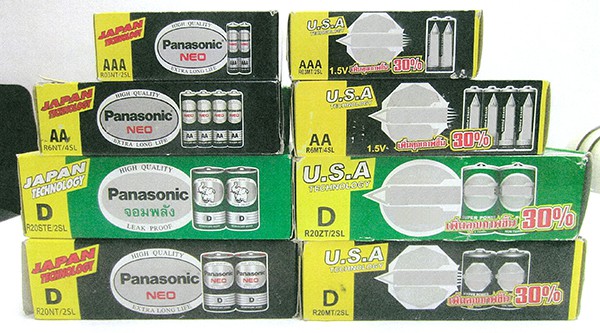
Recently, the Supreme Court rendered a remarkable and highly significant judgment on the grounds of passing off, which should serve as a landmark trademark infringement case in Thailand. Panasonic, the plaintiff, owns various trademark registrations worldwide. Among those registered marks, the most eye-catching mark is the PANASONIC mark itself. Panasonic registered this mark for use with manganese and alkaline batteries in Class 9 in Thailand in 1985. Panasonic exerted huge efforts and much research in designing the unique colors used with its batteries and the labeling on the packaging to let consumers recognize its products immediately as belonging to Panasonic.

Approximately five years ago, a Thai manufacturing company (defendants) was discovered to be manufacturing different types of batteries that were found to be similar to those manufactured by Panasonic under its own trademark. The defendants’ batteries were closely similar to Panasonic’s battery colors and the text was positioned almost identically to Panasonic’s packaging.

After trying unsuccessfully to reach an amicable settlement, Panasonic decided to bring a civil lawsuit against the defendants on the grounds of trademark infringement and passing off.
IP&IT Court Decision   

At the Intellectual Property and International Trade (IP&IT) Court, Panasonic argued that the appearance of its packaging was immediately recognizable among Thai public consumers and distinguishable from the packaging of other battery manufacturers. To support its claim, Panasonic conducted a public survey opinion poll comparing the overall appearances of its packaging and that of other battery manufacturers’ packaging. The survey results revealed that the average consumer readily recognizes Panasonic’s packaging without seeing the PANASONIC mark, and that there is a likelihood of confusion when consumers see the defendant’s packaging. Unfortunately, these survey results were not convincing evidence to the court. Without considering the defendant’s bad faith in imitating the color, size, and word arrangement of its battery packaging, the court instead took into consideration the trademark itself, and therefore considered that the defendant’s batteries were distinguishable when considering pronunciation and overall appearance.    

Panasonic disagreed with the court’s opinion and decided to appeal the case to the Supreme Court, arguing that the IP&IT Court failed to elaborate on the legal point of the defendants’ bad faith, as it was using similar packaging, labeling, and colors to its own product designs and benefiting from Panasonic’s widespread reputation.

The Supreme Court Decision   

The Supreme Court confirmed the IP&IT Court decision with regard to the dissimilarity of the registered marks, when considering pronunciation and the shape of the Roman characters of the marks. However, the Supreme Court disagreed with most other aspects of the IP&IT Court’s reasoning, especially in its failure to determine whether the defendants, by using a similar packaging, label, and product design to that of Panasonic’s, acted in bad faith and thereby infringed Panasonic’s unregistered trademark rights.    

The Supreme Court emphasized the importance of the bad faith intention of the defendants by determining the manner in which the trademark is used on goods and packages. The court found that even though the registered mark in dispute was not confusingly similar to the PANASONIC trademark in either appearance or pronunciation, the court must compare the characteristics of the batteries and the packaging of the defendants with those aspects of Panasonic’s batteries to determine whether the two companies’ products are similar.    

With regard to the color scheme, the Supreme Court took an approach contrary to the IP&IT Court’s reasoning. Even though color is a common feature that anyone can freely use, a certain color combination (e.g., green and silver; black and silver; or red, white, black and yellow), together with the placement of the colors, text, and images, creates a visual design and pattern indicating that Panasonic’s goods are different from others’ goods.   

The Supreme Court further elaborated that the appearance of the defendants’ batteries and packaging, which appear to be closely similar to Panasonic’s, clearly reflect the bad-faith intention of the defendants to use their registered mark with batteries in order to deceive the relevant consumers into believing that the batteries belong to Panasonic. The court held that such tortious conduct can only have the result of causing injury to Panasonic and is thus unlawful.    

The Supreme Court ruled that the defendants must cease using their product designs and packaging designs of similar coloring and patterns to those of Panasonic, and must not pass off their products as those of Panasonic. Moreover, the court awarded Panasonic compensatory damages, together with its attorneys’ fees and court fees.

Conclusion   

The trademark owner’s victory in this case offers a valuable lesson in determining that trademark infringement should not only consider the mark itself but also the manner in which an alleged infringer uses its mark to imitate a brand owner’s unique product designs and packaging, which can now be considered to be unregistered trademarks. This Supreme Court judgment establishes an exemplary guideline for brand owners facing similar issues, whereby brand owners can protect themselves from others imitating their unique product designs and packaging.

RELATED INSIGHTS​ 

October 25, 2021
Michael Ramirez, a counsel in Tilleke & Gibbins’ dispute resolution group in Bangkok, has updated the firm’s contribution to the Global Attorney-Client Privilege Guide, published by Lex Mundi. The newly expanded guide provides information on what constitutes attorney-client privilege in over 70 countries around the world. The Thailand section of the guide contains in-depth information on the function and applications of attorney-client privilege in Thailand (or, as explained in the guide, an equivalent concept enshrined in Thai law), including coverage of the following topics: Privilege in corporations Common interest doctrine Litigation funding Crime-fraud exception Work product doctrine/litigation privilege Other privileges including mediation, accountant-client and settlement negotiation The interactive guide features expert contributions by Lex Mundi member firms from jurisdictions worldwide. Readers can browse the contributions, generate country-specific reports, and compare attorney-client privilege in multiple jurisdictions. For more information, please visit the Lex Mundi website.
October 14, 2021
As part of its membership in Lex Mundi, Tilleke & Gibbins has published an updated edition of its Guide to Doing Business in Thailand for 2021. This guide outlines all of the key factors for starting and operating a business in the Thai market. Issues covered include: Investment incentives Financial facilities Exchange controls Import and export regulations Structures for doing business Requirements for the Establishment of a Business Operation of the Business Cessation or Termination of the Business Labor legislation, relations, and supply Tax Immigration requirements This publication is part of Lex Mundi’s Guides to Doing Business series prepared by member firms in more than 100 jurisdictions worldwide. The guides serve as a useful resource when planning an international business strategy or researching a new market.
August 26, 2021
The Ministry of Health of Vietnam recently issued Circular No. 10/2021/TT-BYT dated June 30, 2021, stipulating the list of substances prohibited from use in the production and trading of health supplements (“Circular 10”). Circular 10 will come into effect on September 1, 2021. Accordingly, substances found on the following lists will be prohibited from use in health supplements: The list of drugs and drug materials prohibited from importation and production found in Annex V of Decree No. 54/2017/ND-CP of the Government dated May 8, 2017, guiding the implementation of Law on Pharmacy (Decree 54). Lists promulgated with Decree No. 73/2018/ND-CP of the Government dated May 15, 2018, stipulating the list of narcotic substances and precursors, including: List I: Narcotic substances banned from use in healthcare and daily life, the use of which for analysis, testing, scientific research, and criminal investigation is subject to permission by competent authorities. List II: Narcotic substances restricted from analysis, testing, scientific research, criminal investigation, or healthcare as regulated by competent authorities. List III: Narcotic substances permitted in analysis, testing, scientific research, criminal investigation, healthcare, and veterinary medicine as regulated by competent authorities. List IVA: Essential precursors involved in forming the structure of narcotic substances. The list of narcotic active ingredients found in Annex I of Circular No. 20/2017/TT-BYT of the Ministry of Health, detailing articles of the Law on Pharmacy and Decree 54 related to drugs and drug materials under special control. The list of toxic drugs and toxic drug materials under Circular No. 06/2017/TT-BYT of the Ministry of Health dated May 3, 2017. Lists under Circular No. 42/2017/TT-BYT of the Ministry of Health dated November 13, 2017, stipulating the lists of toxic herbal materials, including: Annex I: List of toxic herbal materials of plant origin. Annex II: List of toxic herbal materials of
August 26, 2021
In April 2021, the Vietnamese government made public a draft decree to amend Decree No. 43/2017/ND-CP of the Government dated April 14, 2017, on goods labeling (“Decree 43”), which is the primary legislation in Vietnam on the labeling requirements for domestically circulating goods and imported goods. Some noteworthy differences between the draft and the current Decree 43 include the following: 1. Original labels for imported products For imported goods, the draft adds a requirement on compulsory information for original labels, which is not mentioned in Decree 43. In particular, the original product label for goods being imported to circulate on the Vietnam market must contain the following compulsory information in a foreign language or in Vietnamese before customs clearance: Product name; Name and address of the entities responsible for the products; Product origin or place where the final production stage to complete the product was conducted. (If this information is not presented on the original product label, it must be included in the import documents accompanying the product.) 2. Vietnamese labels for imported products Under the draft, if it is impossible to determine the product origin under rules/guidance on determining product origin in Vietnam, it is acceptable to instead indicate on the product label the place(s) where the final production stage to complete the product was conducted. 3. Nutritional information for food Instead of being optional information as mentioned in Decree 43, “nutritional value” is compulsory information on labels for some food products under the draft. The Ministry of Health will have a roadmap for carrying out nutritional labeling and will provide appropriate guidance to manufacturers and importers, as well as issue regulations on types of food that are partially or entirely exempt from declaration of nutritional value. The draft has not yet been finalized and is subject to