
You are using an outdated browser and your browsing experience will not be optimal. Please update to the latest version of Microsoft Edge, Google Chrome or Mozilla Firefox. Install Microsoft Edge

August 29, 2018

A Novel Approach to Evaluating the Similarity of Trademarks in Thailand

Informed Counsel

The Court of Appeal for Specialized Cases (Specialized Appeal Court) was established in October 2016 to review all appeals against the judgments of the five specialized first instance courts in Thailand, including the Central Intellectual Property and International Trade Court (IP&IT Court). Most, if not all, judges of the Specialized Appeal Court, who are responsible for reviewing IP-related appeals, have had experience working as judges at the IP&IT Court and can be expected to be well versed in IP law and practices. They are capable of providing fair, practical, and sometimes novel judgments, as illustrated in a recent case involving how similarity of trademarks should be evaluated.

Opposition of Similar Trademarks

In June 2009, a Thai company filed an application for registration of the trademark MOBIL-AG & Device, Application No. 734360, for use with goods in Class 1, namely chemical fertilizers. This application was subsequently published in a trade gazette in September 2012. As the applicant’s mark is closely similar to the well-known registered trademarks of Exxon Mobil Corporation (“ExxonMobil”), ExxonMobil filed an opposition petition against this application with the Trademark Office in December 2012 under Section 13 of the Trademark Act, among others. The opposition was based on several prior registered trademarks of ExxonMobil, particularly:

  1. Trademark Registration No. Kor. 63198, registered for use with goods in Class 4, including lubricant oil, kerosene, gasoline, diesel; and
  2. Trademark Registration No. Kor. 99756, registered for use with goods in Class 5, including antiseptics in plants and pesticides.

The marks are shown in the table below.
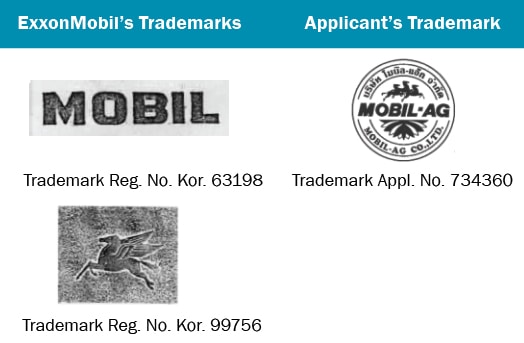
Even though the Trademark Office Registrar found that the applicant’s trademark and ExxonMobil’s trademark MOBIL, Reg. No. Kor. 63198, are similar, the registrar unfortunately dismissed the opposition because it found that both marks are for use with goods in different classes and that the lists of goods were not of the same character.     

ExxonMobil then appealed the decision to the Board of Trademarks, which dismissed the appeal based on the same reasons. ExxonMobil therefore further appealed the decision by filing a lawsuit with the IP&IT Court.

IP&IT Court’s Judgment

In January 2017, after reviewing the evidence and statements of witnesses produced by both parties, the IP&IT Court rendered judgment dismissing the lawsuit. The IP&IT Court found that (1) the appearances and pronunciations of both parties’ marks were different; (2) the classifications of the goods of both parties’ marks were different; and (3) the lists of goods of both parties’ marks were not related. The court therefore ruled that the applicant’s mark was not prohibited from registration under Section 13 of the Trademark Act. Disappointed with the judgment, ExxonMobil instructed Tilleke & Gibbins to appeal the IP&IT Court judgment to the Specialized Appeal Court.

Specialized Appeal Court’s Judgment   

On October 11, 2017, the Specialized Appeal Court rendered judgment finding that the applicant’s Trademark Application No. 734360 is similar enough to ExxonMobil’s Trademark Registration Nos. Kor. 99756 and Kor. 63198 so as to cause confusion among the public.

Even though both parties’ marks are for use with goods of different classes, the lists of goods were found to have the same character. Accordingly, the applicant’s Trademark Application No. 734360 is not registrable under Section 13 of the Trademark Act. The Specialized Appeal Court therefore reversed the judgment of the IP&IT Court and ordered that the prior decisions of the Trademark Registrar and the Board of Trademarks be withdrawn.

It is interesting to note that the Specialized Appeal Court not only addressed the similarity of both parties’ marks, element by element, but also discussed the origin of the word “MOBIL.” Particularly, it stated that this word is not Thai, but foreign. If this foreign word has not been used until it has a comparative meaning in Thai, there would be limitations for general consumers to recognize and remember it. Most importantly, “MOBIL” does not have a meaning in the dictionary and ExxonMobil’s witness confirmed that the word has been used as a trademark since 1906 and has been registered worldwide. It can therefore be concluded that the applicant used the same word as that of ExxonMobil as a part of its trademark.

Moreover, in the appeal, in addition to the similarity issue, ExxonMobil argued that its registered trademarks are well known, and the applicant, who was well aware of ExxonMobil’s well-known mark, applied for registration of a similar mark in bad faith. Even though the Specialized Appeal Court did not discuss or rule on the well-known and bad faith issues, it is obvious that these arguments were taken into consideration when evaluating the similarity between both parties’ marks. 

The ruling has positive implications for future similar cases in Thailand as it implies that, in deciding whether an applicant’s trademark is prohibited from registration under Section 13 of the Trademark Act, the Specialized Appeal Court will take into consideration the fame of the prior registered trademark and the bad faith of the applicant. This approach should help in deterring any bad faith applicant from imitating other parties’ well-known trademarks or applying for registration of such imitation trademarks.

RELATED INSIGHTS​ 

June 16, 2026
Since the implementation of the Trademark Law 2019 on April 1, 2023, Myanmar has operated under a modern first-to-file trademark system that brings its registration framework closer to international practice. As the new regime continues to develop in practice, applicants are increasingly required to navigate formal examination requirements, substantive objections, and procedural deadlines with greater precision. This article provides a high-level review of the trademark examination process in Myanmar, focusing on the principal stages from initial review to approval, the types of objections commonly raised by the Intellectual Property Department (IPD), and the key considerations for responding effectively. A clear understanding of these issues is essential for applicants seeking to secure registration efficiently and to mitigate avoidable delays or refusals. Examination Process: Key Stages Trademark applications filed with the IPD undergo two stages of review. Formality Examination The IPD first verifies compliance with procedural requirements, including: Correct Nice Classification Clear mark representation Accurate applicant details Clearly defined goods or services Representative details, if the application is filed by a representative Other formality requirements cover translation and transliteration of any non-English or non-Myanmar elements in the mark, color claim details, applicable disclaimers, and payment of official fees. Deficiencies result in an office action requiring correction within 30 days, which may be extended upon request. Registrability Examination The IPD also assesses registrability. A mark may be refused if it: Lacks distinctiveness Is descriptive or generic Misleads the public or violates public order/morality Contains prohibited state symbols Only compliant applications proceed to publication. Responding to Office Actions Applicants must respond within 30 days of notification from the IPD. Depending on the nature of the objection, strategies may include submitting legal arguments for distinctiveness, providing evidence of acquired distinctiveness, filing appropriate disclaimers, clarifying descriptions such as color claims, or amending the listed goods
June 15, 2026
The surge in AI development has led to a desperate demand for large, high-quality training data. However, real-world data can be expensive to collect, difficult to access, and often subject to strict privacy and regulatory constraints. Synthetic data, which consists of artificially generated records that replicate the statistical properties of real-world data without reproducing specific individuals’ information, provides an appealing solution by generating artificial datasets at scale without relying on identifiable personal information. It combines speed, cost efficiency, and regulatory compliance, making it a sensible alternative for organizations seeking to reduce risks while maintaining data utility. When properly anonymized, synthetic datasets may fall outside the scope of laws such as the EU’s General Data Protection Regulation (GDPR) or Thailand’s Personal Data Protection Act (PDPA), reducing compliance burdens while still supporting high-quality model training. However, relying on synthetic data without rigorous legal due diligence could be a strategic mistake. It replaces one set of known risks (scraping, direct privacy liability) with a new set of complex liabilities. The narrative that synthetic data is a “silver bullet” for privacy and IP compliance is dangerous and could be misleading. While synthetic data addresses data scarcity, it also introduces new legal uncertainties. Legal counsel should anticipate downstream risks arising from compromised data sources. Models trained on unlawfully obtained data may need to be decommissioned, even if their outputs appear lawful. What is synthetic data? Synthetic data refers to artificially generated information created using AI techniques such as deep learning and generative models. Instead of copying real records, it reproduces the statistical patterns and relationships found in the original dataset. Synthetic data generally falls into three categories: Fully synthetic data – Entirely new data points generated from learned patterns. The model studies the structure of the original data and produces records that resemble real-world
June 10, 2026
In March 2026, the Intellectual Property Office of Vietnam (IP Office) issued a decision refusing a trademark application after considering an opposition based primarily on copyright grounds. The outcome is noteworthy because the foreign brand owner had neither trademark registrations nor applications in Vietnam at the time the opposition was filed, and the IP Office has historically applied a stringent approach to oppositions relying on copyright. The Opposition Maurten is a well-known Swedish sports nutrition brand recognized globally for its innovative hydrogel technology, which is designed to help endurance athletes fuel more effectively without gastrointestinal discomfort. The brand’s distinctive logo is characterized by clean lines and a bold black-and-white color scheme, and has long been associated with the company’s performance products. The brand’s logo is displayed above. An identical mark was filed for registration by a Vietnamese trademark squatter. In 2023, a Vietnamese individual filed an application for registration of an identical mark (Application No. 4-2023-38668), a practice commonly observed in Vietnam as trademark squatting. The brand owner engaged Tilleke & Gibbins to assist with strategy and filing an opposition to the mark. At the time, Maurten had no trademark rights or meaningful use in Vietnam, and global marketing data showed only modest figures without any local presence. Thus, to convince the IP Office to refuse the squatter’s application, instead of relying on trademark rights or use evidence, the opposition strategy centered on the copyright protection of the logo itself, as copyright arises automatically in Vietnam upon creation of the work and does not require registration. (It is worth noting, however, that the IP Office has traditionally been cautious in accepting copyright as a basis for refusing trademark applications.) On September 24, 2024, an opposition was filed on three main grounds: confusing similarity, copyright infringement of the artistic work,
June 10, 2026
For multinational franchisors operating in Thailand, a key risk after franchise termination is that former outlets may continue operating in ways that could easily mislead consumers into believing they remain within the authorized network. To justify such operations, former franchisees often argue that the termination was invalid or ineffective. As a result, these cases are often treated as contractual disputes, making it difficult for franchisors to obtain injunctive relief before a final judgment confirms that the termination was lawful. Franchisors face significant commercial and reputational harm during lengthy proceedings, including consumer confusion, disruption to franchise restructuring, and damage to brand reputation and customer trust. In an encouraging development, the Thai court in a 2025 case responded to the problem of unauthorized post-termination franchise operations by granting interim relief, recognizing broader brand and consumer harm, and awarding substantial damages, highlighting a successful litigation strategy of framing the dispute not merely as a contractual termination issue but as trademark infringement causing ongoing commercial injury. The Subway Case From December 2024 to mid-2025, an unauthorized “Subway®” franchise operation in Thailand attracted substantial public and media attention. Reports and online discussions about unauthorized Subway® stores circulated widely after complaints arose about food quality and customer experience at certain outlets that were allegedly operating after their franchise rights had expired. Because these stores continued to use Subway® trademarks, trade dress, and overall commercial appearance, many consumers were unable to distinguish them from authorized operations, resulting in reputational risks and customer confusion that affected the franchisor’s brand and franchise system in Thailand. Subway treated this matter with the utmost seriousness and moved promptly to protect its brand, franchise system, and customers. It filed a civil action with the IP&IT Court seeking a permanent injunction and damages. During the proceedings, the court granted a preliminary injunction