
You are using an outdated browser and your browsing experience will not be optimal. Please update to the latest version of Microsoft Edge, Google Chrome or Mozilla Firefox. Install Microsoft Edge

August 29, 2018

A Novel Approach to Evaluating the Similarity of Trademarks in Thailand

Informed Counsel

The Court of Appeal for Specialized Cases (Specialized Appeal Court) was established in October 2016 to review all appeals against the judgments of the five specialized first instance courts in Thailand, including the Central Intellectual Property and International Trade Court (IP&IT Court). Most, if not all, judges of the Specialized Appeal Court, who are responsible for reviewing IP-related appeals, have had experience working as judges at the IP&IT Court and can be expected to be well versed in IP law and practices. They are capable of providing fair, practical, and sometimes novel judgments, as illustrated in a recent case involving how similarity of trademarks should be evaluated.

Opposition of Similar Trademarks

In June 2009, a Thai company filed an application for registration of the trademark MOBIL-AG & Device, Application No. 734360, for use with goods in Class 1, namely chemical fertilizers. This application was subsequently published in a trade gazette in September 2012. As the applicant’s mark is closely similar to the well-known registered trademarks of Exxon Mobil Corporation (“ExxonMobil”), ExxonMobil filed an opposition petition against this application with the Trademark Office in December 2012 under Section 13 of the Trademark Act, among others. The opposition was based on several prior registered trademarks of ExxonMobil, particularly:

  1. Trademark Registration No. Kor. 63198, registered for use with goods in Class 4, including lubricant oil, kerosene, gasoline, diesel; and
  2. Trademark Registration No. Kor. 99756, registered for use with goods in Class 5, including antiseptics in plants and pesticides.

The marks are shown in the table below.
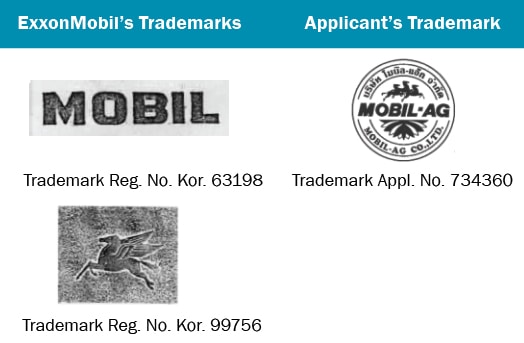
Even though the Trademark Office Registrar found that the applicant’s trademark and ExxonMobil’s trademark MOBIL, Reg. No. Kor. 63198, are similar, the registrar unfortunately dismissed the opposition because it found that both marks are for use with goods in different classes and that the lists of goods were not of the same character.     

ExxonMobil then appealed the decision to the Board of Trademarks, which dismissed the appeal based on the same reasons. ExxonMobil therefore further appealed the decision by filing a lawsuit with the IP&IT Court.

IP&IT Court’s Judgment

In January 2017, after reviewing the evidence and statements of witnesses produced by both parties, the IP&IT Court rendered judgment dismissing the lawsuit. The IP&IT Court found that (1) the appearances and pronunciations of both parties’ marks were different; (2) the classifications of the goods of both parties’ marks were different; and (3) the lists of goods of both parties’ marks were not related. The court therefore ruled that the applicant’s mark was not prohibited from registration under Section 13 of the Trademark Act. Disappointed with the judgment, ExxonMobil instructed Tilleke & Gibbins to appeal the IP&IT Court judgment to the Specialized Appeal Court.

Specialized Appeal Court’s Judgment   

On October 11, 2017, the Specialized Appeal Court rendered judgment finding that the applicant’s Trademark Application No. 734360 is similar enough to ExxonMobil’s Trademark Registration Nos. Kor. 99756 and Kor. 63198 so as to cause confusion among the public.

Even though both parties’ marks are for use with goods of different classes, the lists of goods were found to have the same character. Accordingly, the applicant’s Trademark Application No. 734360 is not registrable under Section 13 of the Trademark Act. The Specialized Appeal Court therefore reversed the judgment of the IP&IT Court and ordered that the prior decisions of the Trademark Registrar and the Board of Trademarks be withdrawn.

It is interesting to note that the Specialized Appeal Court not only addressed the similarity of both parties’ marks, element by element, but also discussed the origin of the word “MOBIL.” Particularly, it stated that this word is not Thai, but foreign. If this foreign word has not been used until it has a comparative meaning in Thai, there would be limitations for general consumers to recognize and remember it. Most importantly, “MOBIL” does not have a meaning in the dictionary and ExxonMobil’s witness confirmed that the word has been used as a trademark since 1906 and has been registered worldwide. It can therefore be concluded that the applicant used the same word as that of ExxonMobil as a part of its trademark.

Moreover, in the appeal, in addition to the similarity issue, ExxonMobil argued that its registered trademarks are well known, and the applicant, who was well aware of ExxonMobil’s well-known mark, applied for registration of a similar mark in bad faith. Even though the Specialized Appeal Court did not discuss or rule on the well-known and bad faith issues, it is obvious that these arguments were taken into consideration when evaluating the similarity between both parties’ marks. 

The ruling has positive implications for future similar cases in Thailand as it implies that, in deciding whether an applicant’s trademark is prohibited from registration under Section 13 of the Trademark Act, the Specialized Appeal Court will take into consideration the fame of the prior registered trademark and the bad faith of the applicant. This approach should help in deterring any bad faith applicant from imitating other parties’ well-known trademarks or applying for registration of such imitation trademarks.

RELATED INSIGHTS​ 

June 10, 2026
For multinational franchisors operating in Thailand, a key risk after franchise termination is that former outlets may continue operating in ways that could easily mislead consumers into believing they remain within the authorized network. To justify such operations, former franchisees often argue that the termination was invalid or ineffective. As a result, these cases are often treated as contractual disputes, making it difficult for franchisors to obtain injunctive relief before a final judgment confirms that the termination was lawful. Franchisors face significant commercial and reputational harm during lengthy proceedings, including consumer confusion, disruption to franchise restructuring, and damage to brand reputation and customer trust. In an encouraging development, the Thai court in a 2025 case responded to the problem of unauthorized post-termination franchise operations by granting interim relief, recognizing broader brand and consumer harm, and awarding substantial damages, highlighting a successful litigation strategy of framing the dispute not merely as a contractual termination issue but as trademark infringement causing ongoing commercial injury. The Subway Case From December 2024 to mid-2025, an unauthorized “Subway®” franchise operation in Thailand attracted substantial public and media attention. Reports and online discussions about unauthorized Subway® stores circulated widely after complaints arose about food quality and customer experience at certain outlets that were allegedly operating after their franchise rights had expired. Because these stores continued to use Subway® trademarks, trade dress, and overall commercial appearance, many consumers were unable to distinguish them from authorized operations, resulting in reputational risks and customer confusion that affected the franchisor’s brand and franchise system in Thailand. Subway treated this matter with the utmost seriousness and moved promptly to protect its brand, franchise system, and customers. It filed a civil action with the IP&IT Court seeking a permanent injunction and damages. During the proceedings, the court granted a preliminary injunction
May 25, 2026
Thailand published new rules on May 1, 2026, establishing clear procedures for how the Anti-Money Laundering Office (AMLO) handles digital assets seized during criminal and money laundering investigations. Taking effect the following day, the Regulation of the Anti-Money Laundering Board on the Custody and Management of Seized or Frozen Assets (No. 3) B.E. 2569 applies to digital asset businesses, cryptocurrency holders, and anyone subject to asset seizure under Thailand’s anti-money laundering laws. For the first time, authorities now have a detailed roadmap for transferring seized digital property from private or foreign control into secure state custody. Digital asset businesses holding customer assets under investigation must be prepared to comply with these rules compelling repatriation of such assets in enforcement actions. Expanded Definition of Digital Assets The regulation defines digital assets to include not only those covered by Thailand’s existing digital asset business law but also any other property that can be stored using the same methods as digital assets. This broad formulation means the custody rules will apply to emerging blockchain-based assets and tokenized property that may not yet fall within the statutory definition of a digital asset business, giving authorities flexibility as the technology evolves. Mandatory Transfer to Domestic Custody When digital assets are held with service providers outside Thailand, AMLO will first attempt to transfer them to an account the office maintains with a licensed domestic digital asset business operator. If the domestic operator does not support that particular asset, the office will instead move the assets to its own cold wallet (offline, internet-isolated storage system). If neither option is feasible, the seizing official will report the situation to the Anti-Money Laundering Committee for alternative instructions. A similar hierarchy governs assets held in an accused party’s private wallet or by any third party that is not a
May 22, 2026
Intellectual property specialists from Tilleke & Gibbins in Vietnam have contributed an updated Intellectual Property Transactions in Vietnam overview for Thomson Reuters Practical Law, an online publication that provides comprehensive legal guides for jurisdictions worldwide. The Vietnam overview was authored by Linh Thi Mai Nguyen, Thanh Phuong Vu, Chi Lan Dang, Son Thai Hoang, and Duc Anh Tran. The chapter provides a high-level examination of key aspects of IP transactions law in Vietnam, including IP assignment and licensing, research and development collaborations, IP in mergers and acquisitions (M&A), lending and taking security over intellectual property rights, settlement agreements, employee- and consultant-created IP, competition law, taxation, and non-tariff trade barriers. Key topics covered in the chapter include: IP assignment: Basis and formalities for assignments of patents, utility models, trade marks, copyright, design rights, trade secrets, confidential information, and domain names in Vietnam. IP licensing: Scope, formalities, and recordal requirements for licensing patents, trade marks, copyright, design rights, and trade secrets. Research and development collaborations: Treatment of improvements, derivatives, and joint ownership of IP, including exploitation and enforcement issues. IP aspects of M&A and security: Due diligence, warranties, transfer formalities, and taking security over intellectual property rights. Practical Law, a legal reference resource from Thomson Reuters, publishes a range of guides for hundreds of jurisdictions and practice areas. The Intellectual Property Transactions Global Guide is a valuable resource for legal practitioners seeking comparative insight into transactional IP issues across multiple jurisdictions. To view the latest version of the Intellectual Property Transactions in Vietnam overview, please visit the Practical Law website and enroll in the free Practical Law trial to gain full access.
May 13, 2026
Laos has significantly broadened its industrial property administrative review framework, most notably by extending it to cover copyright and related rights for the first time. Decision No. 0306/IC on the Administrative Resolution of Disputes Concerning Industrial Property Registration, New Plant Variety Registration, and Copyright and Related Rights Recordation took effect on April 24, 2026, replacing the previous rules from 2023, which had covered only industrial property and new plant variety matters. Decision No. 0306/IC governs how Laos’ Department of Intellectual Property (DIP) and provincial offices handle formal challenges to industrial property registrations and applications. The proceedings covered include oppositions to pending applications, appeals of refused applications, requests for cancellation of existing registrations, and—newly—disputes concerning the recordation and interpretation of copyright and related rights. These administrative proceedings within the DIP are heard by a government-appointed Administrative Dispute Resolution Committee, which functions similarly to the opposition and review boards found in other jurisdictions. Key Changes Decision No. 0306/IC covers four categories of administrative proceedings: Oppositions: Third-party challenges to a pending industrial property application before it is granted. Refusal appeals: Challenges to the DIP’s decision to refuse their application. Cancellation or deletion requests: Applications to invalidate an existing registered right on the grounds that it should not have been granted. Copyright and related rights disputes: Challenges to or interpretations of copyright and related rights recordations, including determinations of whether a work qualifies for copyright protection under Lao law. The most significant development is the committee’s new jurisdiction over copyright matters. The committee is now empowered to resolve disputes concerning copyright and related rights recordation—this includes the authority to determine whether a work qualifies for copyright protection and to interpret the scope of an existing recordation. Parties who believe a competitor has improperly recorded copyright over a work, or who wish to contest