
You are using an outdated browser and your browsing experience will not be optimal. Please update to the latest version of Microsoft Edge, Google Chrome or Mozilla Firefox. Install Microsoft Edge

August 29, 2018

A Novel Approach to Evaluating the Similarity of Trademarks in Thailand

Informed Counsel

The Court of Appeal for Specialized Cases (Specialized Appeal Court) was established in October 2016 to review all appeals against the judgments of the five specialized first instance courts in Thailand, including the Central Intellectual Property and International Trade Court (IP&IT Court). Most, if not all, judges of the Specialized Appeal Court, who are responsible for reviewing IP-related appeals, have had experience working as judges at the IP&IT Court and can be expected to be well versed in IP law and practices. They are capable of providing fair, practical, and sometimes novel judgments, as illustrated in a recent case involving how similarity of trademarks should be evaluated.

Opposition of Similar Trademarks

In June 2009, a Thai company filed an application for registration of the trademark MOBIL-AG & Device, Application No. 734360, for use with goods in Class 1, namely chemical fertilizers. This application was subsequently published in a trade gazette in September 2012. As the applicant’s mark is closely similar to the well-known registered trademarks of Exxon Mobil Corporation (“ExxonMobil”), ExxonMobil filed an opposition petition against this application with the Trademark Office in December 2012 under Section 13 of the Trademark Act, among others. The opposition was based on several prior registered trademarks of ExxonMobil, particularly:

  1. Trademark Registration No. Kor. 63198, registered for use with goods in Class 4, including lubricant oil, kerosene, gasoline, diesel; and
  2. Trademark Registration No. Kor. 99756, registered for use with goods in Class 5, including antiseptics in plants and pesticides.

The marks are shown in the table below.
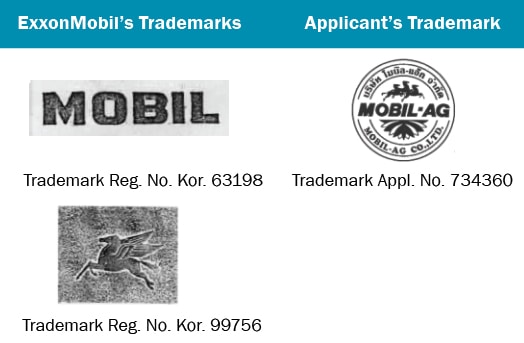
Even though the Trademark Office Registrar found that the applicant’s trademark and ExxonMobil’s trademark MOBIL, Reg. No. Kor. 63198, are similar, the registrar unfortunately dismissed the opposition because it found that both marks are for use with goods in different classes and that the lists of goods were not of the same character.     

ExxonMobil then appealed the decision to the Board of Trademarks, which dismissed the appeal based on the same reasons. ExxonMobil therefore further appealed the decision by filing a lawsuit with the IP&IT Court.

IP&IT Court’s Judgment

In January 2017, after reviewing the evidence and statements of witnesses produced by both parties, the IP&IT Court rendered judgment dismissing the lawsuit. The IP&IT Court found that (1) the appearances and pronunciations of both parties’ marks were different; (2) the classifications of the goods of both parties’ marks were different; and (3) the lists of goods of both parties’ marks were not related. The court therefore ruled that the applicant’s mark was not prohibited from registration under Section 13 of the Trademark Act. Disappointed with the judgment, ExxonMobil instructed Tilleke & Gibbins to appeal the IP&IT Court judgment to the Specialized Appeal Court.

Specialized Appeal Court’s Judgment   

On October 11, 2017, the Specialized Appeal Court rendered judgment finding that the applicant’s Trademark Application No. 734360 is similar enough to ExxonMobil’s Trademark Registration Nos. Kor. 99756 and Kor. 63198 so as to cause confusion among the public.

Even though both parties’ marks are for use with goods of different classes, the lists of goods were found to have the same character. Accordingly, the applicant’s Trademark Application No. 734360 is not registrable under Section 13 of the Trademark Act. The Specialized Appeal Court therefore reversed the judgment of the IP&IT Court and ordered that the prior decisions of the Trademark Registrar and the Board of Trademarks be withdrawn.

It is interesting to note that the Specialized Appeal Court not only addressed the similarity of both parties’ marks, element by element, but also discussed the origin of the word “MOBIL.” Particularly, it stated that this word is not Thai, but foreign. If this foreign word has not been used until it has a comparative meaning in Thai, there would be limitations for general consumers to recognize and remember it. Most importantly, “MOBIL” does not have a meaning in the dictionary and ExxonMobil’s witness confirmed that the word has been used as a trademark since 1906 and has been registered worldwide. It can therefore be concluded that the applicant used the same word as that of ExxonMobil as a part of its trademark.

Moreover, in the appeal, in addition to the similarity issue, ExxonMobil argued that its registered trademarks are well known, and the applicant, who was well aware of ExxonMobil’s well-known mark, applied for registration of a similar mark in bad faith. Even though the Specialized Appeal Court did not discuss or rule on the well-known and bad faith issues, it is obvious that these arguments were taken into consideration when evaluating the similarity between both parties’ marks. 

The ruling has positive implications for future similar cases in Thailand as it implies that, in deciding whether an applicant’s trademark is prohibited from registration under Section 13 of the Trademark Act, the Specialized Appeal Court will take into consideration the fame of the prior registered trademark and the bad faith of the applicant. This approach should help in deterring any bad faith applicant from imitating other parties’ well-known trademarks or applying for registration of such imitation trademarks.

RELATED INSIGHTS​ 

February 3, 2026
Thailand’s alternative dispute resolution (ADR) landscape has evolved significantly over the past decade. Legislative reforms such as the Dispute Mediation Act and expanded court‑annexed mediation have strengthened non‑litigious options, while institutional choices have broadened. Parties can now choose between the Thai Arbitration Institute (TAI), the Thailand Arbitration Center (THAC), and a growing number of sector‑specific dispute forums. For businesses, these choices matter. Each forum has different rules, administration, costs, speed, and enforcement mechanisms. These factors can directly impact commercial leverage, recovery outcomes, and business continuity. Choosing the right forum and drafting an effective dispute resolution clause can materially influence how a dispute is resolved. This article outlines the practical differences between Thailand’s leading alternative dispute resolution forums, explains when each is likely to deliver the most value, and offers drafting and strategy tips to embed those advantages into your dispute resolution clauses. Why ADR Is Gaining Traction in Thailand Thai policy increasingly supports the resolution of civil and commercial disputes through ADR. Recent amendments to the Civil Procedure Code now provide for court-supervised pre-action and in-case mediation. This type of mediation has its advantages: it suspends limitation periods, involves no court fees, and can conclude with a consent judgment that is immediately enforceable and subject to only limited grounds of appeal. In parallel, the Mediation Act supports out‑of‑court mediation for qualifying disputes within defined subject‑matter and monetary thresholds. Valid settlement agreements reached under this law may be enforced through a streamlined court process. Thailand’s arbitration framework has also matured into a reliable, pro‑enforcement framework under the Arbitration Act, which closely follows the UNCITRAL Model Law and applies to both domestic and international cases, so cross‑border users see familiar rules. As Thailand is a signatory to the New York Convention, Thai courts generally recognize and enforce foreign awards subject only
January 30, 2026
On December 26, 2025, the government of Vietnam promulgated Decree No. 341/2025/ND-CP on administrative sanctions for violations of copyright and related rights (Decree 341), with an effective date of February 15, 2026. The new decree replaces Decree No. 131/2013/ND-CP, as amended, and represents the first comprehensive revision of the administrative enforcement framework in this area in eight years. Legislative Context and Objectives Decree 341 reflects Vietnam’s evolving copyright and related-rights framework, particularly in light of the country’s commitments under bilateral, regional, and multilateral treaties governing the digital environment. While the decree retains a number of provisions from the previous regime, it also introduces significant amendments to infringing acts, penalty thresholds, remedial measures, and enforcement procedures. The primary objectives of the new decree are to (i) enhance the deterrent effect of administrative sanctions; (ii) harmonize sanctions with the 2025 amendments to the Law on Intellectual Property and criminal law principles; and (iii) address enforcement challenges arising from online and cross-border exploitation of copyrighted works. Expanded Scope of Sanctionable Subjects Under Decree 341, administrative sanctions apply not only to Vietnamese entities committing infringing acts within Vietnam, but also to Vietnamese and foreign entities that commit acts of infringement on the internet where the protected content is accessed, consumed, or exploited by users in Vietnam. This expansion reflects the realities of cross-border digital exploitation. However, the decree does not yet provide precise definitions of key terms such as “users” or “consumers” of digital content in Vietnam, which may require further regulatory clarification. Monetary Penalties and Penalty Structure The statutory maximum fines remain unchanged, at VND 250 million for individuals and VND 500 million for organizations, but the penalty framework is substantially restructured. Fines are now calibrated based on three core criteria: (i) the amount of illegal profit obtained; (ii) the level of
January 30, 2026
Vietnam’s Intellectual Property (IP) Law, despite being amended in 2022, underwent another significant revision at the end of 2025. The latest amendment aimed to address five major policy objectives set by the Vietnamese government, including promoting innovation, digital transformation, and international integration. Among the most notable changes in the 2025 IP Law, which takes effect on 1 April 2026, is the expansion of industrial design protection under Article 4.13. The revised definition now includes partial designs and intangible designs, marking a transformative shift in Vietnam’s industrial design regime. This change has particularly significant implications on designs classified under Class 32 of the Locarno Classification—which covers graphic designs, logos, ornamentation, surface patterns, arrangements, and other intangible products. These designs, previously excluded from protection in Vietnam, are now recognized under the new legal framework. Background: Status of Class 32 Designs Before 2026 Th Intellectual Property Office of Vietnam currently applies the 13th edition of the Locarno Classification for industrial design filings. However, not all classes in this system have historically been eligible for protection. Under the 2022 IP Law, Class 32 designs were explicitly excluded based on the following legal grounds: Definition under Article 4.13 (2022 IP Law): “An industrial design is the external appearance of a product or a component for assembly into a complex product, expressed in shapes, lines, colors, or a combination thereof, and visible during the exploitation of the product’s utility or the complex product.” Product requirements under Article 21.2 of Circular 23/2023/TT-BKHCN: A product is defined as an object, a tool, a device, or means, manufactured by industrial or handicraft methods, with clear structure and function. A component for assembly into a complex product must be capable of independent circulation and detachable from the complex product. Based on these definitions, Class 32 designs, such as graphical
January 29, 2026
Following the recent enactment of a comprehensive legal framework addressing sexual harassment, Thailand has launched a fast-track judicial process enabling victims of online sexual harassment to obtain court orders suspending and removing obscene content from the internet. On January 26, 2026, the Office of the Judiciary introduced the “Take It Down” procedure through the Court Integral Online Service (CIOS) platform, providing victims with their first direct, expedited pathway to halt the spread of online content that violates the new legal provisions against sexual harassment. This new remedy stems from section 284/4 of the Penal Code, introduced through the Act Amending the Penal Code (No. 30) B.E. 2568, which took effect on December 30, 2025. Under section 284/4, an injured person or a competent official may petition the court to suspend dissemination of violating data and remove the data from computer systems within a court-specified period. The court may also direct system controllers, service providers, or competent authorities to carry out the order and report back within 15 days. Filing through the CIOS Platform The CIOS platform serves as the primary electronic channel for these petitions. Key features include: Individuals can file online without appearing in person and may submit petitions at any time the system is available. Users must complete digital identity verification via the ThaID application to access the CIOS. Petitions under section 284/4 are limited to requests to suspend or remove violating content. Claims for monetary damages must be pursued separately, including via separate proceedings or prefiling mediation. Streamlined Review Process The submission workflow is end-to-end electronic, and the system provides step-by-step guidance. After submission, court staff review the petition before presenting it to a judge for consideration. The court may conduct an online inquiry to obtain additional information, and in-person attendance is required only if deemed