
You are using an outdated browser and your browsing experience will not be optimal. Please update to the latest version of Microsoft Edge, Google Chrome or Mozilla Firefox. Install Microsoft Edge

August 29, 2018

A Novel Approach to Evaluating the Similarity of Trademarks in Thailand

Informed Counsel

The Court of Appeal for Specialized Cases (Specialized Appeal Court) was established in October 2016 to review all appeals against the judgments of the five specialized first instance courts in Thailand, including the Central Intellectual Property and International Trade Court (IP&IT Court). Most, if not all, judges of the Specialized Appeal Court, who are responsible for reviewing IP-related appeals, have had experience working as judges at the IP&IT Court and can be expected to be well versed in IP law and practices. They are capable of providing fair, practical, and sometimes novel judgments, as illustrated in a recent case involving how similarity of trademarks should be evaluated.

Opposition of Similar Trademarks

In June 2009, a Thai company filed an application for registration of the trademark MOBIL-AG & Device, Application No. 734360, for use with goods in Class 1, namely chemical fertilizers. This application was subsequently published in a trade gazette in September 2012. As the applicant’s mark is closely similar to the well-known registered trademarks of Exxon Mobil Corporation (“ExxonMobil”), ExxonMobil filed an opposition petition against this application with the Trademark Office in December 2012 under Section 13 of the Trademark Act, among others. The opposition was based on several prior registered trademarks of ExxonMobil, particularly:

  1. Trademark Registration No. Kor. 63198, registered for use with goods in Class 4, including lubricant oil, kerosene, gasoline, diesel; and
  2. Trademark Registration No. Kor. 99756, registered for use with goods in Class 5, including antiseptics in plants and pesticides.

The marks are shown in the table below.
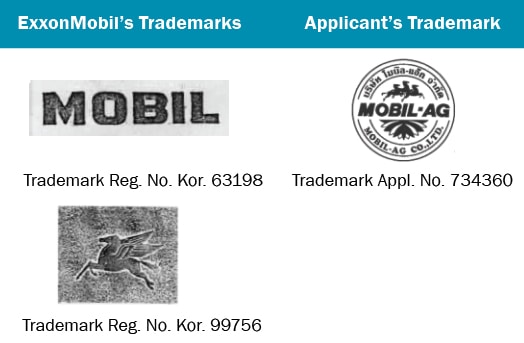
Even though the Trademark Office Registrar found that the applicant’s trademark and ExxonMobil’s trademark MOBIL, Reg. No. Kor. 63198, are similar, the registrar unfortunately dismissed the opposition because it found that both marks are for use with goods in different classes and that the lists of goods were not of the same character.     

ExxonMobil then appealed the decision to the Board of Trademarks, which dismissed the appeal based on the same reasons. ExxonMobil therefore further appealed the decision by filing a lawsuit with the IP&IT Court.

IP&IT Court’s Judgment

In January 2017, after reviewing the evidence and statements of witnesses produced by both parties, the IP&IT Court rendered judgment dismissing the lawsuit. The IP&IT Court found that (1) the appearances and pronunciations of both parties’ marks were different; (2) the classifications of the goods of both parties’ marks were different; and (3) the lists of goods of both parties’ marks were not related. The court therefore ruled that the applicant’s mark was not prohibited from registration under Section 13 of the Trademark Act. Disappointed with the judgment, ExxonMobil instructed Tilleke & Gibbins to appeal the IP&IT Court judgment to the Specialized Appeal Court.

Specialized Appeal Court’s Judgment   

On October 11, 2017, the Specialized Appeal Court rendered judgment finding that the applicant’s Trademark Application No. 734360 is similar enough to ExxonMobil’s Trademark Registration Nos. Kor. 99756 and Kor. 63198 so as to cause confusion among the public.

Even though both parties’ marks are for use with goods of different classes, the lists of goods were found to have the same character. Accordingly, the applicant’s Trademark Application No. 734360 is not registrable under Section 13 of the Trademark Act. The Specialized Appeal Court therefore reversed the judgment of the IP&IT Court and ordered that the prior decisions of the Trademark Registrar and the Board of Trademarks be withdrawn.

It is interesting to note that the Specialized Appeal Court not only addressed the similarity of both parties’ marks, element by element, but also discussed the origin of the word “MOBIL.” Particularly, it stated that this word is not Thai, but foreign. If this foreign word has not been used until it has a comparative meaning in Thai, there would be limitations for general consumers to recognize and remember it. Most importantly, “MOBIL” does not have a meaning in the dictionary and ExxonMobil’s witness confirmed that the word has been used as a trademark since 1906 and has been registered worldwide. It can therefore be concluded that the applicant used the same word as that of ExxonMobil as a part of its trademark.

Moreover, in the appeal, in addition to the similarity issue, ExxonMobil argued that its registered trademarks are well known, and the applicant, who was well aware of ExxonMobil’s well-known mark, applied for registration of a similar mark in bad faith. Even though the Specialized Appeal Court did not discuss or rule on the well-known and bad faith issues, it is obvious that these arguments were taken into consideration when evaluating the similarity between both parties’ marks. 

The ruling has positive implications for future similar cases in Thailand as it implies that, in deciding whether an applicant’s trademark is prohibited from registration under Section 13 of the Trademark Act, the Specialized Appeal Court will take into consideration the fame of the prior registered trademark and the bad faith of the applicant. This approach should help in deterring any bad faith applicant from imitating other parties’ well-known trademarks or applying for registration of such imitation trademarks.

RELATED INSIGHTS​ 

January 20, 2026
Arbitrations seated in Thailand are governed principally by the Arbitration Act B.E. 2545 (2002) and, where applicable, the rules of institutions such as the Thailand Arbitration Center (THAC) and the Thai Arbitration Institute (TAI). While these instruments set the core procedural structure, they are not comprehensive. To fill in these procedural gaps, arbitral tribunals often look to the Thai Civil Procedure Code (CPC) and apply its principles when the Arbitration Act or institutional rules are silent. This hybrid system is familiar to local practitioners but can surprise international parties who expect a more self-contained arbitral procedure. Examples of How CPC Principles Are Applied Evidence Management: Section 25 of the Arbitration Act requires equal treatment of the parties and guarantees each side a full opportunity to present its case. At the same time, it grants tribunals broad discretion to conduct proceedings “as it deems appropriate” and expressly suggests that arbitrators may apply the CPC evidence rules where appropriate. In practice, tribunals frequently apply CPC evidence rules when addressing: submission of evidence lists, late or additional evidence, questions of admissibility and relevance, and assessment of witness and expert testimony. Amendments to Pleadings: Because the Arbitration Act and institutional rules provide limited guidance on amending pleadings, tribunals often rely on CPC principles when parties seek to amend a statement of claim or defense. Amendments may be permitted if they are sought in a timely manner, do not unfairly prejudice the opposing party, do not cause undue delay, and do not alter the nature of the dispute. These conditions closely mirror the standards applied by Thai courts under the CPC. Subpoenas and Court Assistance: Arbitral tribunals seated in Thailand generally do not have inherent subpoena powers. Section 33 of the Arbitration Act fills this gap by permitting the tribunal, an individual arbitrator, or a
January 14, 2026
Employers operating in Thailand can enforce post-employment noncompete covenants, but success depends on precise drafting and strong evidentiary support. Thai courts will uphold restraints that protect legitimate employer interests and are fair and reasonable in duration, geographic reach, and substantive scope. Overbroad covenants, however, draw judicial skepticism and may fail unless they are drafted in severable, defensible components tied to the employee’s actual role. This article synthesizes recent trends in Thai case practice, explains how Thai courts assess reasonableness in employment restraints, and provides a practical litigation-focused framework for drafting enforceable covenants, preparing evidence, and pursuing relief through the Labor Court. The Legal Framework and Its Practical Implications Thai courts evaluate noncompete covenants under general principles of contract enforceability and public policy, with particular focus on whether a restraint is necessary to protect a legitimate employer interest and proportionate to that objective. In employment matters, this analysis is shaped by the employee-protective tenor of Thai labor law and by the Labor Court’s equitable discretion in determining appropriate remedies. The practical takeaway is that standardized or broadly drafted covenants rarely survive scrutiny. Courts look for a demonstrable nexus between the employee’s actual exposure to confidential information, trade secrets, or customer relationships and the scope of the restraint. Where that nexus is weak or the restraint operates as a blanket prohibition, courts are inclined to decline enforcement or limit relief to a narrowly tailored prohibition. The employer interests most commonly recognized as legitimate in Thai practice include the protection of trade secrets, confidential business information, and goodwill tied to identifiable customer segments or territories. Courts are more likely to enforce restraints where employers can clearly document what information is at risk, why particular customer relationships matter, and how the employee was involved with those assets. Judges also look closely at the
January 8, 2026
Doing business in Thailand means operating under a strict regulatory framework. From time to time, companies may receive unexpected administrative orders from government authorities that restrict their operations, impose new compliance obligations, or levy fines and penalties. When this happens, a business may challenge the order under Thailand’s administrative law system. The primary concern in pursuing administrative litigation is timing, as strict statutory deadlines apply and missing them can permanently affect a company’s rights. First Step: Administrative Appeal Many companies assume the first step is to immediately bring the matter before the Administrative Court to seek revocation or suspension of the order. Some even attempt to request an interim injunction to stop the order from taking effect. However, Thai law generally requires that the company first challenge the order through an administrative appeal with the same agency that issued it. Only after this process is complete can the matter be taken to court. Seeking an interim injunction at this stage is also not possible. This is because Thai law does not allow a standalone application for an interim injunction; an injunction can only be requested together with the underlying complaint filed with the Administrative Court. Since a court complaint cannot be filed until the administrative appeal process has been exhausted, an injunction is usually not available at the early stage. What Are the Timeframes for Administrative Appeal? Thailand applies a two-stage administrative appeal process. The appeal must first be submitted to the same authority that issued the order, which will review its own decision. If that authority affirms its decision, the appeal is then escalated to the relevant higher authority for further review. In most cases, both stages must be completed before a company is allowed to proceed to court. The timeframe for filing an administrative appeal is very
December 30, 2025
The Intellectual Property Office of Vietnam (IP Office), with support from the Japan International Cooperation Agency (JICA), is drafting additional annexes to its Guidelines for Patent Examination, focusing on the examination of patent applications in the pharmaceutical and biotechnology sectors. The new annexes are expected to be officially issued in early 2026 as Annexes III and IV, following the successful issuance in 2023 of Annexes I and II addressing computer program-related inventions. The IP Office recently organized a seminar to gather feedback on the draft annexes from intellectual property representatives, academic institutions, research institutes, and other interested parties, emphasizing its intention to receive further constructive opinions to refine the guidelines for pharmaceuticals and biotechnology. Why These Guidelines Matter Patent examination in Vietnam has traditionally relied on the Guidelines for Patent Examination issued under Decision No. 487/QD-SHTT (2010), recently supplemented by Annexes I and II. While these documents provide a solid foundation, they do not fully address practical challenges in examining pharmaceutical and biotech inventions, particularly issues related to clarity, sufficiency of disclosure, enablement, features of function and utility, combination therapies, and inventions involving artificial intelligence (AI) applications in these fields. Annexes III and IV aim to close these gaps by introducing structured principles and illustrative examples. Guidance on Patent Specification Requirements Annex III provides detailed guidance on the requirements for patent specifications in pharmaceuticals and biotechnology, covering two main parts: Part A addresses sufficiency of disclosure, clarity of specifications, and consistency between claims and descriptions. Part B covers inventions related to Markush-type compounds, claims containing exclusion statements (disclaimers), and additional experimental data submitted during examination. The Guidelines outline specific disclosure requirements for subject matters such as compounds, formulations, pharmaceutical compositions, genes, polypeptides, proteins, vectors, transgenic organisms, modified organisms, and hybrid cells. Annex III emphasizes that disclaimers are not accepted