
You are using an outdated browser and your browsing experience will not be optimal. Please update to the latest version of Microsoft Edge, Google Chrome or Mozilla Firefox. Install Microsoft Edge

August 29, 2018

A Novel Approach to Evaluating the Similarity of Trademarks in Thailand

Informed Counsel

The Court of Appeal for Specialized Cases (Specialized Appeal Court) was established in October 2016 to review all appeals against the judgments of the five specialized first instance courts in Thailand, including the Central Intellectual Property and International Trade Court (IP&IT Court). Most, if not all, judges of the Specialized Appeal Court, who are responsible for reviewing IP-related appeals, have had experience working as judges at the IP&IT Court and can be expected to be well versed in IP law and practices. They are capable of providing fair, practical, and sometimes novel judgments, as illustrated in a recent case involving how similarity of trademarks should be evaluated.

Opposition of Similar Trademarks

In June 2009, a Thai company filed an application for registration of the trademark MOBIL-AG & Device, Application No. 734360, for use with goods in Class 1, namely chemical fertilizers. This application was subsequently published in a trade gazette in September 2012. As the applicant’s mark is closely similar to the well-known registered trademarks of Exxon Mobil Corporation (“ExxonMobil”), ExxonMobil filed an opposition petition against this application with the Trademark Office in December 2012 under Section 13 of the Trademark Act, among others. The opposition was based on several prior registered trademarks of ExxonMobil, particularly:

  1. Trademark Registration No. Kor. 63198, registered for use with goods in Class 4, including lubricant oil, kerosene, gasoline, diesel; and
  2. Trademark Registration No. Kor. 99756, registered for use with goods in Class 5, including antiseptics in plants and pesticides.

The marks are shown in the table below.
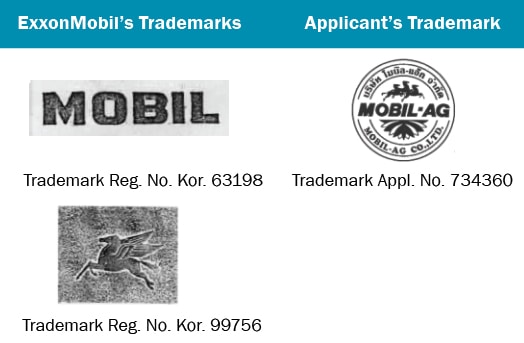
Even though the Trademark Office Registrar found that the applicant’s trademark and ExxonMobil’s trademark MOBIL, Reg. No. Kor. 63198, are similar, the registrar unfortunately dismissed the opposition because it found that both marks are for use with goods in different classes and that the lists of goods were not of the same character.     

ExxonMobil then appealed the decision to the Board of Trademarks, which dismissed the appeal based on the same reasons. ExxonMobil therefore further appealed the decision by filing a lawsuit with the IP&IT Court.

IP&IT Court’s Judgment

In January 2017, after reviewing the evidence and statements of witnesses produced by both parties, the IP&IT Court rendered judgment dismissing the lawsuit. The IP&IT Court found that (1) the appearances and pronunciations of both parties’ marks were different; (2) the classifications of the goods of both parties’ marks were different; and (3) the lists of goods of both parties’ marks were not related. The court therefore ruled that the applicant’s mark was not prohibited from registration under Section 13 of the Trademark Act. Disappointed with the judgment, ExxonMobil instructed Tilleke & Gibbins to appeal the IP&IT Court judgment to the Specialized Appeal Court.

Specialized Appeal Court’s Judgment   

On October 11, 2017, the Specialized Appeal Court rendered judgment finding that the applicant’s Trademark Application No. 734360 is similar enough to ExxonMobil’s Trademark Registration Nos. Kor. 99756 and Kor. 63198 so as to cause confusion among the public.

Even though both parties’ marks are for use with goods of different classes, the lists of goods were found to have the same character. Accordingly, the applicant’s Trademark Application No. 734360 is not registrable under Section 13 of the Trademark Act. The Specialized Appeal Court therefore reversed the judgment of the IP&IT Court and ordered that the prior decisions of the Trademark Registrar and the Board of Trademarks be withdrawn.

It is interesting to note that the Specialized Appeal Court not only addressed the similarity of both parties’ marks, element by element, but also discussed the origin of the word “MOBIL.” Particularly, it stated that this word is not Thai, but foreign. If this foreign word has not been used until it has a comparative meaning in Thai, there would be limitations for general consumers to recognize and remember it. Most importantly, “MOBIL” does not have a meaning in the dictionary and ExxonMobil’s witness confirmed that the word has been used as a trademark since 1906 and has been registered worldwide. It can therefore be concluded that the applicant used the same word as that of ExxonMobil as a part of its trademark.

Moreover, in the appeal, in addition to the similarity issue, ExxonMobil argued that its registered trademarks are well known, and the applicant, who was well aware of ExxonMobil’s well-known mark, applied for registration of a similar mark in bad faith. Even though the Specialized Appeal Court did not discuss or rule on the well-known and bad faith issues, it is obvious that these arguments were taken into consideration when evaluating the similarity between both parties’ marks. 

The ruling has positive implications for future similar cases in Thailand as it implies that, in deciding whether an applicant’s trademark is prohibited from registration under Section 13 of the Trademark Act, the Specialized Appeal Court will take into consideration the fame of the prior registered trademark and the bad faith of the applicant. This approach should help in deterring any bad faith applicant from imitating other parties’ well-known trademarks or applying for registration of such imitation trademarks.

RELATED INSIGHTS​ 

February 25, 2026
In December 2025, the National Assembly of Vietnam enacted a new Law on Construction, replacing the 2014 Law on Construction as amended in 2020. The 2025 Law on Construction will, in principle, take effect on July 1, 2026, subject to certain exceptions. Among its notable reforms, one development has attracted particular attention from both legal practitioners and market participants: the introduction of a statutory framework governing predetermined damages, commonly referred to as “liquidated damages.” This marks the first time liquidated damages have been expressly recognized at the level of primary legislation in Vietnam. While liquidated damages clauses have long been a common feature of construction contracts in practice, their legal enforceability has historically been subject to uncertainty. Although the new provision appears to represent a positive step toward greater legal clarity, it remains an open question whether it is sufficient, on its own, to provide a solid legal basis for the enforceability of liquidated damages clauses in construction disputes in Vietnam. What’s New? Article 86.2 of the 2025 Law on Construction provides (emphasis added): “Compensation for damages shall be determined on the basis of actual damages [or] predetermined damages corresponding to obligations under the construction contracts that are breached [and] the extent of such breaches.” This provision is significant in that it expressly recognizes predetermined damages, or liquidated damages, as a lawful basis for determining compensation for damage. However, the new law does not define “predetermined damages.” The absence of a statutory definition creates potential ambiguity as to the scope and nature of this concept and may give rise to disputes over how—and whether—a particular contractual clause qualifies as predetermined damages for the purposes of Article 86.2. Further, Article 86.2 qualifies the application of predetermined damages by requiring that such damages correspond to the obligations not fulfilled and the
February 25, 2026
Tilleke & Gibbins has updated the Vietnam chapter in the newly released Licensing 2026 guide, published by Lexology Panoramic. The comparative guide provides companies and other interested readers with information on licensing law and practice in various countries around the world. Licensing 2026 provides detailed information on the following topics: Restrictions, laws and licensing arrangements Intellectual property issues: Paris Convention for the Protection of Industrial Property, contesting the validity of licensor’s IP rights, invalidity and expiry of IP rights, security interests, proceedings against third parties, sublicensing, jointly owned IP, first to file, scope of patent protection, trade secrets, copyright Software licensing: Perpetual licensing, legal requirements, user restrictions Royalties and payments, currency conversion, and taxes: Relevant legislation, restrictions, taxation of foreign licensors Competition law issues: Restrictions on trade, legal restrictions, and IP-related court rulings Indemnification, disclaimers, and damages: Prevalence and enforceability of indemnity provisions and contractual waivers of damages Termination: Right to terminate, impact of termination Bankruptcy: Impact of licensee or licensor bankruptcy Dispute resolution: Governing law, arbitration, enforceability, injunctive relief, contractual waivers The Vietnam chapter is available below as a PDF. Readers can gain 30 days of complementary access to the full Licensing 2026 guide and the rest of Lexology Panoramic’s varied offerings through this link.
February 20, 2026
Thailand’s Supreme Administrative Court has issued a decisive ruling annulling the Ministry of Labor’s notification that had granted an exemption for foreign pilots to fly domestic routes under wet‑lease arrangements. A wet lease is a leasing arrangement in which the aircraft is provided together with its foreign flight crew, including pilots, and related operational support, rather than the airline supplying its own pilots. The judgment, delivered on November 17, 2025, and published in the Government Gazette on January 30, 2026, follows a legal challenge brought by the Thai Pilots Association, which argued that the exemption unlawfully enabled foreign workers to assume a role traditionally reserved for Thai nationals. The notification in question, dated December 13, 2024, authorized foreign pilots who came as part of wet‑leased aircraft to fly domestic routes. The Thai Pilots Association disputed the legality of this rationale, asserting that the exemption was triggered by a private airline’s request rather than by any statutory necessity. The Ministry of Labor justified this measure by relying on aircraft‑specific approvals issued by the Ministry of Transport and by enabling the Department of Employment to issue corresponding work permits. Arguments Presented in the Case The Thai Pilots Association argued that the exemption undermined the interests of domestic pilots and conflicted with the policy intent of Thailand’s foreign‑worker regulatory framework. The lawsuit emphasized that the notification arose directly from a private airline company’s request to operate two A320 aircraft under a wet lease and that the measure had the practical effect of displacing Thai pilots who remained unemployed. Meanwhile, the Ministry of Labor defended the exemption as a temporary and necessary response to industry shortages and part of national efforts to support tourism and restore aviation capacity. Legal Framework Thai law establishes a general prohibition against foreign nationals piloting domestic aircraft. Section
February 9, 2026
When unauthorized credit card transactions occur, who bears responsibility—the cardholder or the issuing bank? In Thailand, a landmark 2025 ruling by the country’s Supreme Court has clarified this question, establishing a stricter standard for banks in fraud disputes and significantly strengthening consumer protections. The case centered on disputed charges where a customer claimed their credit card had been used without authorization. The bank sued to recover the amount, and both the court of first instance and the Court of Appeal ruled in favor of the bank. However, the Supreme Court overruled their judgments and decided that the customer did not need to pay for the unauthorized transactions, placing liability squarely on the bank. This ruling was based on three key findings, which are outlined below. Finding 1: Insufficient Expert Testimony In this case, the bank bore the burden of proving matters related to the credit card system’s manufacture, design, security, and operation, as required under the Consumer Case Procedure Act B.E. 2551 (2008). To meet this requirement, the bank presented testimony from two employees in its credit card department regarding ’security measures and issuance procedures. However, the Supreme Court found these witnesses unqualified as experts, as they did not present technical or academic evidence and did not possess specialized expertise in credit card technology. As a result, their testimony failed to establish that the bank’s credit card technology was sufficiently secure against fraudulent misuse. Finding 2: Contradictory Terms and Conditions The bank’s own credit card terms and conditions included a provision acknowledging that despite the card’s EMV security standards, cardholders must still exercise caution to prevent unauthorized access. The Supreme Court interpreted this clause as an explicit admission that credit card systems remain vulnerable to hacking and fraud, even with high-level security measures in place. This acknowledgment undermined the