
You are using an outdated browser and your browsing experience will not be optimal. Please update to the latest version of Microsoft Edge, Google Chrome or Mozilla Firefox. Install Microsoft Edge

August 29, 2018

A Novel Approach to Evaluating the Similarity of Trademarks in Thailand

Informed Counsel

The Court of Appeal for Specialized Cases (Specialized Appeal Court) was established in October 2016 to review all appeals against the judgments of the five specialized first instance courts in Thailand, including the Central Intellectual Property and International Trade Court (IP&IT Court). Most, if not all, judges of the Specialized Appeal Court, who are responsible for reviewing IP-related appeals, have had experience working as judges at the IP&IT Court and can be expected to be well versed in IP law and practices. They are capable of providing fair, practical, and sometimes novel judgments, as illustrated in a recent case involving how similarity of trademarks should be evaluated.

Opposition of Similar Trademarks

In June 2009, a Thai company filed an application for registration of the trademark MOBIL-AG & Device, Application No. 734360, for use with goods in Class 1, namely chemical fertilizers. This application was subsequently published in a trade gazette in September 2012. As the applicant’s mark is closely similar to the well-known registered trademarks of Exxon Mobil Corporation (“ExxonMobil”), ExxonMobil filed an opposition petition against this application with the Trademark Office in December 2012 under Section 13 of the Trademark Act, among others. The opposition was based on several prior registered trademarks of ExxonMobil, particularly:

  1. Trademark Registration No. Kor. 63198, registered for use with goods in Class 4, including lubricant oil, kerosene, gasoline, diesel; and
  2. Trademark Registration No. Kor. 99756, registered for use with goods in Class 5, including antiseptics in plants and pesticides.

The marks are shown in the table below.
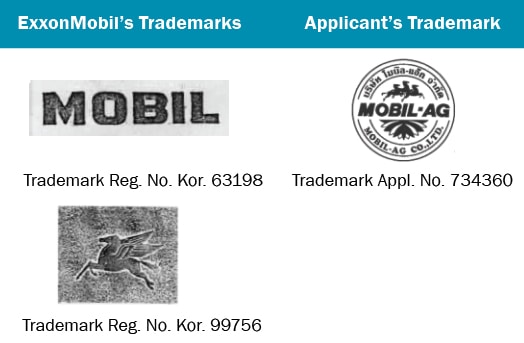
Even though the Trademark Office Registrar found that the applicant’s trademark and ExxonMobil’s trademark MOBIL, Reg. No. Kor. 63198, are similar, the registrar unfortunately dismissed the opposition because it found that both marks are for use with goods in different classes and that the lists of goods were not of the same character.     

ExxonMobil then appealed the decision to the Board of Trademarks, which dismissed the appeal based on the same reasons. ExxonMobil therefore further appealed the decision by filing a lawsuit with the IP&IT Court.

IP&IT Court’s Judgment

In January 2017, after reviewing the evidence and statements of witnesses produced by both parties, the IP&IT Court rendered judgment dismissing the lawsuit. The IP&IT Court found that (1) the appearances and pronunciations of both parties’ marks were different; (2) the classifications of the goods of both parties’ marks were different; and (3) the lists of goods of both parties’ marks were not related. The court therefore ruled that the applicant’s mark was not prohibited from registration under Section 13 of the Trademark Act. Disappointed with the judgment, ExxonMobil instructed Tilleke & Gibbins to appeal the IP&IT Court judgment to the Specialized Appeal Court.

Specialized Appeal Court’s Judgment   

On October 11, 2017, the Specialized Appeal Court rendered judgment finding that the applicant’s Trademark Application No. 734360 is similar enough to ExxonMobil’s Trademark Registration Nos. Kor. 99756 and Kor. 63198 so as to cause confusion among the public.

Even though both parties’ marks are for use with goods of different classes, the lists of goods were found to have the same character. Accordingly, the applicant’s Trademark Application No. 734360 is not registrable under Section 13 of the Trademark Act. The Specialized Appeal Court therefore reversed the judgment of the IP&IT Court and ordered that the prior decisions of the Trademark Registrar and the Board of Trademarks be withdrawn.

It is interesting to note that the Specialized Appeal Court not only addressed the similarity of both parties’ marks, element by element, but also discussed the origin of the word “MOBIL.” Particularly, it stated that this word is not Thai, but foreign. If this foreign word has not been used until it has a comparative meaning in Thai, there would be limitations for general consumers to recognize and remember it. Most importantly, “MOBIL” does not have a meaning in the dictionary and ExxonMobil’s witness confirmed that the word has been used as a trademark since 1906 and has been registered worldwide. It can therefore be concluded that the applicant used the same word as that of ExxonMobil as a part of its trademark.

Moreover, in the appeal, in addition to the similarity issue, ExxonMobil argued that its registered trademarks are well known, and the applicant, who was well aware of ExxonMobil’s well-known mark, applied for registration of a similar mark in bad faith. Even though the Specialized Appeal Court did not discuss or rule on the well-known and bad faith issues, it is obvious that these arguments were taken into consideration when evaluating the similarity between both parties’ marks. 

The ruling has positive implications for future similar cases in Thailand as it implies that, in deciding whether an applicant’s trademark is prohibited from registration under Section 13 of the Trademark Act, the Specialized Appeal Court will take into consideration the fame of the prior registered trademark and the bad faith of the applicant. This approach should help in deterring any bad faith applicant from imitating other parties’ well-known trademarks or applying for registration of such imitation trademarks.

RELATED INSIGHTS​ 

March 6, 2026
Myanmar’s Trademark Law 2019 introduced a modern framework for the registration, enforcement, and protection of trademarks. However, due to the high volume of applications filed during the soft-opening period of the Intellectual Property Department (IPD), marks submitted from 2022 onward remain pending as the IPD works its way through the applications filed in 2021, which it has been publishing on a monthly basis since May 1, 2024. During this period, businesses should adopt proactive strategies to protect their brands, monitor conflicting marks, and ensure a smooth registration process. Practical Steps for Safeguarding Pending Marks While a pending application does not confer full trademark rights, brand owners can take several practical steps to strengthen their position: Monitor IPD publications. Businesses should regularly review the IPD’s monthly gazette to identify any identical or confusingly similar marks at an early stage and prepare timely oppositions in accordance with the Trademark Law’s provisions allowing “any interested party” to file an objection to a trademark application. Monitor market activity. Early detection of potential infringement enables swift action, such as cease-and-desist letters and opposition proceedings. Businesses should monitor competitors, distributors, and retailers for unauthorized use of their marks. Collect evidence of use. Maintaining evidence of use strengthens claims of distinctiveness and supports enforcement efforts. Businesses should keep records of commercial activities, distribution, brand promotion and development, marketing communications, product packaging and labeling, and sales demonstrating brand recognition in Myanmar and internationally, particularly in Southeast Asian markets. Although the Trademark Law 2019 establishes a first-to-file system, evidence of use provides considerable practical support for distinctiveness claims and enforcement actions. Pursue Interim Enforcement Options. A pending trademark application can be relied upon to oppose or refuse other marks on absolute and/or relative grounds of refusal. In addition, marks with established reputations may be protected under passing-off principles
March 5, 2026
Amid increasing financial globalization, Vietnam’s establishment of an International Financial Center (IFC) represents a strategic initiative to attract high-quality foreign investment and enhance the country’s position in the global financial system. In support of this objective, a Specialized Court was introduced under Resolution No. 222/2025/QH15 as a dedicated dispute resolution mechanism within the IFC framework. The Specialized Court at the IFC was subsequently operationalized by Law on the Specialized Court No. 150/2025/QH15, effective from January 1, 2026. Organizational Structure of the Specialized Court The Specialized Court at the IFC is a court within the system of the People’s Courts, organized and operating in accordance with the Law on the Specialized Court, and vested with jurisdiction to adjudicate and resolve cases at the IFC. The Specialized Court is located in Ho Chi Minh City and comprises (i) a Court of First Instance; (ii) a Court of Appeal, and (iii) a supporting apparatus. Jurisdiction of the Specialized Court The jurisdiction of the Specialized Court at the IFC is strictly defined based on both (i) the subject matter of the cases and (ii) the membership status of the parties involved. Specifically, the Specialized Court has jurisdiction over (except for cases involving public interests or the interests of the state) the following: Disputes arising from investment and business activities. Requests for recognition and enforcement in Vietnam of judgments and decisions of foreign courts and foreign arbitral awards. Requests related to dispute resolution by arbitration. Other disputes directly related to investment and business activities (to be specified by the Supreme People’s Court). Additionally, at least one party in the case must be a member of the IFC. The IFC’s membership status is established through registration, recognition as a member, or the grant of a license for establishment and operation within the IFC. In the
February 27, 2026
On January 26, 2026, Vietnam’s Ministry of Finance issued Circular No. 06/2026/TT-BTC (Circular 06), amending and supplementing Circular No. 13/2015/TT-BTC, which provides guidance on dossiers and procedures for customs recordal and customs supervision in relation to intellectual property rights (IPR). Circular 06 has an effective date of March 1, 2026. Some notable points of Circular 06 include the following: Simplified Documentation for Customs Recordal Applications Circular 06 reduces some documentary requirements for IPR owners: A power of attorney is no longer required to be legalized. Applicants are no longer required to submit title or registration certificates if such documents are issued in digital form. In such cases, it is sufficient to declare comprehensive information on the relevant IPR, enabling customs authorities to verify the information through publicly accessible databases. In practice, this amendment is particularly beneficial for international trademark registrations designating Vietnam. IPR owners may no longer need to obtain a confirmation letter from the Intellectual Property Office of Vietnam regarding the validity of a trademark registration in Vietnam. Instead, they may rely on registration status information available from the World Intellectual Property Organization (WIPO) database, reflecting that the international registration has been granted protection in Vietnam. Clearer Mechanism for Ex Officio Suspension of Suspected Infringing Goods Although ex officio suspension has been referenced in earlier regulations, Circular 06 provides clearer guidance on the circumstances and procedures under which customs may proactively suspend customs procedures for consignments suspected of being counterfeit or pirated goods. Accordingly, customs authorities may initiate the suspension of clearance without waiting for a formal request from IPR owners. Enhanced Supervision of Imported/Exported Goods in E-Commerce Circular 06 also supplements provisions on the inspection of imported and exported goods transacted through e-commerce channels. Customs authorities may apply risk management measures to assess goods traded via e-commerce
February 26, 2026
Thailand is preparing to offer new tools for intellectual property enforcement as the Electronic Transactions Development Agency (ETDA) recently released for public consultation a draft notification requiring social media platforms to verify user identities and conduct know-your-customer (KYC) checks on advertisers. The draft Notification of the Electronic Transactions Commission on Measures to Prevent Technological Crimes for Social Media Service Providers, which is to be issued under the Emergency Decree on Measures for the Prevention and Suppression of Technological Crimes B.E. 2566 (2023), as amended in 2025, primarily aims to combat online fraud and technology-related crimes. However, its new obligations also provide IP owners with valuable tools to identify anonymous infringers. Key Regulatory Mandates The draft notification imposes several verification requirements on social media platforms operating in Thailand. These requirements also strengthen IP rights holders’ ability to identify anonymous infringers, as platforms must: Verify user identities through registered phone numbers and link all accounts to verifiable identities. Conduct KYC checks on advertisers, including individuals, companies, and any third-party payers. Perform heightened identity checks for high-risk or repeat offenders before publishing advertisements. Promptly remove content flagged by the Anti-Technology Crime Division and prescreen advertisements for prohibited or high-risk content. How IP Owners Can Use This Notification for Enforcement The phone number–based verification requirement enables IP owners to work more effectively with enforcement authorities in tracing individuals or entities responsible for infringing content. The comprehensive advertiser KYC obligations, including mandatory disclosure of third-party payment sources, create a clear audit trail even when bad actors attempt to obscure their identity through intermediaries or shell accounts. This traceability is essential for pursuing damages and dismantling organized counterfeit operations. The ETDA is now considering adjustments to the draft notification after receiving comments during the public consultation period, which ended on February 2, 2026. Following finalization