
You are using an outdated browser and your browsing experience will not be optimal. Please update to the latest version of Microsoft Edge, Google Chrome or Mozilla Firefox. Install Microsoft Edge

August 29, 2018

A Novel Approach to Evaluating the Similarity of Trademarks in Thailand

Informed Counsel

The Court of Appeal for Specialized Cases (Specialized Appeal Court) was established in October 2016 to review all appeals against the judgments of the five specialized first instance courts in Thailand, including the Central Intellectual Property and International Trade Court (IP&IT Court). Most, if not all, judges of the Specialized Appeal Court, who are responsible for reviewing IP-related appeals, have had experience working as judges at the IP&IT Court and can be expected to be well versed in IP law and practices. They are capable of providing fair, practical, and sometimes novel judgments, as illustrated in a recent case involving how similarity of trademarks should be evaluated.

Opposition of Similar Trademarks

In June 2009, a Thai company filed an application for registration of the trademark MOBIL-AG & Device, Application No. 734360, for use with goods in Class 1, namely chemical fertilizers. This application was subsequently published in a trade gazette in September 2012. As the applicant’s mark is closely similar to the well-known registered trademarks of Exxon Mobil Corporation (“ExxonMobil”), ExxonMobil filed an opposition petition against this application with the Trademark Office in December 2012 under Section 13 of the Trademark Act, among others. The opposition was based on several prior registered trademarks of ExxonMobil, particularly:

  1. Trademark Registration No. Kor. 63198, registered for use with goods in Class 4, including lubricant oil, kerosene, gasoline, diesel; and
  2. Trademark Registration No. Kor. 99756, registered for use with goods in Class 5, including antiseptics in plants and pesticides.

The marks are shown in the table below.
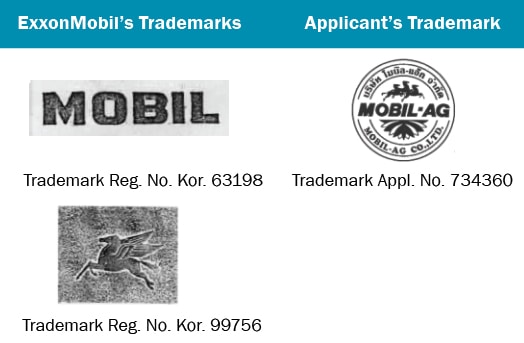
Even though the Trademark Office Registrar found that the applicant’s trademark and ExxonMobil’s trademark MOBIL, Reg. No. Kor. 63198, are similar, the registrar unfortunately dismissed the opposition because it found that both marks are for use with goods in different classes and that the lists of goods were not of the same character.     

ExxonMobil then appealed the decision to the Board of Trademarks, which dismissed the appeal based on the same reasons. ExxonMobil therefore further appealed the decision by filing a lawsuit with the IP&IT Court.

IP&IT Court’s Judgment

In January 2017, after reviewing the evidence and statements of witnesses produced by both parties, the IP&IT Court rendered judgment dismissing the lawsuit. The IP&IT Court found that (1) the appearances and pronunciations of both parties’ marks were different; (2) the classifications of the goods of both parties’ marks were different; and (3) the lists of goods of both parties’ marks were not related. The court therefore ruled that the applicant’s mark was not prohibited from registration under Section 13 of the Trademark Act. Disappointed with the judgment, ExxonMobil instructed Tilleke & Gibbins to appeal the IP&IT Court judgment to the Specialized Appeal Court.

Specialized Appeal Court’s Judgment   

On October 11, 2017, the Specialized Appeal Court rendered judgment finding that the applicant’s Trademark Application No. 734360 is similar enough to ExxonMobil’s Trademark Registration Nos. Kor. 99756 and Kor. 63198 so as to cause confusion among the public.

Even though both parties’ marks are for use with goods of different classes, the lists of goods were found to have the same character. Accordingly, the applicant’s Trademark Application No. 734360 is not registrable under Section 13 of the Trademark Act. The Specialized Appeal Court therefore reversed the judgment of the IP&IT Court and ordered that the prior decisions of the Trademark Registrar and the Board of Trademarks be withdrawn.

It is interesting to note that the Specialized Appeal Court not only addressed the similarity of both parties’ marks, element by element, but also discussed the origin of the word “MOBIL.” Particularly, it stated that this word is not Thai, but foreign. If this foreign word has not been used until it has a comparative meaning in Thai, there would be limitations for general consumers to recognize and remember it. Most importantly, “MOBIL” does not have a meaning in the dictionary and ExxonMobil’s witness confirmed that the word has been used as a trademark since 1906 and has been registered worldwide. It can therefore be concluded that the applicant used the same word as that of ExxonMobil as a part of its trademark.

Moreover, in the appeal, in addition to the similarity issue, ExxonMobil argued that its registered trademarks are well known, and the applicant, who was well aware of ExxonMobil’s well-known mark, applied for registration of a similar mark in bad faith. Even though the Specialized Appeal Court did not discuss or rule on the well-known and bad faith issues, it is obvious that these arguments were taken into consideration when evaluating the similarity between both parties’ marks. 

The ruling has positive implications for future similar cases in Thailand as it implies that, in deciding whether an applicant’s trademark is prohibited from registration under Section 13 of the Trademark Act, the Specialized Appeal Court will take into consideration the fame of the prior registered trademark and the bad faith of the applicant. This approach should help in deterring any bad faith applicant from imitating other parties’ well-known trademarks or applying for registration of such imitation trademarks.

RELATED INSIGHTS​ 

June 29, 2026
Thailand’s cabinet has approved the draft Act on Liability for Defective Goods, commonly called Thailand’s “Lemon Law.” The Draft Act is currently pending consideration by Parliament. The draft law aims to strengthen buyers’ position in pursuing cases against sellers. While the Civil and Commercial Code offers provisions governing liability for defective goods, it is difficult in practice for buyers to successfully make a claim against sellers, particularly where defects are latent and not discoverable at the time of sale or delivery. By introducing product-specific rules and clearer remedies, the new law is intended to modernize Thailand’s consumer protection framework and align it more closely with international standards, and to help relieve the buyer’s burden of proof against the seller in product liability cases. If enacted, the draft act will take effect 180 days after publication in the Government Gazette, giving businesses a transition period to assess their compliance obligations. This article provides an overview of the key provisions of the draft act and highlights some practical considerations for businesses operating in Thailand. Scope and Key Definitions The draft act applies to sellers—defined as persons who sell goods in the ordinary course of business—and protects buyers, a term defined broadly to include not just the original purchaser but also transferees and successors in title. This expands the class of people who can bring claims. The law does not apply to used goods, live animals, or goods exempted by future ministerial regulation. It also leaves intact any separate warranties, promises, advertisements, or other guarantees a seller has given; those remain enforceable alongside the new statutory rights. General Liability for Defective Goods Sellers are liable for defects that exist at the time of delivery, regardless of whether the seller knew about them. Liability arises where a defect reduces: The benefit intended under
June 24, 2026
Patent enablement requirements are provided under Article 102 of Vietnam’s Law on Intellectual Property (IP Law). In particular, a patent specification must “fully and clearly disclose the nature of the invention to such an extent that, based on the specification, a person having ordinary skill in the relevant art can implement the invention.” In pharmaceutical and biotechnology patents, this requirement is more complicated and subject to more rigorous assessment. The Patent Examination Guidelines (Guidelines) of the Intellectual Property Office of Vietnam (IP Office) were amended in March 2026 to introduce Annexes III and IV for the pharmaceutical and biotechnology sectors, in which Annex III provides detailed guidelines on the assessment of specification requirements. These amendments were made under a project for strengthening capacity in industrial property examination between the Japan International Cooperation Agency (JICA) and the IP Office. Annex III provides detailed instructions on how examiners assess enablement in a pharmaceutical or biotechnology application, and offers examples of acceptable and unacceptable descriptions with regard to the enablement aspect. Enablement Requirements in Pharma and Biotech Patents Article 12.7 of Circular 10/2026/TT-BKHCN (Circular 10) adds to the requirements of Article 102 of the IP Law that the description must demonstrate the novelty, inventive step, and industrial applicability of the technical solution. For pharmaceutical composition subject matters, Article 12.9 of Circular 10 sets out that the description must present the results of clinical trials and/or the pharmacological effects of the claimed pharmaceutical composition, and must include at least the following information: Substance/mixture used. Testing method (system) employed. Information on the test results. Correlation between the pharmacological effects obtained from the tests and the application of the pharmaceutical product in the prevention, diagnosis, and treatment of diseases. The Guidelines note that pharmacological study results should be presented in a quantified manner, and pharmacological
June 22, 2026
Arbitrator independence and impartiality form the cornerstone of a legitimate arbitral process. Under section 19 of the Thai Arbitration Act B.E. 2545 (2002), prospective arbitrators must disclose circumstances likely to give rise to justifiable doubts as to their impartiality or independence, and existing arbitrators must do so throughout proceedings. This mirrors article 12 of the UNCITRAL Model Law. Yet despite this clear mandate, practical implementation varies significantly across Thailand’s arbitration landscape. Background Thailand’s two principal arbitration institutions, the Thai Arbitration Institute (TAI) and the Thailand Arbitration Center (THAC), both maintain procedures for addressing arbitrator challenges and require compliance with the statutory disclosure obligation. Under both sets of rules, any party wishing to challenge an arbitrator must submit a challenge application within fifteen days of becoming aware of the relevant facts, and a committee is appointed to consider the matter on a case-by-case basis. The TAI additionally prescribes its Code of Ethics and Conduct for Arbitrators to further emphasize the expectation of impartiality and transparency. However, Thailand’s arbitration ecosystem extends well beyond the TAI and THAC. Several sector-specific institutions also administer arbitral proceedings, including the Thai Commercial Arbitration Office under the Board of Trade of Thailand, the Arbitration Centre of the Office of the Insurance Commission, the Arbitration Centre of the Securities and Exchange Commission, the Office for the Prevention and Resolution of Disputes regarding Intellectual Property, and the Arbitration Centre of the Thai General Insurance Association. These institutions each operate under their own procedural rules, which were developed to serve particular industries and dispute profiles. The procedural mechanisms for securing and documenting an independence declaration are not uniformly established across these forums. Consequences of Procedural Inconsistency This creates a notable gap. Not all arbitration bodies have a formalized procedure requiring written independence statements before proceedings commence. Some tribunals proceed
June 16, 2026
The president of Thailand’s Supreme Court has issued new recommendations providing courts with criminal jurisdiction with a comprehensive framework for identifying and dismissing criminal cases brought in bad faith. Published in the Government Gazette on May 29, 2026, after being signed on May 25, the Recommendations of the President of the Supreme Court Concerning Bad-Faith Litigation in Criminal Cases B.E. 2569 were issued under Section 5 of the Act on the Organization of Courts of Justice. The recommendations took effect upon publication and represent a significant step in Thailand’s efforts to curb abusive criminal litigation, including strategic lawsuits against public participation (SLAPP). Background Section 161/1 of Thailand’s Criminal Procedure Code empowers courts to dismiss criminal cases filed dishonestly or with the intent to harass or take unfair advantage of a defendant. The new recommendations provide detailed guidance that courts previously lacked on identifying and handling such prosecutions. Definition of Bad-Faith Litigation Under recommendation 1, filing a criminal case in bad faith is defined broadly to encompass three categories: Harassment-type filings involving intimidation, threats, or creating unreasonable hardship for the defendant; Coercive filings designed to pressure the defendant into acting or refraining from acting for illegitimate benefit; and False or misleading filings that deliberately assert incorrect material facts or conceal such facts. Circumstances Indicating Bad Faith Recommendation 2 sets out specific circumstances that should raise a court’s suspicion that a filing may violate section 161/1. These include: Filing in a distant court far from the defendant’s domicile without benefiting the adjudication; Retaliation against the defendant’s advocacy for human rights, environmental protection, consumer rights, labor rights, or other public interests—effectively establishing an express anti-SLAPP framework; Retaliation against whistleblowers who disclosed corruption or unlawful conduct; Retaliation against individuals responsible for investigating the plaintiff’s wrongdoing or who concluded such an investigation; Filing multiple