You are using an outdated browser and your browsing experience will not be optimal. Please update to the latest version of Microsoft Edge, Google Chrome or Mozilla Firefox. Install Microsoft Edge

December 21, 2021

No Change for Thailand’s Land and Building Tax Rates for 2022

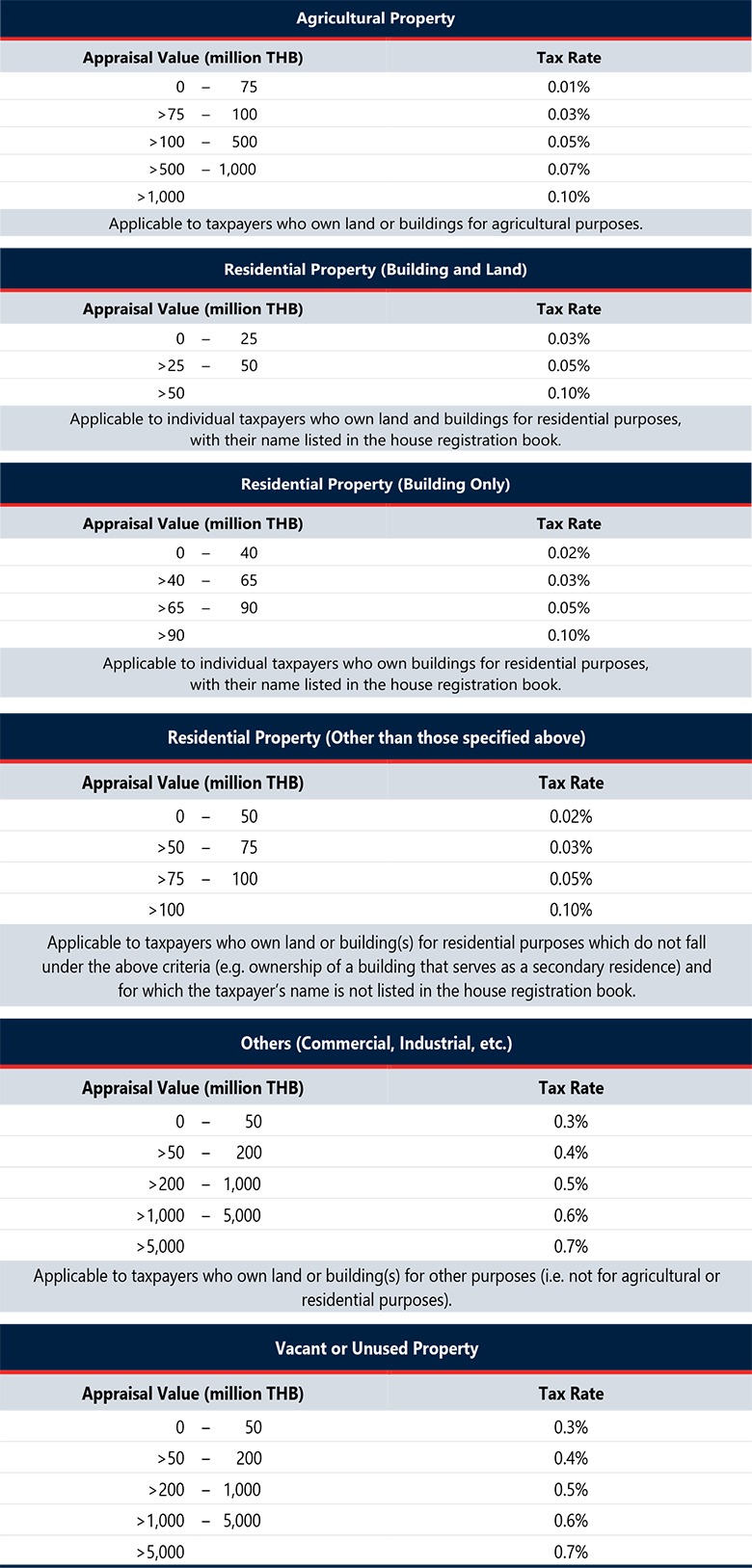
On December 13, 2021, the Royal Decree on the Stipulation of Land and Building Tax Rates B.E. 2564 (2021) was published in the Government Gazette. The royal decree, which was issued under the Land and Building Tax Act B.E. 2562 (2019) and takes effect on January 1, 2022, maintains the current land and building tax rates, which have been in place since 2020.

The land and building tax rates for each type of property stipulated under the royal decree are provided below:

RELATED INSIGHTS​ 

December 15, 2023
As part of its membership in Lex Mundi, Tilleke & Gibbins has published an updated edition of its Guide to Doing Business in Thailand for 2023. This guide outlines the key factors for starting and operating a business in the Thai market. Issues covered include: Investment incentives Financial facilities Exchange controls Import and export regulations Structures for doing business Requirements for the Establishment of a Business Operation of the Business Cessation or Termination of the Business Labor legislation, relations, and supply Tax Immigration requirements This publication is part of Lex Mundi’s Country Guides series prepared by member firms in more than 100 jurisdictions worldwide. The guides serve as a useful resource for planning international business strategy and researching new markets. The full Guide to Doing Business in Thailand is available through the button below.
December 8, 2023
Thailand’s Ministry of Interior has extended the deadlines for payment of the 2024 land and building tax and related procedures by two months. The announcement was published in the Government Gazette on November 30, 2023. According to the new timeline in the ministry’s announcement, the official land and building tax assessment forms will be sent to taxpayers by the end of April 2024 (extended from February 2024) while the deadline for payment of land and building tax has been extended to June 30, 2024 (from April 30, 2024). For payments made in installments, the announcement also extended the deadline for each installment as follows: For more details on these measures, or any aspect of Thailand’s land and building tax, please contact Chaiwat Keratisuthisathorn at [email protected] or Supranee Arjjit at [email protected].
November 23, 2023
Thailand’s Revenue Department has issued an order clarifying its recent order imposing personal income tax (PIT) on the offshore-sourced income of Thailand tax residents whenever it is brought into Thailand. The clarifying order, which was issued on November 20, 2023, confirms that the new rule will not apply to offshore-sourced income earned before January 1, 2024, which is the date the order comes into effect. This means that offshore-sourced income earned before January 1, 2024, will not be subject to PIT if it is brought into Thailand after the year 2023. This grandfather protection means that Thai tax residents will not have to pay PIT on offshore-sourced income earned before 2024 and brought into Thailand at any time after 2023. This is favorable to many who have earned income from offshore sources but may not have had sufficient time to revise their tax planning in response to the new rule. For more details on Thailand’s taxation of tax residents’ offshore-sourced income, or on any aspect of tax laws and regulations in Thailand, please contact Tilleke & Gibbins at [email protected].
November 13, 2023
On November 6, 2023, Thailand’s Department of Lands issued a circular letter clarifying that the use of units in condominium buildings for hotel business operations is not allowed. Circular Letter No. Mor Tor 0517.3/Wor 23302, which was sent to all provincial governors in Thailand, explains this by emphasizing that although the Condominium Act (No. 4) B.E. 2551 (2008) rules that some condominium units can be used for commercial operations purposes, the term “commercial operations” does not include hotel business operations. This is in accordance with the Condominium Act’s primary aim of safeguarding the rights of condominium unit owners for residential purposes rather than for the purpose of commercial or hotel business operations. The circular letter also references Opinion of the Council of State No. 710/2550, which specifies that the commercial operations allowed under the Condominium Act are those providing services to the co-owners of a condominium building (e.g., convenience stores and restaurants) and further specifies that these commercial condominium unit areas must have separate exits and entrances that do not disturb the residents of the condominium building. In light of these considerations, using a condominium building for hotel business operations is not permissible, regardless of whether consent is obtained from the co-owners of the condominium building or whether the condominium building’s purpose is changed from residential to hotel purposes (whether in whole or in part). To use a condominium building for hotel business operations, the building owner would have to first cancel the condominium building’s registration under the Condominium Act so that it is no longer regarded as a condominium building. Then it can be used for hotel business operations, provided that the building and business operator comply with the requirements under the hotel law and other relevant laws and regulations (e.g., Building Control Act, Town and Country Planning