
You are using an outdated browser and your browsing experience will not be optimal. Please update to the latest version of Microsoft Edge, Google Chrome or Mozilla Firefox. Install Microsoft Edge

August 30, 2022

New Minimum Wages in Thailand

On August 26, 2022, Thailand’s National Wage Committee voted to raise the minimum wage to THB 328–354 per day (USD 9.01–9.72)—an increase of approximately 5% from the previous range of THB 313–336. The decision to boost minimum wages, which were last increased in January 2020, came after a 14-year-high headline inflation rate of 7.61% in July 2022.

The new minimum wages have been submitted to the cabinet for final approval and are expected to take effect on October 1, 2022, following publication in the Government Gazette. The exact minimum wage depends on the province in which the workplace is located, as shown in the table below.
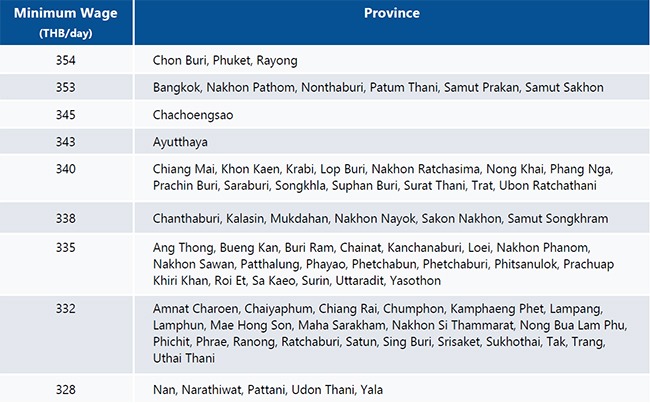
These minimum rates are for one working day, which consists of eight hours for normal work, or seven hours for work that may be harmful to the health and safety of the employee.

Legal Requirements

After the new minimum wages are announced in the Government Gazette, employers may not pay employees wages below the prescribed rates. Violations are punishable by imprisonment for up to six months, a fine of up to THB 100,000, or both.

Regarding the question of whether employers can reduce the working hours in order to pay less than minimum wages (e.g., a prorated amount), based on past practice, the National Wage Committee’s announcement is expected to provide that a “day” refers to an employee’s normal working day, regardless of whether it is shorter than the “normal working hours” set by the employer under the Labor Protection Act.

For example, an employee in Bangkok who earns the current minimum wage of THB 331 per day for normal working hours of eight hours a day would still be entitled to the full new rate of THB 353 per day in October 2022, even if the employer reduces the working hours.

For further information on Thailand’s minimum wage regulations, or on any aspect of employment law in Thailand, please contact Tilleke & Gibbins at [email protected] or +66 2056 5555.

RELATED INSIGHTS​ 

January 10, 2020
On December 30, 2019, the government of Vietnam issued Decree 99/2019/ND-CP detailing and guiding the implementation of the amended 2018 Law on Higher Education (Decree 99). Decree 99 will take effect on 15 February 2020, and sets out, among other things, conditions for the establishment of campuses in Vietnam of foreign higher-education institutions, regulations on governing boards, and the autonomy and accountability of higher-education institutions.
January 7, 2020
In this first Human Resource Watch column of 2020, Tilleke & Gibbins’ labor and employment lawyers take a look back at three of the most common issues that our clients have asked us about over the past year, including some of the most significant recent legal developments and applications that employers in Thailand have been facing.Thailand’s Personal Data Protection Act
December 24, 2019
On January 1, 2020, region-based minimum wages for non-state employees in Vietnam will increase by an average of 5.5%. The increase was passed by Vietnam’s National Wage Council on July 11, 2019, and approved by the prime minister on November 17 of the same year.
December 24, 2019
If an employer collects employees’ personal information, the employer must comply with the Personal Data Protection Act (PDPA).Thailand’s PDPA, which was enacted earlier this year, contains significant new requirements for employers that collect employees’ (called “data subjects” in the PDPA) personal information. Most sections of the PDPA will become effective on May 27, 2020, so employers should be aware of their duties and liabilities.Important PDPA requirements that relate to employers include the following: