
You are using an outdated browser and your browsing experience will not be optimal. Please update to the latest version of Microsoft Edge, Google Chrome or Mozilla Firefox. Install Microsoft Edge

December 24, 2019

Vietnam’s Regional Minimum Wages to Increase

Taylor Vinters – International Employment Law Update

On January 1, 2020, region-based minimum wages for non-state employees in Vietnam will increase by an average of 5.5%. The increase was passed by Vietnam’s National Wage Council on July 11, 2019, and approved by the prime minister on November 17 of the same year.

As the cost of living varies dramatically throughout Vietnam, the government divides the country into four salary regions for the purpose of issuing minimum wages, reflecting the economic realities of the urban/rural divide and other developmental factors. The increase in the minimum wage for 2020 is summarised in the table below.

Monthly minimum wage by region:
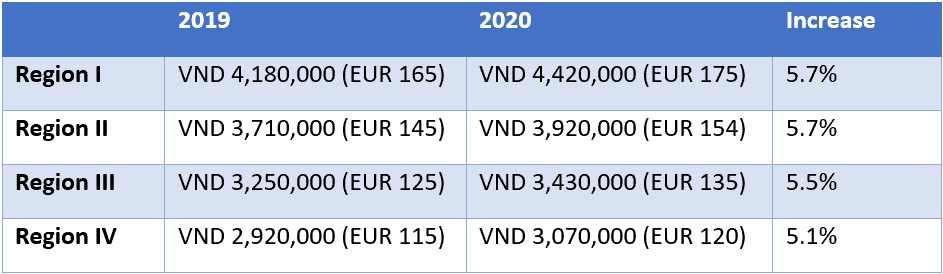
  • Companies are not permitted to pay unskilled employees monthly wages which are lower than the relevant minimum wage. Wages paid to employees who have undergone vocational training should be at least 7% higher than the minimum salary, according to the country’s Ministry of Labor, Invalids and Social Affairs.Region I includes the urban and suburban districts of Hanoi and Hai Phong in the north, and the urban and suburban districts of Ho Chi Minh City and its neighboring provinces of Dong Nai, Binh Duong, and Ba Ria – Vung Tau in the south.
  • Region II includes the outskirts of Hanoi and Ho Chi Minh City, as well as other large and medium-sized cities throughout Vietnam, such as Da Nang, Nha Trang, and Can Tho.
  • Region III includes smaller provincial cities and suburban districts.
  • Region IV includes all remaining areas, including the least developed and sparsely populated rural and mountainous regions of Vietnam.

Comment

Employers with employees in each of the four regions mentioned above should be aware of these changes and ensure that they are complying with them by paying their employees the minimum wage for that region. Contract and payroll reviews are therefore recommended to ensure compliance.

RELATED INSIGHTS​ 

August 31, 2026
Thailand has introduced a new regulatory framework that may expose foreign nationals who violate the Foreign Business Act (FBA) to deportation. The Regulation of the Office of the Prime Minister on Deportation B.E. 2569 was published in the Government Gazette on August 27, 2026. The regulation establishes an administrative process for referring foreign nationals for deportation where this is deemed necessary in the interests of public order or public morality. It does not create new substantive deportation powers, but it expressly identifies unlawful business conduct under the FBA—including nominee arrangements—as grounds for referral. Grounds for Deportation Referral The regulation sets out five grounds that may give rise to a referral to the relevant authorities: Unlawful entry into, or unlawful stay in, Thailand in violation of immigration laws. Unlawful employment or engagement in work in violation of laws governing the employment of foreign nationals. Carrying on business in violation of the FBA, including through the use of nominee arrangements. Forging official documents or using forged official documents. Committing an offense punishable by imprisonment of five years or more. The framework takes a broad approach, extending not only to the perpetrators of these acts but also to those who facilitate, instigate, or otherwise support such acts. Deportation Risk Following a Criminal Judgment Where a foreign national has committed any of the above offenses and has fully served the sentence imposed pursuant to a final judgment, the interior minister has the power to order deportation. This power also applies where a court has issued a final judgment sentencing a foreign national to imprisonment but has suspended the execution of the sentence, or has imposed a fine. A deportation order may also specify a period during which the foreign national is prohibited from reentering Thailand. FBA Noncompliance: Broader Consequences Noncompliance with the FBA—including
August 20, 2026
As part of its membership in Lex Mundi, Tilleke & Gibbins has released the latest edition of its Guide to Doing Business in Thailand, providing an overview of the legal, regulatory, and commercial considerations for companies establishing or expanding operations in Thailand. The 2026 edition offers practical insight into the country’s business environment, investment framework, and operational requirements. The guide covers a wide range of topics relevant to foreign and domestic investors, including: Investment incentives and promotion schemes Financial facilities and banking regulations Exchange controls and money transfers Import and export regulations Business structures and incorporation options Requirements for establishing a business Operational and compliance considerations Business cessation and insolvency procedures Employment and labor laws Taxation Immigration and visa requirements Prepared by Tilleke & Gibbins lawyers across multiple practice areas, the publication outlines key aspects of doing business in Thailand, including foreign investment restrictions, regulatory compliance obligations, corporate structures, employment requirements, and recent legal and economic developments affecting investors. The publication forms part of Lex Mundi’s Country Guides series, a global collection of jurisdiction-specific reference materials prepared by member firms around the world. Together, these guides help companies evaluate opportunities, compare regulatory environments, and plan international business activities across multiple markets. The full Guide to Doing Business in Thailand 2026 is available through the button below.
July 30, 2026
Thailand’s cabinet has approved a draft ministerial regulation introducing significant changes to the calculation of old-age pension and old-age gratuity benefits under the Social Security Fund. The reform would replace the current pension calculation method with a career average revalued earnings (CARE) model designed to better reflect an individual’s lifetime contributions while supporting the long-term financial sustainability of the Social Security Fund. The changes are also intended to improve fairness and align Thailand’s pension framework with international practices. Key proposed changes under the draft ministerial regulation are outlined below. CARE-Based Formula for Old-Age Pension Calculations Currently, old-age pensions are calculated based on the insured person’s average salary over the preceding 60 months. The proposed regulation would replace this approach with the CARE model, under which pension benefits will be calculated based on earnings throughout an individual’s entire working life. Historical earnings will be revalued to reflect their present value before the pension benefit is calculated. According to the Ministry of Labor, this change is intended to better align pension benefits with an individual’s lifetime contribution history and provide a fairer basis for calculating benefits. Pension Accrual Rate for Contributions Exceeding 180 Months Under the current rules, insured persons who contribute for more than 180 months receive an additional pension accrual of 1.5% for each completed 12-month contribution period, with any remaining months disregarded. The proposed regulation would instead calculate the additional accrual on a monthly basis at a rate of 0.125% of actual monthly contributions; this aims to make pension benefits more accurately reflect the actual duration of each individual’s contribution history. Transitional Protections for Insured Persons The draft regulation includes transitional protections for both existing pension recipients and those who will become eligible within five years of the CARE model taking effect. For existing recipients, the following protections
June 4, 2026
On May 19, 2026, the Cabinet of the Royal Thai Government approved, in principle, revisions to Thailand’s visa exemption scheme and visa on arrival (VOA) program, as proposed by the Ministry of Foreign Affairs and the Ministry of Tourism and Sports. The revisions represent a tightening of Thailand’s immigration framework and will affect a broad range of short-term visitors. Background On July 15, 2024, Thailand expanded its visa exemption scheme by increasing the permitted period of visa-exempt stay from 30 days to 60 days in order to promote tourism, support the country’s post-pandemic economic recovery, and facilitate international travel. Under this revised scheme, passport holders from 93 countries and territories (an increase from the previous 57 countries and territories) have been permitted to enter Thailand without a visa and remain in the country for up to 60 days per entry for purposes including tourism, business engagements, urgent work, and ad hoc assignments. In addition, eligible visitors may apply at the Thai Immigration Bureau for a further 30-day extension of stay. Key Changes The proposed revisions would revoke the current 60-day exemption and reinstate the previous stay period, thereby reducing the maximum permitted stay for eligible travelers to 30 days per entry. In addition, the number of countries and territories eligible under the 30-day visa-exemption scheme is expected to be reduced to 54. The scope of the VOA scheme would likewise be significantly narrowed, with the number of eligible countries reduced from 31 countries to just four (Azerbaijan, Belarus, Serbia, and India). Further, Thailand is expected to introduce a new 15-day visa exemption category for nationals of Seychelles, the Maldives, and Mauritius. The revised framework would also limit each country or territory to a single visa exemption privilege in order to simplify Thailand’s immigration framework and reduce overlapping immigration privileges.