
You are using an outdated browser and your browsing experience will not be optimal. Please update to the latest version of Microsoft Edge, Google Chrome or Mozilla Firefox. Install Microsoft Edge

August 30, 2022

New Minimum Wages in Thailand

On August 26, 2022, Thailand’s National Wage Committee voted to raise the minimum wage to THB 328–354 per day (USD 9.01–9.72)—an increase of approximately 5% from the previous range of THB 313–336. The decision to boost minimum wages, which were last increased in January 2020, came after a 14-year-high headline inflation rate of 7.61% in July 2022.

The new minimum wages have been submitted to the cabinet for final approval and are expected to take effect on October 1, 2022, following publication in the Government Gazette. The exact minimum wage depends on the province in which the workplace is located, as shown in the table below.
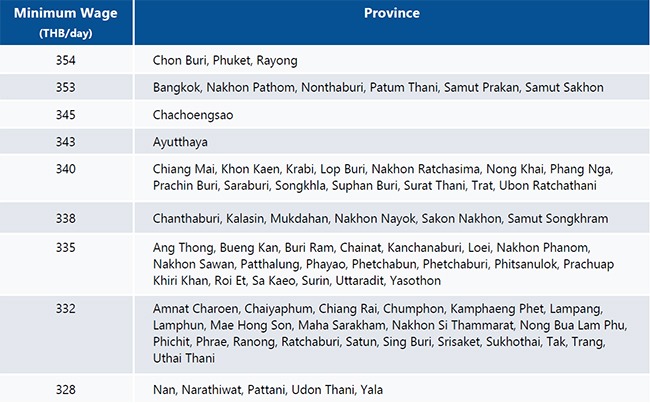
These minimum rates are for one working day, which consists of eight hours for normal work, or seven hours for work that may be harmful to the health and safety of the employee.

Legal Requirements

After the new minimum wages are announced in the Government Gazette, employers may not pay employees wages below the prescribed rates. Violations are punishable by imprisonment for up to six months, a fine of up to THB 100,000, or both.

Regarding the question of whether employers can reduce the working hours in order to pay less than minimum wages (e.g., a prorated amount), based on past practice, the National Wage Committee’s announcement is expected to provide that a “day” refers to an employee’s normal working day, regardless of whether it is shorter than the “normal working hours” set by the employer under the Labor Protection Act.

For example, an employee in Bangkok who earns the current minimum wage of THB 331 per day for normal working hours of eight hours a day would still be entitled to the full new rate of THB 353 per day in October 2022, even if the employer reduces the working hours.

For further information on Thailand’s minimum wage regulations, or on any aspect of employment law in Thailand, please contact Tilleke & Gibbins at [email protected] or +66 2056 5555.

RELATED INSIGHTS​ 

April 12, 2024
On April 10, 2024, new minimum wage rates for workers in certain hotels in Thailand were published in the Government Gazette, taking effect on April 13, 2024. Under the Notification of the National Wage Committee on Minimum Wage Rate for the Hotel Industry, the new minimum wage rate is THB 400 per day, applicable to employees working in four-star (and above) hotels that have at least 50 employees and are located in the following specific areas: Bangkok: Pathumwan and Wattana districts Krabi: Ao Nang Subdistrict Administrative Organization areas Chon Buri: Pattaya city Chiang Mai: Chiang Mai municipality Prachuap Khiri Khan: Hua Hin municipality Phang-nga: Khukkhak sub-district municipality Phuket: Whole province Rayong: Phe subdistrict Songkhla: Hat Yai municipality Surat Thani: Koh Samui municipality Rationale The increase in the minimum wage is to drive and stimulate the economy in Thailand’s tourism industry, which is critical to the overall economy of the country. The ten areas identified above are those that earn a significant portion of their revenue from tourism. The decision underwent a public hearing process involving stakeholders. Although there were objections from some hotels claiming they were not yet ready to bear the increased costs, the law was enacted, taking effect on April 13, 2024. For more information on Thailand’s minimum wage regulations, or on any aspect of employment law in Thailand, please contact Pimvimol (June) Vipamaneerut at [email protected], Ketnut Pukahuta at [email protected], Dusita Khanijou at [email protected], or Chomanut Arif at [email protected].
March 27, 2024
Cambodia’s Ministry of Labor and Vocational Training issued the Notification on the Compensation for Terminating an Employment Contract on March 21, 2024, clarifying the compensation due to employees upon the termination of their employment contracts. The notification outlines different requirements depending on the nature of the termination and the type of employment contract, as laid out below. Termination without Valid Reason and in Absence of Serious Misconduct If an employment contract has been terminated by an employer without a valid reason and the employee did not commit any serious misconduct as defined under the relevant article of the Labor Law, the employer must compensate the employee as follows: Fixed-Duration Contract: Wages that have not yet been paid; Unused and unpaid annual leave through the termination date; Severance payment equal to at least 5% of the wages paid to the employee during the length of the contract; and Damages for being laid off before the expiration date of the fixed-duration contract, at least equal to the wages the employee would have received had he or she completed the original contracted term of employment. Unspecified-Duration Contract: Wages that have not yet been paid; Unused and unpaid annual leave through the termination date; Compensation in lieu of notice if the employer did not give prior notice in accordance with the Labor Law; Seniority indemnity for the semester that the employee is terminated and total seniority back payments that have not been paid; and Damages for being laid off, in an amount equal to the seniority payment received during the employment contract. Termination in Cases of Serious Misconduct Employees who commit any serious misconduct as defined under the Labor Law (regardless of whether they are under a fixed-duration or unspecified-duration contract) are entitled only to the following compensation: Wages that have not yet
March 18, 2024
Lawyers from Tilleke & Gibbins’ labor and employment team have contributed a new Vietnam chapter to Thomson Reuters Practical Law’s Employment and Employee Benefits Global Guide. The guide provides a high-level comparative overview of employment laws and regulations across various jurisdictions around the world. Tilleke & Gibbins also contributed the Myanmar chapter of the guide. The Vietnam chapter covers a wide range of typical employment matters, such as limitations on working hours, paid leave requirements, minimum wage, and health and safety obligations. In addition, the guide provides insight on a number of topics of special interest to foreign investors doing business in Vietnam, including the following: Mandatory contents of a labor contract; Visas and permits required for expatriate employees; Employers’ obligations for protecting employees’ privacy and personal data; Procedural requirements for the dismissal of an employee; Employer and parent company liability. To view the latest version of Employment and Employee Benefits, please visit the Practical Law website and enroll in the free Practical Law trial to gain full access.
February 28, 2024
The Myanmar Investment Commission (MIC) has announced the opening of the trial period for MIC-permitted or MIC-endorsed companies to reenter investment data for using the Myanmar Investment Online (MyInO) system. The trial period is open until June 30, 2024. The MyInO system allows for the submission and recordal of applications for investment under the Myanmar Investment Law. With the implementation of phase 2 from September 1, 2023, applications for the appointment or resignation of foreign experts and employees within MIC-permitted or MIC-endorsed companies can now be submitted manually or through the Investment Monitoring System available on MyInO. To initiate the application process in MyInO, applicants are required to create an account on the platform. Subsequently, companies holding an MIC permit or endorsement must reenter all investment-related data since the obtaining of the relevant permits/endorsements, in compliance with the announcement. Following this data update, applications can be filed through MyInO. After this trial period, the submission of applications for appointments will be available online. The benefit of using MyInO to submit a foreign expert or employee appointment or resignation application is that the application can be submitted within 30 days of the foreign expert’s arrival in Myanmar. In contrast, hard copy applications must be submitted within seven working days of arrival. According to the Myanmar Investment Law, a foreign expert is one who qualifies as a senior manager, technical or operational expert, or advisor in permitted or endorsed companies within Myanmar. For assistance with completing the investment data reentry process or filing applications for appointment or resignation of foreign experts or employees, or for further details on any aspect of the Investment Monitoring System under MyInO, please contact Tilleke & Gibbins at [email protected].