
You are using an outdated browser and your browsing experience will not be optimal. Please update to the latest version of Microsoft Edge, Google Chrome or Mozilla Firefox. Install Microsoft Edge

August 30, 2022

New Minimum Wages in Thailand

On August 26, 2022, Thailand’s National Wage Committee voted to raise the minimum wage to THB 328–354 per day (USD 9.01–9.72)—an increase of approximately 5% from the previous range of THB 313–336. The decision to boost minimum wages, which were last increased in January 2020, came after a 14-year-high headline inflation rate of 7.61% in July 2022.

The new minimum wages have been submitted to the cabinet for final approval and are expected to take effect on October 1, 2022, following publication in the Government Gazette. The exact minimum wage depends on the province in which the workplace is located, as shown in the table below.
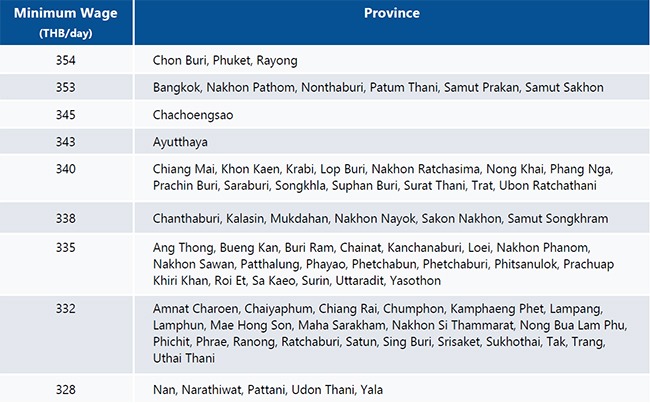
These minimum rates are for one working day, which consists of eight hours for normal work, or seven hours for work that may be harmful to the health and safety of the employee.

Legal Requirements

After the new minimum wages are announced in the Government Gazette, employers may not pay employees wages below the prescribed rates. Violations are punishable by imprisonment for up to six months, a fine of up to THB 100,000, or both.

Regarding the question of whether employers can reduce the working hours in order to pay less than minimum wages (e.g., a prorated amount), based on past practice, the National Wage Committee’s announcement is expected to provide that a “day” refers to an employee’s normal working day, regardless of whether it is shorter than the “normal working hours” set by the employer under the Labor Protection Act.

For example, an employee in Bangkok who earns the current minimum wage of THB 331 per day for normal working hours of eight hours a day would still be entitled to the full new rate of THB 353 per day in October 2022, even if the employer reduces the working hours.

For further information on Thailand’s minimum wage regulations, or on any aspect of employment law in Thailand, please contact Tilleke & Gibbins at [email protected] or +66 2056 5555.

RELATED INSIGHTS​ 

February 9, 2024
Tilleke & Gibbins employment specialists in Myanmar have contributed an updated Employment and Employee Benefits in Myanmar overview for Thomson Reuters Practical Law, an online publication that provides an overview of employment and employee benefits in jurisdictions worldwide. The Myanmar overview was written by members of Tilleke & Gibbins’ Yangon office, including Yuwadee Thean-ngarm, director; Nwe Oo, senior associate; and Kyaw Min Tun, associate. The chapter covers a wide range of key employment topics, including employment status, background checks, regulation of the employment relationship, minimum wage, working hours and holidays, illness and injury of employees, discrimination and harassment, termination of employment, resolution of employer-employee disputes, redundancy/layoffs, employee representation and consultation, business transfer and insolvency, employee relocation, health and safety obligations, taxation of employment income, intellectual property issues, and more. Practical Law, one of the many legal reference resources from Thomson Reuters, publishes a wide range of guides for hundreds of jurisdictions and practice areas. The Employment and Employee Benefits Global Guide covers 44 jurisdictions around the world, with Tilleke & Gibbins also providing the Vietnam chapter of the guide. To view the latest version of the Employment and Employee Benefits in Myanmar overview, please visit the Practical Law website and enroll in the free Practical Law trial to gain full access.
January 12, 2024
On December 28, 2023, Cambodia’s Ministry of Labor and Vocational Training (MLVT) issued Notification No. 110/23 on the issuance of work permits for foreign employees, in accordance with the country’s Labor Law and Prakas 195 dated August 20, 2014, on work permits and employment cards for foreign employees. This is a more comprehensive notification than existed previously, as it specifically clarifies the parties that are required to apply for work permits and employment cards. Notification No. 110/23 specifies that the following types of foreign individuals must hold a valid foreign work permit and/or employment card in order to work in Cambodia: A foreign employer whose name is stated in an enterprise’s patent tax certificate must hold a foreign work permit. A foreign employee whose name is stated in an enterprise’s patent tax certificate must hold a foreign work permit and an employment card. Self-employed individuals must hold a foreign work permit and an employment card. Applications for work permits and employment cards can be submitted through the MLVT’s online portal, accompanied by the following required documents: Valid passport; Latest patent tax certificate; Physical examination form; and Photo (4×6 cm) However, foreign shareholders and members of the board of directors as defined in the company’s articles of incorporation who do not have a Cambodian resident visa are not required to obtain a work permit or employment card. For more information on regulations and requirements for foreign employees in Cambodia, please contact Tilleke & Gibbins at [email protected].
December 15, 2023
Tilleke & Gibbins’ office in Yangon provided the Myanmar chapter to the Guide to Restructuring a Cross-Border Workforce from International Employment Lawyer. This global guide, which covers 45 jurisdictions worldwide, examines the issue of workplace restructurings, particularly in relation to the needs of multinational companies. The Myanmar chapter was written by Kyaw Min Tun, an associate in the firm’s Myanmar office. The Q&A-style chapter focuses on key areas related to workplace restructuring, covering each of the following topics in detail: Reduction in workforce; Restructuring or reorganization of the business; Changing terms and conditions; and Areas to watch. A PDF of the Myanmar chapter can be downloaded through the button below. Tilleke & Gibbins also provided the Cambodia, Laos, Thailand, and Vietnam chapters to the Guide to Restructuring a Cross-Border Workforce 2024. To browse the full guide for all 45 jurisdictions, please visit the International Employment Lawyer website.
December 15, 2023
Employment law specialists from Tilleke & Gibbins’ office in Vientiane have provided the Laos chapter to the Guide to Restructuring a Cross-Border Workforce from International Employment Lawyer. This global guide, which covers 45 jurisdictions worldwide, examines the issue of workplace restructurings, particularly in relation to the needs of multinational companies. The Laos chapter was written by associates Naiyane Xaechao and Sayphin Singsouvong. The Q&A-style chapter focuses on key areas related to workplace restructuring, covering each of the following topics in detail: Reduction in workforce; Restructuring or reorganization of the business; Changing terms and conditions; and Areas to watch. A PDF of the Laos chapter can be downloaded through the button below. Tilleke & Gibbins also provided the Cambodia, Myanmar, Thailand, and Vietnam chapters to the Guide to Restructuring a Cross-Border Workforce 2024. To browse the full guide for all 45 jurisdictions, please visit the International Employment Lawyer website.