You are using an outdated browser and your browsing experience will not be optimal. Please update to the latest version of Microsoft Edge, Google Chrome or Mozilla Firefox. Install Microsoft Edge

December 4, 2018

New Guarantee Requirement for Direct Sales and Direct Marketing Businesses

A new Ministerial Regulation was published in the Royal Thai Government Gazette  on November 20, 2018, requiring existing business operators who are engaged in direct sales or direct marketing activities to place a guarantee with the Office of the Consumer Protection Board of Thailand (OCPB) within 90 days, i.e. by February 17, 2019.

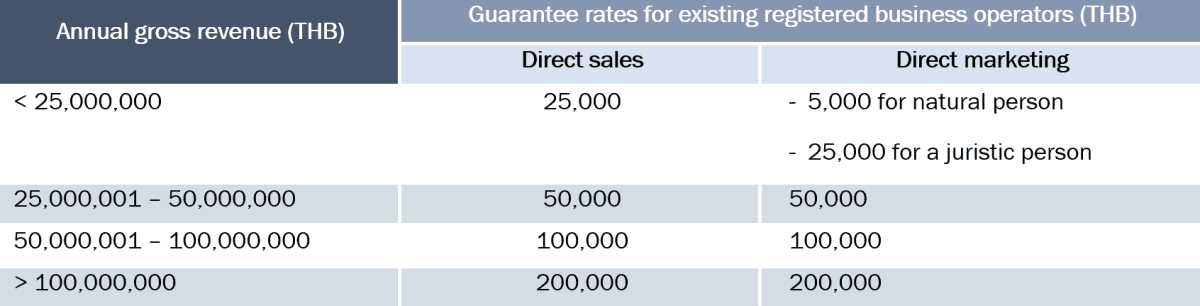
The new regulation, which was issued under the authority of the updated Direct Sales and Direct Marketing Act (No. 3), B.E. 2560 (2017), affects existing registered direct sales and direct marketing business operators and new applicants alike. New applicants will be required to pay a fixed fee, while existing business operators who are already registered will be subject to rates based on their gross revenue.

Guarantees under the new regulation can be made in cash, bank guarantees, government bonds, and state-enterprise bonds.

The key requirements of the Ministerial Regulation are set out below:

  • New applicants must place the required guarantee with the OCPB within 30 days of receiving a notification letter from the OCPB. Failure to place the required guarantee within the prescribed timeframe will result in the OCPB rejecting the application.
  • All existing registered business operators must place the required guarantee with the OCPB by February 17, 2019. Failure to place the required guarantee within the prescribed timeframe may result in the OCPB cancelling their operating license.
  • When placing the guarantee, new applicants or existing registered business operators must use the applicable official form, to be announced by Direct Sales and Direct Marketing Committee.
  • Every registered business operator must inform the OCPB of its gross annual revenue within 60 days of the end of each fiscal year. The OCPB registrar will then determine whether the registered business operator’s guarantee should be increased. If an increase is necessary, the OCPB will notify the registered business operator accordingly, either in writing or electronically. The registered business operator will then have 60 days to comply by placing an additional guarantee. Failure to place the required guarantee within the prescribed timeframe may result in the OCPB cancelling the business operation license.
  • Registered business operators can change the form of a guarantee placed with the OCPB (excluding cash), by submitting a request and a new guarantee.

The rates of guarantees under the Ministerial Regulation are as follows:

Direct sales and direct marketing business operators should ensure that they take all necessary steps to comply with the Ministerial Regulation by the deadline of February 17, 2019. Failure to do so may negatively affect their registration status.

If you have any questions regarding the new guarantee, the new Ministerial Regulation, or any matter concerning direct sales and direct marketing businesses, please feel free contact us at: [email protected], or on +66 2056 5555.

RELATED INSIGHTS​ 

September 15, 2026
The Myanmar Investment Commission (MIC) has issued a notification that gives investors with projects in Myanmar clearer guidance for securing approval and for changing, expanding, or exiting an approved project. Issued on August 19, 2026, MIC Notification No. 5/2026 replaces MIC Notification No. 26/2021 and sets procedures for state or regional investment committees to review, approve, and supervise investment projects, including project amendments, investment increases, land-use rights applications, compliance inspections, and suspension or termination of approved businesses. Endorsement Application Timeline and Deemed Acceptance In Myanmar, prospective investors seeking approval under the Myanmar Investment Law generally do so through an MIC permit or an MIC endorsement, depending on the nature of the investment. While certain large-scale investment projects require an MIC permit, projects that are not required to obtain an MIC permit may instead apply for an MIC endorsement. Investors seeking MIC endorsement for their planned projects typically submit their applications to the relevant state or regional investment committee. These committees are established under the Myanmar Investment Law and are authorized to approve investments of less than USD 5 million, subject to the project’s nature and location. MIC Notification No. 5/2026 specifies that upon receiving an endorsement application, the relevant investment committee office will check it for completeness and determine whether it can be considered at the state or regional level or must be referred to the MIC; if it must be forwarded to the MIC, this will be done within 10 working days. If an application is within its purview, the committee may reject the endorsement application within 15 working days of receipt; otherwise, the application is deemed accepted. If approved, the endorsement certificate will be issued within 10 working days of the approval decision, subject to applicable procedures. Endorsement Certificate Amendment The notification clarifies which amendments a state
September 9, 2026
Certain securities, derivatives, and treasury activities in Thailand were opened to foreign investors when Thailand’s Ministry of Commerce published two new ministerial regulations in the Government Gazette on August 28, 2026. The regulations significantly broaden the service activities that foreign-owned businesses may conduct without a license or certificate under the Foreign Business Act B.E. 2542, as amended (FBA). Securities and Derivatives Business Exemptions Prior to the issuance of these ministerial regulations, the exemptions covered (1) securities brokerage and derivatives brokerage with their only underlying assets being agricultural commodities, financial instruments, and securities; and (2) dealers, advisers, and fund managers conducting derivatives business under Thailand’s derivatives laws. The ministerial regulations provide broader exemptions. In addition to derivatives under the laws on derivatives as before, the following two major categories are provided: Derivatives whose underlying assets or variables fall outside the scope of Thailand’s laws on derivatives. This addresses a gap in the previous framework, which did not comprehensively exempt derivatives tied to nonregulated underlying assets or variables, such as certain commodities. Foreign brokers, advisors, and fund managers can now facilitate a broader range of hedging and risk management instruments without triggering FBA licensing requirements. Derivatives traded outside a derivatives exchange, or over the counter (OTC), whose payments are calculated by reference to foreign exchange rates or interest rates. This removes an FBA licensing barrier for foreign providers of widely used OTC hedging products, broadening the solutions available to importers and exporters managing currency exposure and to borrowers seeking greater certainty over financing costs. The ministerial regulations also exempt brokers and agents handling transactions involving either of these two derivatives categories. For securities businesses, the ministerial regulations add exemptions for margin loans used to purchase securities and for securities repurchase transactions. These additions clarify whether such activities qualify as exempt brokerage
September 4, 2026
Foreign business restrictions on telecommunications, treasury center businesses, and intragroup support services were eased when Thailand published the Ministerial Regulation Prescribing Service Businesses Not Requiring Permission for Foreign Business Operations (No. 5) B.E. 2569 (2026) in the Government Gazette on August 28, 2026. The ministerial regulation expands the categories of service businesses that foreign investors may operate without a foreign business license (FBL) under the Foreign Business Act B.E. 2542 (1999) (FBA). Of particular relevance to the telecommunications, fintech, and technology sectors, the ministerial regulation exempts: Type 1 telecommunications licensees, which do not have their own networks; Treasury center businesses operated in accordance with Thailand’s exchange control regulations; and Certain intragroup administrative, human resources, and information technology management services. Telecommunications Services Foreign-owned businesses providing telecommunications services under a type 1 telecommunications license may now operate without obtaining an FBL. This may streamline market entry for qualifying telecommunications and digital infrastructure businesses. The exemption applies only to the FBA licensing requirement. Operators must continue to comply with applicable requirements under the Telecommunications Business Act and the regulations of the National Broadcasting and Telecommunications Commission, and the change does not affect foreign ownership restrictions applicable to type 2 or type 3 telecommunications businesses. Treasury Center Businesses The ministerial regulation also exempts qualifying treasury center businesses from the FBL requirement. This may facilitate centralized treasury functions in Thailand, including liquidity management, foreign exchange management, and intragroup funding arrangements. Treasury center operations remain subject to applicable requirements of the Bank of Thailand and other competent authorities. Intragroup Administrative, HR, and IT Services Certain administrative, human resources, and information technology management services provided between affiliated entities are also exempt, provided the relevant entities satisfy prescribed ownership or management criteria. The exemption is available where the service provider and recipient are related through specified ownership
September 1, 2026
Thailand has taken another step toward liberalizing its foreign business framework, exempting additional service activities and derivatives brokerage or agency businesses from the licensing requirements of the Foreign Business Act (FBA). Since the FBA came into effect, Thailand has taken a measured approach to opening its economy to foreign investment. While the FBA regulates foreign participation in businesses that may affect domestic interests, the framework has also evolved to allow foreign participation in certain business activities where sector-specific laws and regulatory frameworks already provide sufficient oversight, making additional FBA restrictions unnecessary. This is particularly true where Thai businesses are sufficiently capable of competing in certain service sectors, or where liberalization is intended to facilitate the provision of services among companies within the same corporate group. Against this backdrop, two new ministerial regulations have been issued pursuant to the FBA. Service Businesses Under the FBA Under the FBA, certain categories of business are restricted for foreign operators. List 3 of the FBA sets out businesses that foreigners may operate only if they obtain a foreign business license (FBL) or a foreign business certificate (FBC), or unless a specific exemption applies. List 3 (21) covers “other service businesses,” which is a catch-all provision that captures a wide range of service businesses not specifically enumerated elsewhere in the FBA. In practice, this means that most service activities carried on by foreigners in Thailand require an FBL or FBC unless otherwise exempted. Notwithstanding the foregoing, the FBA provides a mechanism to address this breadth by empowering the Minister of Commerce to issue ministerial regulations excluding specific types of service businesses from List Three (21). Once a service business is so excluded, foreigners may operate it without obtaining an FBL or FBC. Prior to the new regulations, four ministerial regulations had been issued to