
You are using an outdated browser and your browsing experience will not be optimal. Please update to the latest version of Microsoft Edge, Google Chrome or Mozilla Firefox. Install Microsoft Edge

December 28, 2017

New Decree on Minimum Wage Increases in Vietnam

On December 7, 2017, the government issued Decree No. 141/2017/ND-CP stipulating new minimum wage requirements for employees working under labor contracts (Decree 141). Under the provisions of Decree 141, which will apply from January 1, 2018, the monthly minimum wage will be increased by VND 180,000 to 230,000 (USD 7.92 to 10.13), depending on the region.

Levels of Increase  

Decree 141 determines four minimum wage rates in Vietnam for four different regions (cumulatively covering the whole country). Each region is evaluated according to its socio-economic development, costs of living, and location. The specific level of minimum wage increase applied in each region is summarized in the table below:
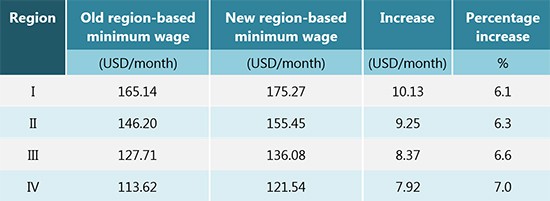
As such, by January 1, 2018, the average minimum wage will increase by about 6.5 percent.
 

Adjusted Regions

As mentioned above, the minimum wages vary across four geographical regions. The number of regions remains unchanged in the new decree, but there are slight adjustments to the list of cities/provinces which each region covers.

Under Decree 141, Region I spans the urban areas of Hanoi and Ho Chi Minh City. Region II covers the rural areas of Hanoi and Ho Chi Minh City, in addition to the urban localities of Can Tho City, Da Nang City, and Hai Phong City. Region III comprises the provincial cities of Bac Ninh Province, Bac Giang Province, Hai Duong Province, and Vinh Phuc Province, while Region IV covers the remaining localities. Some cities/provinces are moved up from Region II to Region I, from Region III to Region II, and from Region IV to Region III, while some others are moved down a level.

Reasons and Impacts

According to the Ministry of Labor, Invalids and Social Affairs, the level of minimum wage increase was calculated based on the necessary compensation for daily living expenses in 2017 to ensure that employees meet their minimum needs. Once Decree 141 comes into effect, the new minimum wages should help meet about 92-96% of the minimum living demands of employees and their families, depending on the region.

The above-mentioned adjustment plan was given taking into account the impacts of minimum wage increase on various matters such as jobs, unemployment, difficulties in manufacturing and trading, conditions of enterprises, minimum living requirements of employees and their dependents, etc. In particular, the adjustment plan was also affected by the new provisions which expand the range of employees who are subject to the statutory social insurance contribution (according to which employees with a labor contract of one month or more must participate in the social insurance scheme, as opposed to those with a contract of three months and more as presently), and the new salary will be used as the basis for payment of statutory insurance contributions.

As a result, the raise will meet basic living costs and certainly improve the living standards of employees and their families. However, on the other hand, the expenditures of enterprises will increase, as they must not only adjust the monthly salary of their workers, but must also increase their statutory insurance contributions.

RELATED INSIGHTS​ 

May 28, 2025
Tilleke & Gibbins attorneys in Vietnam have contributed the 2025 edition of Doing Business in Vietnam, a comprehensive Q&A-style resource from Thomson Reuters Practical Law that provides essential insights for companies navigating business operations in Vietnam. The guide presents a detailed overview of the country’s legal framework and regulatory environment, reflecting recent updates in Vietnamese legislation and practice. This annually updated guide offers key information on the following areas: Legal system: Structure of the Vietnamese judiciary and the role of codified law. Foreign investment: Conditions for market access, licensing requirements, foreign ownership restrictions, and investment incentives. Business vehicles: Formation and operation of legal entities, including limited liability companies, joint-stock companies, and representative offices. Employment: Employment contracts, social insurance, labor rights, and procedures for hiring foreign nationals. Tax: Overview of corporate income tax, personal income tax, value-added tax, and other tax obligations. Intellectual property: Procedures for protecting and enforcing patents, trademarks, copyrights, and other IP rights. Data protection: Compliance requirements under Vietnam’s data privacy laws, including the Personal Data Protection Decree. Competition law: Antitrust rules and regulatory oversight under the Law on Competition. Anti-bribery and corruption: Legal framework and enforcement practices aimed at curbing corrupt activities. E-commerce and digital business: Regulations governing online platforms, digital content, and cross-border services. Marketing and advertising: Laws and guidelines on advertising standards and consumer protection. Product regulation and liability: Safety requirements, product liability issues, and roles of relevant authorities. Doing Business in Vietnam is part of Practical Law’s global series of legal guides designed to support international practitioners and businesses. To access the most recent edition of the Vietnam guide, visit the Practical Law website and sign up for a free trial.
May 28, 2025
On May 6, 2025, Cambodia’s Ministry of Labor and Vocational Training (MLVT) issued Prakas No. 112/25 on Overtime Work, Work on Paid Holidays, and Suspension of Weekly Days Off, which outlines specific conditions, formalities, and procedures in relation to working overtime, work on paid holidays, and suspension of weekly days off. Overtime Work Employees may be requested to perform overtime work based on the operational needs of the employer, particularly in the following circumstances: When undertaking special assignments related to inventory and balance sheets, liquidation deadlines, and closing of accounting books. In cases of excessive workload arising from exceptional circumstances where alternative measures are not feasible for the employer. However, the overtime work must be conducted voluntarily and must not be enforced through coercion or disciplinary action. Although this new prakas on overtime work does not specify the maximum allowable hours of overtime work, the Labor Law states that overtime must not cause total working hours to exceed 10 hours per day, except in cases of disaster prevention or rectification. Work on Paid Public Holidays Employees are entitled to paid public holidays announced annually by the MLVT. However, when work cannot be suspended, employees may be requested to perform work on paid public holidays on a voluntary basis. Suspension of Weekly Days Off When urgent work is required to prevent imminent accidents or to repair damage to materials, facilities, or buildings, weekly days off may be suspended for up to two nonconsecutive days per month. This applies to both employees of the affected enterprise and those of external entities engaged in the repairs of the affected enterprise. Reduction of Weekly Days Off Due to Weather Certain categories of enterprises are permitted to reduce employees’ weekly days off by up to two nonconsecutive days per month as compensation for working
May 9, 2025
On May 6, 2025, Cambodia’s Ministry of Labour and Vocational Training (MLVT) issued Prakas No. 113/25, introducing new obligations for enterprise owners and directors regarding the use and maintenance of enterprise payroll books. Under this prakas, enterprise owners or directors are required to: Utilize and maintain the enterprise payroll book in accordance with the official template provided by the MLVT. Make the enterprise payroll book available to labor inspectors for annotations related to compliance with labor laws and regulations. Review and adjust (if necessary) internal practices based on any findings, recommendations, and restrictions issued by labor inspectors during inspections. The official enterprise payroll book template can be downloaded via the ministry’s Labor Automated Central Management System (LACMS). Additional requirements include: Retention of supporting documents related to the payroll book at the enterprise’s head office to facilitate inspections. Preservation of completed payroll books for a minimum of three years after their closure. Downloading a new payroll book from the LACMS once the current one is fully used. Labor inspectors are authorized to conduct inspections of the payroll book and related documentation at any time. Noncompliance with the provisions of Prakas No. 113/25 may result in significant monetary penalties, as stipulated in Cambodia’s Labour Law. This prakas also repeals Prakas No. 268, dated October 11, 2001, and any provisions in related regulations that conflict with Prakas No. 113/25. All enterprises are strongly advised to comply with the new requirements and begin using the updated enterprise payroll book template from the LACMS to avoid potential penalties.
May 2, 2025
Attorneys from Tilleke & Gibbins have updated the latest edition of Doing Business in Thailand, a Q&A-style guide from Thomson Reuters Practical Law that offers an overview of key legal considerations for companies operating in jurisdictions worldwide. The contribution outlines the country’s legal and regulatory framework for foreign investment and business operations and reflects the latest legislative developments. The chapter addresses the following core topics: Legal system: Structure of the courts and the codified nature of Thai law. Foreign investment: Business restrictions under the Foreign Business Act, sector-specific regulations, exchange control rules, and investment incentives. Business vehicles: Overview of partnerships, private and public limited companies, and other legal entities. Employment: Labor protections, employment contracts, foreign worker requirements, and termination procedures. Tax: Corporate and personal income tax, indirect taxes, and tax obligations for residents and non-residents. Intellectual property: Registration and enforcement of patents, trademarks, designs, and copyrights. Data protection: Key provisions of the Personal Data Protection Act and related compliance obligations. Competition law: Regulatory framework under the Trade Competition Act. Anti-bribery and corruption: Relevant legislation and enforcement mechanisms. E-commerce and digital business: Legal regime for online transactions and digital platforms. Marketing and advertising: Consumer protection laws and regulations affecting advertising and marketing practices. Product regulation and liability: Safety standards, liability regimes, and roles of enforcement authorities. Practical Law, a legal reference resource from Thomson Reuters, publishes a range of guides for hundreds of jurisdictions and practice areas. The insurance and reinsurance guide is a valuable resource for legal practitioners, covering numerous jurisdictions worldwide. To view the latest version of the guide, please visit the Practical Law website and enroll in the free Practical Law trial to gain full access.