
You are using an outdated browser and your browsing experience will not be optimal. Please update to the latest version of Microsoft Edge, Google Chrome or Mozilla Firefox. Install Microsoft Edge

December 28, 2017

New Decree on Minimum Wage Increases in Vietnam

On December 7, 2017, the government issued Decree No. 141/2017/ND-CP stipulating new minimum wage requirements for employees working under labor contracts (Decree 141). Under the provisions of Decree 141, which will apply from January 1, 2018, the monthly minimum wage will be increased by VND 180,000 to 230,000 (USD 7.92 to 10.13), depending on the region.

Levels of Increase  

Decree 141 determines four minimum wage rates in Vietnam for four different regions (cumulatively covering the whole country). Each region is evaluated according to its socio-economic development, costs of living, and location. The specific level of minimum wage increase applied in each region is summarized in the table below:
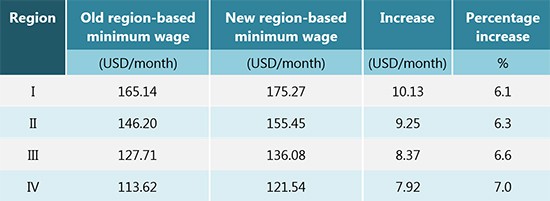
As such, by January 1, 2018, the average minimum wage will increase by about 6.5 percent.
 

Adjusted Regions

As mentioned above, the minimum wages vary across four geographical regions. The number of regions remains unchanged in the new decree, but there are slight adjustments to the list of cities/provinces which each region covers.

Under Decree 141, Region I spans the urban areas of Hanoi and Ho Chi Minh City. Region II covers the rural areas of Hanoi and Ho Chi Minh City, in addition to the urban localities of Can Tho City, Da Nang City, and Hai Phong City. Region III comprises the provincial cities of Bac Ninh Province, Bac Giang Province, Hai Duong Province, and Vinh Phuc Province, while Region IV covers the remaining localities. Some cities/provinces are moved up from Region II to Region I, from Region III to Region II, and from Region IV to Region III, while some others are moved down a level.

Reasons and Impacts

According to the Ministry of Labor, Invalids and Social Affairs, the level of minimum wage increase was calculated based on the necessary compensation for daily living expenses in 2017 to ensure that employees meet their minimum needs. Once Decree 141 comes into effect, the new minimum wages should help meet about 92-96% of the minimum living demands of employees and their families, depending on the region.

The above-mentioned adjustment plan was given taking into account the impacts of minimum wage increase on various matters such as jobs, unemployment, difficulties in manufacturing and trading, conditions of enterprises, minimum living requirements of employees and their dependents, etc. In particular, the adjustment plan was also affected by the new provisions which expand the range of employees who are subject to the statutory social insurance contribution (according to which employees with a labor contract of one month or more must participate in the social insurance scheme, as opposed to those with a contract of three months and more as presently), and the new salary will be used as the basis for payment of statutory insurance contributions.

As a result, the raise will meet basic living costs and certainly improve the living standards of employees and their families. However, on the other hand, the expenditures of enterprises will increase, as they must not only adjust the monthly salary of their workers, but must also increase their statutory insurance contributions.

RELATED INSIGHTS​ 

April 22, 2025
Thailand’s Immigration Bureau has announced the launch of the Thailand Digital Arrival Card (TDAC) as part of ongoing efforts to improve entry procedures and streamline immigration processing. Effective May 1, 2025, all foreign nationals with any type of visa entering Thailand by any means will be required to complete the TDAC online prior to arrival. This requirement does not apply to individuals transiting or transferring through Thailand without passing through immigration control, or to those entering with a border pass. Foreign nationals planning to enter Thailand must complete and submit their TDAC within the three days prior to their arrival date. The form, which collects passport information, personal details, travel information (e.g., flight number), Thai accommodation information, and a health declaration—can be filled out in English online at https://tdac.immigration.go.th. Once the form is submitted, an acknowledgment will be sent to the email address entered on the form. This acknowledgment must be presented at the immigration checkpoint in Thailand along with travel documents for verification. The Thai government strongly encourages all foreign passport holders to complete the TDAC ahead of their departure to prevent any entry delays or issues at the checkpoint.
April 18, 2025
On March 31, 2025, Cambodia’s Ministry of Labour and Vocational Training (MLVT) issued Notification 009/25, which grants an extension for the renewal of foreign workers’ work permits and employment books in 2025. This extension is to ensure that those who have not yet applied for the renewal of their work permits are provided with sufficient time to complete the application process, as there have been delays in the submission of work permit extension requests. The new deadline for the submission of renewal applications for work permits and employment books is April 30, 2025. Applications and renewals must be processed via the MLVT’s online Foreign Workforce Centralized Management System before the specified deadline. Failure to extend the validity of work permits and employment books for foreign workers before the deadline may result in significant monetary penalties for both employers and foreign nationals. All foreign workers should renew their work permits and employment books within the extended deadline to ensure continued validity for working in Cambodia.
March 13, 2025
The recent freeze on US foreign aid has led to the suspension of billions of dollars in foreign assistance as well as widespread layoffs at contracting organizations around the world. Under this situation, USAID-funded offices in all jurisdictions, including Cambodia, may face the challenge of determining whether they need to lay off their employees. Employers in Cambodia may take different steps in response to this and other instances of sudden financial stress in order to manage their workforce in accordance with Cambodian laws and regulations. Suspension Cambodia’s Labor Law allows employers to suspend employment contracts due to a major economic or material issue or any unexpected difficulty that results in the suspension of operations. To impose this employment contract suspension, the employer must initially submit a suspension request to the Ministry of Labor and Vocational Training (MLVT), detailing the reasons for the requested suspension. If the reasons are deemed valid and the request is approved, the suspension period cannot exceed two months. During the suspension period, the employer must continue providing accommodation for employees if this benefit is already being provided. In some circumstances, the suspension period can be extended if necessary (as happened during the COVID-19 pandemic). However, financial difficulties alone may not be a valid reason for extension. The decision is at the discretion of the MLVT labor inspectors on a case-by-case basis. Therefore, given the uncertain timeline of financial difficulties that may significantly impact the employer’s budget, suspending employment contracts might be ineffective. Mass Layoffs Under Cambodia’s Labor Law, mass layoffs due to a significant reduction in an establishment’s operation or an internal reorganization foreseen by the employer are permissible. The layoff order must be based on professional qualifications, seniority period, and family burdens of the employees. The first employees to be laid off must be
February 25, 2025
On February 4, 2025, Thailand’s Board of Investment (BOI) issued Announcement No. Por. 3/2568, introducing updated qualifications, criteria, and conditions for long-term resident (LTR) visas. The updated requirements took effect immediately upon issuance of the announcement. The LTR program is intended to stimulate the economy and attract high-potential foreign nationals to Thailand, and these latest updates aim to expand access to a wider range of experts, investors, and executives to reinforce Thailand’s foreign talent pool and enhance its competitiveness. The recent updates primarily affect three categories under the LTR visa program: work-from-Thailand professionals, wealthy global citizens, and high-skilled professionals, as detailed below. Work-from-Thailand Professionals The updated LTR visa program includes some changes to the eligibility criteria for visa applicants in the work-from-Thailand professionals category: The revenue requirement for visa applicants’ employers is now USD 50 million over a three-year period, down from USD 150 million previously. Eligible foreign employers now include wholly owned subsidiaries of: companies listed on any stock exchange in any country; or private companies that have been in operation for at least three years and have generated a combined revenue of at least USD 50 million over the past three years. There are no longer work experience requirements. The other requirements remain the same. Wealthy Global Citizens For the wealthy global citizens category, the latest updates remove the requirement to have an annual personal income of USD 80,000, while the other criteria remain. Highly Skilled Professionals For the highly skilled professionals category, the latest updates expand eligibility to include lecturers in vocational or higher education, and remove work experience requirements. Other categories The updated LTR visa program does not introduce any changes for the wealthy pensioners category. However, the announcement does expand the scope of eligible dependents of LTR visa holders to cover parents and a