
You are using an outdated browser and your browsing experience will not be optimal. Please update to the latest version of Microsoft Edge, Google Chrome or Mozilla Firefox. Install Microsoft Edge

December 28, 2017

New Decree on Minimum Wage Increases in Vietnam

On December 7, 2017, the government issued Decree No. 141/2017/ND-CP stipulating new minimum wage requirements for employees working under labor contracts (Decree 141). Under the provisions of Decree 141, which will apply from January 1, 2018, the monthly minimum wage will be increased by VND 180,000 to 230,000 (USD 7.92 to 10.13), depending on the region.

Levels of Increase  

Decree 141 determines four minimum wage rates in Vietnam for four different regions (cumulatively covering the whole country). Each region is evaluated according to its socio-economic development, costs of living, and location. The specific level of minimum wage increase applied in each region is summarized in the table below:
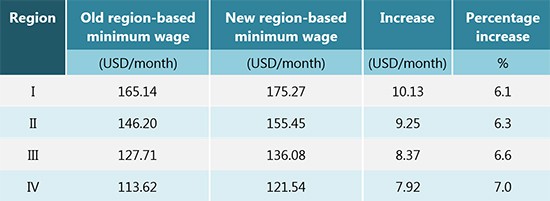
As such, by January 1, 2018, the average minimum wage will increase by about 6.5 percent.
 

Adjusted Regions

As mentioned above, the minimum wages vary across four geographical regions. The number of regions remains unchanged in the new decree, but there are slight adjustments to the list of cities/provinces which each region covers.

Under Decree 141, Region I spans the urban areas of Hanoi and Ho Chi Minh City. Region II covers the rural areas of Hanoi and Ho Chi Minh City, in addition to the urban localities of Can Tho City, Da Nang City, and Hai Phong City. Region III comprises the provincial cities of Bac Ninh Province, Bac Giang Province, Hai Duong Province, and Vinh Phuc Province, while Region IV covers the remaining localities. Some cities/provinces are moved up from Region II to Region I, from Region III to Region II, and from Region IV to Region III, while some others are moved down a level.

Reasons and Impacts

According to the Ministry of Labor, Invalids and Social Affairs, the level of minimum wage increase was calculated based on the necessary compensation for daily living expenses in 2017 to ensure that employees meet their minimum needs. Once Decree 141 comes into effect, the new minimum wages should help meet about 92-96% of the minimum living demands of employees and their families, depending on the region.

The above-mentioned adjustment plan was given taking into account the impacts of minimum wage increase on various matters such as jobs, unemployment, difficulties in manufacturing and trading, conditions of enterprises, minimum living requirements of employees and their dependents, etc. In particular, the adjustment plan was also affected by the new provisions which expand the range of employees who are subject to the statutory social insurance contribution (according to which employees with a labor contract of one month or more must participate in the social insurance scheme, as opposed to those with a contract of three months and more as presently), and the new salary will be used as the basis for payment of statutory insurance contributions.

As a result, the raise will meet basic living costs and certainly improve the living standards of employees and their families. However, on the other hand, the expenditures of enterprises will increase, as they must not only adjust the monthly salary of their workers, but must also increase their statutory insurance contributions.

RELATED INSIGHTS​ 

May 10, 2021
Attorneys from Tilleke & Gibbins’ offices in Myanmar, Thailand, and Vietnam have contributed chapters on labor law in these jurisdictions to the Global Employment Law Guide, published by Lex Mundi. The guide provides answers to key employment-related legal questions in 57 jurisdictions around the world, with all entries provided by member firms in the global Lex Mundi legal network. Each chapter contains in-depth information on the jurisdiction’s legal framework governing employment relationships, including coverage of the following topics: Employment categories and contract types Employee rights and protections Employment termination Leave and social benefits Restrictive covenants COVID-19 vaccination mandates and post-pandemic workplace reopening Readers can browse the contributions, generate country-specific reports, and compare attorney-client privilege in multiple jurisdictions. For more information, please visit the Lex Mundi website.
March 2, 2021
Maintaining positive employee relations is a top concern for virtually all companies. Many companies in Thailand—especially those located in the country’s industrial estates—have labor unions, while others rely on other non-union pathways for attending to the concerns of employees. In all of these cases, the union or collective group of employees also chooses members of the “employee committee” that is charged with fostering good relations and open communications with the employer through regular meetings dedicated to discussion of workplace matters. Companies with a workforce of 50 or more employees need to understand the roles of the employee committee and the specific rights accorded to the committee members, which are different from the rights of the other employees. Besides the obvious benefits that this understanding has for relations with their employees, it is also important if an employer takes disciplinary action against employee committee members, as violation of a committee member’s rights could result in the employer facing criminal penalties. The legal basis for these employee committees is the Labor Relations Act B.E. 2518 (LRA), which stipulates that in any workplace with at least 50 employees, the employees or their labor union of the business establishment is entitled to establish an employee committee. Members are elected (or, in the case of a labor union, appointed) to three-year terms on the committee, with the total number of committee members depending on the size of the workforce, as shown in the table. Membership Requirements Among partially unionized workforces, labor unions are generally given precedence when it comes to control of the committee. If a labor union whose members account for more than 20% of the total employees in a workplace, the union gets to appoint the majority of the employee committee members (e.g., four out of a seven-person committee, five of a
February 23, 2021
As many are already aware, following the change of government in Myanmar on February 1, 2021, a draft Cyber Security Law was proposed which attracted widespread criticism. However, less attention has been paid to significant amendments to two existing laws, some of which have a similar effect to parts of the draft Cyber Security Law. In other words, while the draft Cyber Security Law has not progressed further and is under public scrutiny, significant elements of it have found their way into law in Myanmar by other routes. Because these amendments are already law, it is very important that individuals and businesses in Myanmar understand their implications. Amendments to the Law Protecting the Privacy and Security of Citizens The Law Protecting the Privacy and Security of Citizens (2017), or the “Privacy Law,” was amended on February 13, 2021, less than two weeks after the military government came into power. These amendments chiefly address the power of the government to conduct searches, seizures, and arrests; to extend detention without judicial oversight; and to carry out broad surveillance and investigation activities that could intrude on individual privacy. The amendments accomplish this by suspending various sections of the Privacy Law for as long as the State Administration Council (the military body now governing Myanmar) is in power. The suspended sections include the following: Section 5: Search, seizure, and arrest without civilian observation The relevant part of Section 5 of the Privacy Law states, “The responsible authorities shall … when acting in accordance with existing law, not enter into a person’s residence or a room used as a residence, or a building, compound or building in a compound, for the purpose of search, seizure, or arrest, unless accompanied by minimum of two witnesses who should comprise Ward or Village Tract Administrators…”. The suspension