
You are using an outdated browser and your browsing experience will not be optimal. Please update to the latest version of Microsoft Edge, Google Chrome or Mozilla Firefox. Install Microsoft Edge

November 5, 2018

Myanmar-Language Labeling Required on Wide Range of Products

Myanmar’s Central Committee for Consumer Protection issued Notification 1/2018 on October 26, 2018, which requires labels containing certain information in Myanmar language, jointly or combined with another language, to be affixed to certain products sold in the country. The notification is intended to ensure the safety of consumers.

The notification states that Myanmar-language labels must contain the following information:

  • Directions for use;
  • Storage instructions;
  • Allergy alerts and/or warnings; and
  • Side effects (if any).

The Myanmar-language label must be affixed to consumer units, jointly or combined with labelling in another language, but the legislation does not cover other packaging, such as display boxes.

The list of priority products that require Myanmar-language labelling, jointly or combined with labelling in another language, is as follows: 
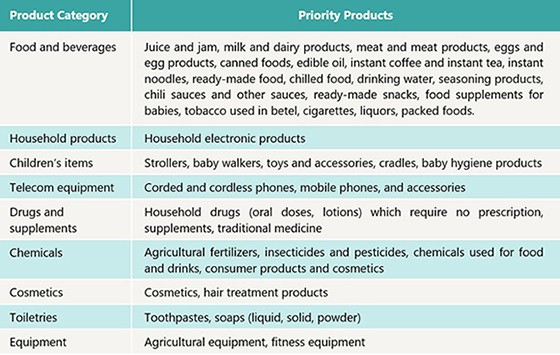
The committee may announce other products to be included in the list in the future.

Companies will have a six-month grace period from the notification date (October 26, 2018) to comply with the new regulation. Any violations after the grace period will leave companies vulnerable to the following sanctions under Section 19 of the Myanmar Consumer Protection Law 2014:

  • warning;
  • severe warning;
  • order to remedy the violation or compensate;
  • temporary prohibition of the sale and distribution of goods in violation;
  • product recall;
  • destruction of goods; and/or,
  • temporary or permanent revocation of business licenses or permits.

RELATED INSIGHTS​ 

June 29, 2015
Kien Trung Trinh, senior attorney-at-law, and Tu Ngoc Trinh, attorney-at-law, in Tilleke & Gibbins’ Hanoi office, have co-authored the Vietnam chapter of The International Comparative Legal Guide to: Pharmaceutical Advertising 2015 (12th edition), a Q&A-style guide that provides practical, cross-border insight into pharmaceutical advertising across 35 jurisdictions. The Vietnam chapter covers the following main topics:
June 3, 2015
The first edition of Global Agriculture Law, a Q&A-style guide that provides detailed overviews of agriculture law worldwide, has been published. The guide covers key practical issues, including those affecting agricultural companies and cooperatives, land ownership and usage rights, tax and financing, crop seed business, plant variety right protection, GM crops, importing animals, gene patents, and product liability.The Thailand chapter, written by lawyers at Tilleke & Gibbins, delves into the following main issues:
June 3, 2015
Global Agriculture Law (1st Ed.), a guide that presents a Q&A-style overview of agriculture law in 22 jurisdictions around the world, has been published. The Vietnam chapter of the guide, written by Kien Trung Trinh, Dung Thi Kim Vu, and Linh Duy Mai of Tilleke & Gibbins, covers key practical issues including those related to agricultural policy, acquisition of agricultural companies, acquisition of agricultural land, crop seed business, plant variety rights, genetically modified crops, importing animals and gene patents, and agricultural safety and product liability.
May 28, 2015
Thailand’s roadmap of food safety, which was approved in 2004, aims to promote the Kingdom as the “kitchen of the world.” Animal feed, i.e., food given to farm animals, plays a major role in the food safety regime—it is part of the stages of food production, dubbed “farm-to-table,” and is an integral component in the overarching food chain. Animal feed must be as safe as meat for human consumption, and therefore registration, inspection, and control of animal feed are vigorously regulated by the regulatory authorities.