
You are using an outdated browser and your browsing experience will not be optimal. Please update to the latest version of Microsoft Edge, Google Chrome or Mozilla Firefox. Install Microsoft Edge

November 5, 2018

Myanmar-Language Labeling Required on Wide Range of Products

Myanmar’s Central Committee for Consumer Protection issued Notification 1/2018 on October 26, 2018, which requires labels containing certain information in Myanmar language, jointly or combined with another language, to be affixed to certain products sold in the country. The notification is intended to ensure the safety of consumers.

The notification states that Myanmar-language labels must contain the following information:

  • Directions for use;
  • Storage instructions;
  • Allergy alerts and/or warnings; and
  • Side effects (if any).

The Myanmar-language label must be affixed to consumer units, jointly or combined with labelling in another language, but the legislation does not cover other packaging, such as display boxes.

The list of priority products that require Myanmar-language labelling, jointly or combined with labelling in another language, is as follows: 
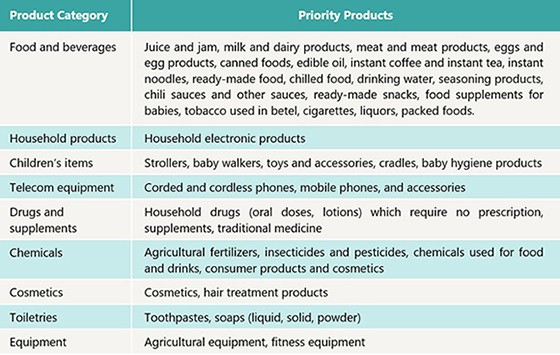
The committee may announce other products to be included in the list in the future.

Companies will have a six-month grace period from the notification date (October 26, 2018) to comply with the new regulation. Any violations after the grace period will leave companies vulnerable to the following sanctions under Section 19 of the Myanmar Consumer Protection Law 2014:

  • warning;
  • severe warning;
  • order to remedy the violation or compensate;
  • temporary prohibition of the sale and distribution of goods in violation;
  • product recall;
  • destruction of goods; and/or,
  • temporary or permanent revocation of business licenses or permits.

RELATED INSIGHTS​ 

November 25, 2016
Intellectual property (IP) linkage refers to connecting an IP office, through open communication lines and complementary processes, to other government agencies that work on IP. This generally includes agencies tasked with regulating food, drugs, and agricultural products, in order to ensure not only that there is proper communication between the officials of both agencies, but also that each agency’s regulations are in line with one another, and the agencies do not promulgate conflicting requirements.
November 14, 2016
Food Regulations and Enforcement in Thailand, a chapter in the Reference Module in Food Science  book, published by Elsevier, provides an overview of food laws and enforcement mechanisms in Thailand.
October 25, 2016
With a population of over 90 million, fast-paced economic growth, and an increasing standard of living, Vietnam has become a market with great potential for original brand name drugs. These drugs are marketed through numerous channels, with drug tenders called by health facilities being one of the most prominent and profitable.
October 25, 2016
On February 4, 2016, Vietnam and 11 other countries signed the Trans-Pacific Partnership (TPP). The TPP includes Australia, Brunei, Canada, Chile, Japan, Malaysia, Mexico, New Zealand, Peru, the United States, Vietnam, and Singapore—countries which represent 36 percent of global GDP and more than 25 percent of world trade.