
You are using an outdated browser and your browsing experience will not be optimal. Please update to the latest version of Microsoft Edge, Google Chrome or Mozilla Firefox. Install Microsoft Edge

November 5, 2018

Myanmar-Language Labeling Required on Wide Range of Products

Myanmar’s Central Committee for Consumer Protection issued Notification 1/2018 on October 26, 2018, which requires labels containing certain information in Myanmar language, jointly or combined with another language, to be affixed to certain products sold in the country. The notification is intended to ensure the safety of consumers.

The notification states that Myanmar-language labels must contain the following information:

  • Directions for use;
  • Storage instructions;
  • Allergy alerts and/or warnings; and
  • Side effects (if any).

The Myanmar-language label must be affixed to consumer units, jointly or combined with labelling in another language, but the legislation does not cover other packaging, such as display boxes.

The list of priority products that require Myanmar-language labelling, jointly or combined with labelling in another language, is as follows: 
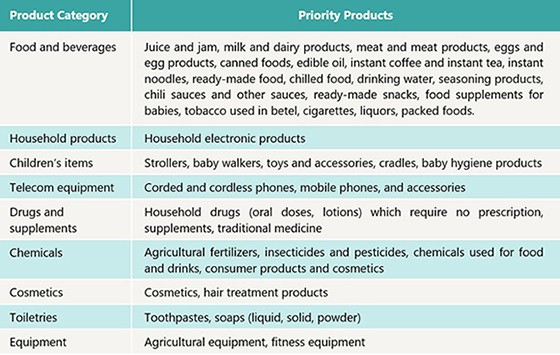
The committee may announce other products to be included in the list in the future.

Companies will have a six-month grace period from the notification date (October 26, 2018) to comply with the new regulation. Any violations after the grace period will leave companies vulnerable to the following sanctions under Section 19 of the Myanmar Consumer Protection Law 2014:

  • warning;
  • severe warning;
  • order to remedy the violation or compensate;
  • temporary prohibition of the sale and distribution of goods in violation;
  • product recall;
  • destruction of goods; and/or,
  • temporary or permanent revocation of business licenses or permits.

RELATED INSIGHTS​ 

October 25, 2016
On May 15, 2016, shortly before the new Law on Pharmacy was adopted, the Vietnamese government issued Decree No. 36/2016/ND-CP on the management of medical devices (Decree 36). This decree took effect on July 1, bringing medical devices under uniform management. Previously, there were two separate systems of legislation—one for medical devices manufactured domestically and the other for imported medical devices.
October 3, 2016
Biologics are composed of complex, large molecules, as opposed to the small molecules that make up conventional chemically derived drugs. Because of the complex nature of biologics, clinical trials and data collections are expensive to produce and require a heightened level of data exclusivity protection beyond those of a patent to incentivize biologic producers to continue research on new biologics.
October 3, 2016
In 2002, the Thai government initiated a universal healthcare scheme to bring equitable healthcare access to the general public. Under the scheme, hospitals receive per capita funding based on 47 million people. At the outset, per capita funding was approximately USD 38 per person. Now, it is USD 83. Although per capita funding has more than doubled, the current figure is still low. This budget constraint has led the Thai government to favor generic companies, as opposed to originator companies.Definition of Biological Product
August 30, 2016
“Let food be your medicine” is a common mantra recited by those in the food business. In Thailand, many food products are fortified with nutrients such as vitamins, minerals and amino acids, and are marketed as offering a range of health benefits.