
You are using an outdated browser and your browsing experience will not be optimal. Please update to the latest version of Microsoft Edge, Google Chrome or Mozilla Firefox. Install Microsoft Edge

November 5, 2018

Myanmar-Language Labeling Required on Wide Range of Products

Myanmar’s Central Committee for Consumer Protection issued Notification 1/2018 on October 26, 2018, which requires labels containing certain information in Myanmar language, jointly or combined with another language, to be affixed to certain products sold in the country. The notification is intended to ensure the safety of consumers.

The notification states that Myanmar-language labels must contain the following information:

  • Directions for use;
  • Storage instructions;
  • Allergy alerts and/or warnings; and
  • Side effects (if any).

The Myanmar-language label must be affixed to consumer units, jointly or combined with labelling in another language, but the legislation does not cover other packaging, such as display boxes.

The list of priority products that require Myanmar-language labelling, jointly or combined with labelling in another language, is as follows: 
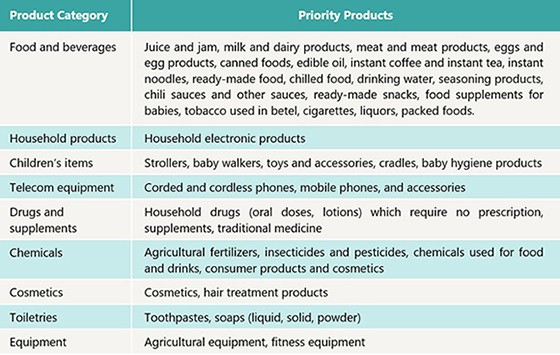
The committee may announce other products to be included in the list in the future.

Companies will have a six-month grace period from the notification date (October 26, 2018) to comply with the new regulation. Any violations after the grace period will leave companies vulnerable to the following sanctions under Section 19 of the Myanmar Consumer Protection Law 2014:

  • warning;
  • severe warning;
  • order to remedy the violation or compensate;
  • temporary prohibition of the sale and distribution of goods in violation;
  • product recall;
  • destruction of goods; and/or,
  • temporary or permanent revocation of business licenses or permits.

RELATED INSIGHTS​ 

February 1, 2021
The latest edition of Practical Law’s Life Sciences Global Guide features contributions from Tilleke & Gibbins attorneys in the firm’s Yangon office. One of the sections they have provided for the Myanmar chapter of this Q&A-style guide to life sciences regulatory frameworks worldwide is “Medicinal Product Regulation and Product Liability in Myanmar.” The section includes discussion of a range of regulatory issues related to the marketing and selling of pharmaceutical products, including the following topics: Regulatory overview: Authorities, scope, and general procedures for pharmaceuticals, biologicals, and medical devices and health care IT Pricing, government funding, and reimbursement: National health care system, price regulation, and reimbursement Clinical trials Manufacturing and distribution Marketing: Authorization for marketing medicinal products, parallel imports and cross-border trade in medicines Restrictions on dealings with health care professionals Selling restrictions Advertising and promotion Data privacy Packaging, labeling, and tracking Product safety, quality, and liability Local establishment, representation, and residency requirements Reform The full “Medicinal Product Regulation and Product Liability in Myanmar” section can be accessed on the Practical Law website. Practical Law, produced by Thomson Reuters, is the world’s leading legal know-how resource for business lawyers, publishing a huge range of guides covering hundreds of jurisdictions and practice areas. Tilleke & Gibbins also supplied “Pharmaceutical IP and Competition Law in Myanmar,” which was published in the Life Sciences Global Guide  at the same time.
February 1, 2021
Attorneys from Tilleke & Gibbins in Myanmar have contributed to the latest edition of Practical Law’s online Life Sciences Global Guide. The guide is a Q&A-style overview of the regulatory frameworks for the life sciences industry across multiple jurisdictions worldwide, and this year the Myanmar chapter includes two sections, one of which is “Pharmaceutical IP and Competition Law in Myanmar.” This section runs through the country’s legal and regulatory environment for patents and trademarks—particularly as they relate to pharmaceutical business in the jurisdiction. The section then turns to IP and competition law issues, with questions and answers focusing on how the country’s competition laws and regulations affect the pharmaceutical sector. Readers are also given information on how to properly comply with Myanmar law on competition, including when it comes to licensing of medicines and pharmaceutical technology. The full Pharmaceutical Intellectual Property and Competition Law in Myanmar guide can be accessed on the Practical Law website. Practical Law, produced by Thomson Reuters, is the world’s leading legal know-how resource for business lawyers, publishing a huge range of guides covering hundreds of jurisdictions and practice areas. Tilleke & Gibbins also supplied the “Medicinal Product Regulation and Product Liability in Myanmar,” which Practical Law published in its Life Sciences Global Guide  at the same time.
January 15, 2021
Following the recent delisting of almost all parts of the hemp plant from Thailand’s list of prohibited narcotics (see here for further details), the Ministry of Public Health has issued a notification allowing hemp to be used in cosmetics. Prior to this development, this use of hemp (whether from natural or synthetic sources) was not allowed, as it fell under the definition of narcotics under the Notification Re: Ingredients Not Allowed for Use in Cosmetics B.E. 2559 (2016). Under the Ministerial Notification Re: Use of Hemp in Cosmetics B.E. 2564 (2021), which was published in the Government Gazette on January 11, 2021, domestic manufacturers are now allowed to produce cosmetics containing hemp seed oil or hemp seed extract, provided the cosmetics do not have a THC level exceeding 0.2% by weight. To register such products with the Thai FDA, applicants must submit a certificate of analysis, safety data sheet, and label for the agency’s evaluation. The timeline for approval of the registration (notification) of a cosmetic containing hemp seed oil or hemp seed extract is three business days. The applicant (i.e., manufacturer or toll manufacturer) must declare the amount of hemp seed extract or hemp seed oil used in the cosmetic in their notification application. Cosmetics must not use a name for the product that evokes an association with hemp flowers or narcotics, and the name of the product must be within the scope of cosmetics. For example, names containing “inflorescence,” “flower,” “CBD,” “THC” or similar will not be allowed. It should also be noted that Thailand does not yet allow the importation of cosmetics containing hemp seeds or hemp seed extract, and this regulation only applies to domestically produced hemp products—a business currently restricted to individuals or companies with Thai nationality. For more details on this development, or
January 8, 2021
Across the globe, the demand for COVID-19 vaccinations has been understandably high, with many regulatory authorities (e.g., U.S. Food and Drug Administration, Medicines & Healthcare Products Regulatory Agency in the U.K., European Medicine Agency, Swissmedic, etc.) issuing emergency use authorizations for COVID-19 vaccines. Similarly, the Thai Food and Drug Administration (Thai FDA) has published the Notification Re: Conditional Approval for Emergency Use of Medical Products, which allows drug importers to register COVID-19 vaccines under the conditional approval scheme.  While as of the date of this article, the Thai FDA has yet to authorize any COVID-19 vaccines, this should follow shortly as clinical trials are completed and government procurement negotiations progress. Under the notification, it appears that the channel of distribution of a COVID-19 vaccine under the conditional approval scheme would be strictly controlled by the Thai FDA. This channel includes the vaccine’s distribution to relevant government agencies (e.g., Department of Disease Control of Thailand and public hospitals specified by the Thai FDA). However, questions have been raised regarding which private hospitals would be included in the distribution list and how the Thai FDA would distribute the vaccine to private hospitals. This confusion over the role of private hospitals was seen recently when one private hospital advertised that it could secure the COVID-19 vaccine from one developer whose product had already been approved elsewhere, until the Thai FDA then stepped in and claimed that the advertisement violated the Drug Act. The Thai FDA notification also enumerates several essential criteria that must be fulfilled in seeking approval for a COVID-19 vaccine, including the following: The available scientific data must substantiate both the efficacy and safety of vaccine. Further, the risk-benefit analysis must indicate that the medicine’s benefits outweigh its risks. A risk management plan, including risk minimization measures, must be submitted.