
You are using an outdated browser and your browsing experience will not be optimal. Please update to the latest version of Microsoft Edge, Google Chrome or Mozilla Firefox. Install Microsoft Edge

November 5, 2018

Myanmar-Language Labeling Required on Wide Range of Products

Myanmar’s Central Committee for Consumer Protection issued Notification 1/2018 on October 26, 2018, which requires labels containing certain information in Myanmar language, jointly or combined with another language, to be affixed to certain products sold in the country. The notification is intended to ensure the safety of consumers.

The notification states that Myanmar-language labels must contain the following information:

  • Directions for use;
  • Storage instructions;
  • Allergy alerts and/or warnings; and
  • Side effects (if any).

The Myanmar-language label must be affixed to consumer units, jointly or combined with labelling in another language, but the legislation does not cover other packaging, such as display boxes.

The list of priority products that require Myanmar-language labelling, jointly or combined with labelling in another language, is as follows: 
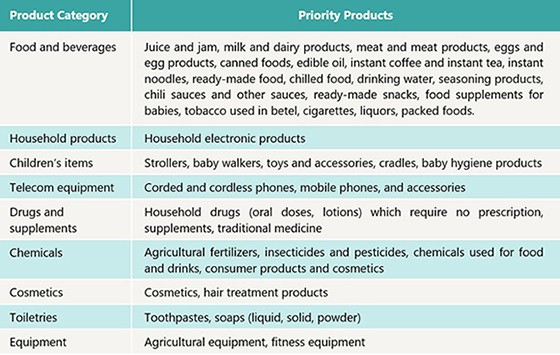
The committee may announce other products to be included in the list in the future.

Companies will have a six-month grace period from the notification date (October 26, 2018) to comply with the new regulation. Any violations after the grace period will leave companies vulnerable to the following sanctions under Section 19 of the Myanmar Consumer Protection Law 2014:

  • warning;
  • severe warning;
  • order to remedy the violation or compensate;
  • temporary prohibition of the sale and distribution of goods in violation;
  • product recall;
  • destruction of goods; and/or,
  • temporary or permanent revocation of business licenses or permits.

RELATED INSIGHTS​ 

January 8, 2021
At a meeting on December 21, 2020, the Thai Board of Investment (BOI) approved a series of stimulus packages aimed at encouraging local and foreign investment, as the government seeks to boost Thailand’s economic recovery from the COVID-19 pandemic. The additional investment incentives, which will be promoted by the BOI in the upcoming year, include a number of sector- and project-specific stimulus measures.   Additional Tax Incentives for Large-Scale Projects Projects in target industries with investment of at least THB 1 billion (approx. USD 33 million) over a 12-month period, starting from the issuance of the BOI promotion certificate, will be entitled to an additional 50% corporate income tax (CIT) deduction for a period of five years, calculated on top of the standard 5–8 year CIT exemptions offered under the normal BOI tax-incentive scheme. To obtain this special tax incentive, eligible projects may apply to the BOI from January 4 to December 30, 2021.   Stimulus Package for Digital Economy and Software Industry Projects that support digital technology adoption, such as software integration, artificial intelligence, machine learning, or big data analytics, may benefit from 50% CIT exemptions on profits generated from their existing BOI projects for an additional three years. Applications for the exemption must be submitted by the end of 2022.   Application Deadline Extensions for Special Economic Zones and Five Southern Provinces Measures relating to special economic zones cover more than 300 investment promotion categories, with both tax and non-tax incentives, including an additional tax incentive for target industries such as textiles, agriculture, home furniture, jewelry, and others. These incentives are available to projects located in the border areas of Thailand (i.e., the 10 special economic zones in the provinces of Chiang Rai, Kanchanaburi, Mukdahan, Nakhon Phanom, Narathiwat, Nong Khai, Sa Kaeo, Songkhla, Tak, and Trat), with the
December 21, 2020
As we continue to await the Thai Food and Drug Administration (TFDA)’s promulgation of its medical cannabis application guidelines, the Thai Ministry of Public Health (TMoPH) has helpfully issued several notifications to further clarify the 2019 amendment to the Narcotics Act that initially paved the way for cannabis liberalization in the kingdom. Cannabis (both marijuana and hemp) has been classified as a Category 5 Narcotic since the enactment of the Narcotics Act in 1979. All activities related to the plants and their derivatives had been strictly restricted until the recent rise of the cannabis legalization movement, which began in Thailand with an amendment to the Narcotics Act in February 2019 to legalize medical marijuana. The Thai government has since been working to reclassify cannabis products and lay out the regulatory pathways to accommodate these new “economic plants.” A notification in August 2019 further carved modern drugs, cosmeceuticals, nutraceuticals, cosmetics, and food containing hemp or a certain amount of CBD out of the scope of Narcotics Act. The most recent TMoPH Notification was published in the Government Gazette on December 14, 2020, and has expanded the delisting of cannabis from the Narcotics Act to include nearly all parts of the cannabis plant, as set out below. Type of Plant Detailed Components Marijuana (plants in the cannabis family) Stalks, stems, fibers, branches, roots, leaves without the tip and inflorescence, extracts comprising CBD with less than 0.2% THC by weight. Hemp Stalks, stems, fibers, branches, roots, seeds, seed oils, seed extracts, leaves without the tip and inflorescence, extracts comprising CBD with less than 0.2% THC by weight, and residues from extraction with less than 0.2% THC by weight. The Narcotics Act and its notifications must be reviewed carefully by anyone seeking to take part in his industry, and items that are conspicuous
December 7, 2020
It is strongly recommended that entities which are considering entering the Thai cannabis market file applications to protect their marks and patents in Thailand as soon as possible. Cannabis Trademarks Thailand operates under a first-to-file trademark system. The Thai Trademark Office has verbally confirmed that trademark applications which include goods or services relating to medical cannabis are registrable. That being said, recent developments indicate that the Trademark Office will require applicants who file specifically for medical cannabis goods or services to submit proof that the applicant has permission to produce drugs containing cannabis from the Thai Food and Drug Administration. In addition, the Trademark Office is taking a conservative approach when it comes to the words and images that are registrable as trademarks. The Trademark Office has advised that words or images relating to cannabis will be refused based on Section 8(9) of the Thai Trademark Act, which states that a trademark that is contrary to public order, morality, or public policy shall not be registered. Given the above, applicants should carefully consider the trademarks that they would like to protect in Thailand to avoid unnecessary refusals. If the applicant does not yet have such permission from the Thai Food and Drug Administration, it is recommended that the applicant’s mark make no reference to cannabis, either visually or verbally, and that the list of goods and/or services does not specifically refer to cannabis or related terminology. In short, we urge applicants to enter into the Thai market early, with carefully-chosen marks and deliberately-worded descriptions of goods and/or services. Cannabis Patents Cannabis-related products and processes are now eligible for patent protection in Thailand, with some restrictions. A cannabis plant, including its parts and crude extract, are considered mere products of nature and thus not patentable. Another important restriction applies to