
You are using an outdated browser and your browsing experience will not be optimal. Please update to the latest version of Microsoft Edge, Google Chrome or Mozilla Firefox. Install Microsoft Edge

November 5, 2018

Myanmar-Language Labeling Required on Wide Range of Products

Myanmar’s Central Committee for Consumer Protection issued Notification 1/2018 on October 26, 2018, which requires labels containing certain information in Myanmar language, jointly or combined with another language, to be affixed to certain products sold in the country. The notification is intended to ensure the safety of consumers.

The notification states that Myanmar-language labels must contain the following information:

  • Directions for use;
  • Storage instructions;
  • Allergy alerts and/or warnings; and
  • Side effects (if any).

The Myanmar-language label must be affixed to consumer units, jointly or combined with labelling in another language, but the legislation does not cover other packaging, such as display boxes.

The list of priority products that require Myanmar-language labelling, jointly or combined with labelling in another language, is as follows: 
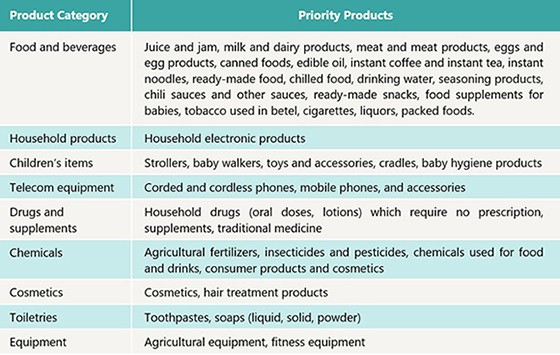
The committee may announce other products to be included in the list in the future.

Companies will have a six-month grace period from the notification date (October 26, 2018) to comply with the new regulation. Any violations after the grace period will leave companies vulnerable to the following sanctions under Section 19 of the Myanmar Consumer Protection Law 2014:

  • warning;
  • severe warning;
  • order to remedy the violation or compensate;
  • temporary prohibition of the sale and distribution of goods in violation;
  • product recall;
  • destruction of goods; and/or,
  • temporary or permanent revocation of business licenses or permits.

RELATED INSIGHTS​ 

April 29, 2011
Foreign agrichemical companies usually opt to appoint their local distributors, agents, or licensees as the local entity to apply for and maintain product registration and import licenses as usually required by Asian Ministries of Agriculture.  Such appointments are normally set out in the distribution agreement.  While on most occasions this is a mutually beneficial relationship, sometimes local partners who have built up the business for those products may begin to compete unfairly or commit other breaches which leads to difficulties in terms of terminating a partner who holds t
April 29, 2011
With the official implementation of the ASEAN Free Trade Agreement effective on January 1, 2010, companies now have an expanded opportunity to increase exports in this important and diverse market. In regard to food, however, it should be noted that companies are still required to register their products with the local Food Agencies. Even though harmonization of rules for food products is a stated aim of ASEAN members—similar to the ASEAN Harmonization on Pharmaceutical Registration already in place for pharmaceutical products—harmonized rules have not yet been implemented in this area.
April 29, 2011
Foreign agrochemical companies usually opt to appoint their local distributors, agents, or licensees as the local entity to apply for and maintain product registration and import licenses as required by Asian Ministries of Agriculture. Such appointments are normally set out in the distribution agreement. While on most occasions this is a mutually beneficial relationship, sometimes local partners who have built up the business for those products may begin to compete unfairly or commit other breaches.
April 29, 2011
Under new Food and Drug Administration requirements, certain cosmetic products may need to be reclassified and re-registered. Previously, there had been three categories of cosmetics: general cosmetics, controlled cosmetics, and specially controlled cosmetics. Under the ASEAN Harmonized Cosmetic Regulation Scheme, all cosmetic products will need to be registered with the Thai FDA within the controlled cosmetics category, and the other two categories will be eliminated.