
You are using an outdated browser and your browsing experience will not be optimal. Please update to the latest version of Microsoft Edge, Google Chrome or Mozilla Firefox. Install Microsoft Edge

November 5, 2018

Myanmar-Language Labeling Required on Wide Range of Products

Myanmar’s Central Committee for Consumer Protection issued Notification 1/2018 on October 26, 2018, which requires labels containing certain information in Myanmar language, jointly or combined with another language, to be affixed to certain products sold in the country. The notification is intended to ensure the safety of consumers.

The notification states that Myanmar-language labels must contain the following information:

  • Directions for use;
  • Storage instructions;
  • Allergy alerts and/or warnings; and
  • Side effects (if any).

The Myanmar-language label must be affixed to consumer units, jointly or combined with labelling in another language, but the legislation does not cover other packaging, such as display boxes.

The list of priority products that require Myanmar-language labelling, jointly or combined with labelling in another language, is as follows: 
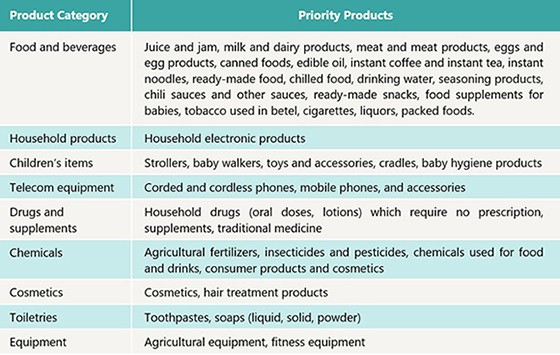
The committee may announce other products to be included in the list in the future.

Companies will have a six-month grace period from the notification date (October 26, 2018) to comply with the new regulation. Any violations after the grace period will leave companies vulnerable to the following sanctions under Section 19 of the Myanmar Consumer Protection Law 2014:

  • warning;
  • severe warning;
  • order to remedy the violation or compensate;
  • temporary prohibition of the sale and distribution of goods in violation;
  • product recall;
  • destruction of goods; and/or,
  • temporary or permanent revocation of business licenses or permits.

RELATED INSIGHTS​ 

April 29, 2011
Circular 22/2009/TT-BYT issued by the Ministry of Health, effective May 24, 2010, has clarified certain issues related to intellectual property rights and drug marketing approval in Vietnam. The Circular emphasizes that the applicant for marketing approval for a drug shall be responsible for any infringement of IPRs used on or in relation to the drug. Consequently, proof of IP cleanness for a drug, such as search reports, registration certificates, or application acceptance decisions, is no longer required by the Drug Administration of Vietnam for obtaining drug marketing approvals.
April 28, 2011
The Thai Food and Drug Administration (FDA), which is responsible for providing support in coordinating and monitoring cosmetic products in the market, announced that the requirements of the ASEAN Harmonized Cosmetic Regulation Scheme will be fully implemented by the beginning of 2011. Among the requirements, certain cosmetic products may need to be reclassified and re-registered, as described in this article.
April 28, 2011
The June 2010 World Economic Forum Report Enabling Trade in the Greater ASEAN Region ranked 125 economies based on market access, border administration, transport and communication infrastructure, and overall business environment.  According to the report, one of the main factors for lower rankings of certain Asian countries lies with difficulties in moving goods around.
April 28, 2011
For many years, Thai people have understood that consuming dietary supplements such as vitamins, minerals, amino acids, and herbs can help them live healthier lives. Based on this, many healthcare companies view Thailand as a strong market with significant growth potential, thus leading to an increase in the number of dietary supplements being registered with the Food and Drug Administration of Thailand (FDA).