
You are using an outdated browser and your browsing experience will not be optimal. Please update to the latest version of Microsoft Edge, Google Chrome or Mozilla Firefox. Install Microsoft Edge

November 5, 2018

Myanmar-Language Labeling Required on Wide Range of Products

Myanmar’s Central Committee for Consumer Protection issued Notification 1/2018 on October 26, 2018, which requires labels containing certain information in Myanmar language, jointly or combined with another language, to be affixed to certain products sold in the country. The notification is intended to ensure the safety of consumers.

The notification states that Myanmar-language labels must contain the following information:

  • Directions for use;
  • Storage instructions;
  • Allergy alerts and/or warnings; and
  • Side effects (if any).

The Myanmar-language label must be affixed to consumer units, jointly or combined with labelling in another language, but the legislation does not cover other packaging, such as display boxes.

The list of priority products that require Myanmar-language labelling, jointly or combined with labelling in another language, is as follows: 
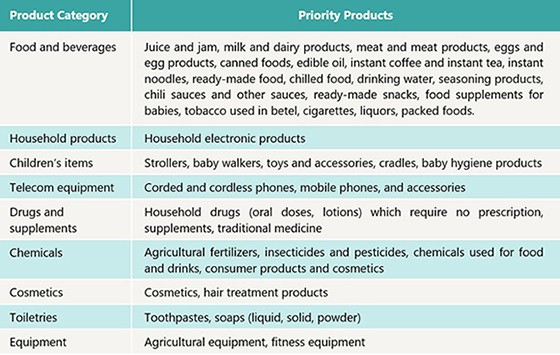
The committee may announce other products to be included in the list in the future.

Companies will have a six-month grace period from the notification date (October 26, 2018) to comply with the new regulation. Any violations after the grace period will leave companies vulnerable to the following sanctions under Section 19 of the Myanmar Consumer Protection Law 2014:

  • warning;
  • severe warning;
  • order to remedy the violation or compensate;
  • temporary prohibition of the sale and distribution of goods in violation;
  • product recall;
  • destruction of goods; and/or,
  • temporary or permanent revocation of business licenses or permits.

RELATED INSIGHTS​ 

May 12, 2011
In response to regular queries received from our multinational clients, David Lyman, Chairman & Chief Values Officer of Tilleke & Gibbins, has been providing periodic updates on the ongoing political events in Thailand since 2006. This Viewpoint summarizes and updates several of these reports, while providing observations on the Thai political landscape ahead of the upcoming elections.
May 12, 2011
The Report: Thailand 2011, published by Oxford Business Group, provides an in-depth analysis of various sectors of the Thai economy. In the legal section of the publication, Tilleke & Gibbins examines the government’s recent push for further liberalization of foreign investment laws. In addition to foreign investment, the article examines forms of business organization, capital markets, property law, labor and employment issues, and intellectual property.
May 6, 2011
On January 1, 2008, Asean member countries implemented the Asean Harmonization Cosmetics Regulation Scheme in order to harmonize a previously chaotic process. A multitude of confusing laws and procedures has now been transformed into a streamlined system with just a single category for cosmetic products and an efficient registration process.
May 3, 2011
Generic drug manufacturers in Thailand have become particularly active in recent years. There is a clear development trend among local generic producers to catch up with new technology and take advantage of the government’s pro-generic policy at the moment. Several generic manufacturers recently began to develop and market generic versions of various best-seller drugs, despite the fact that some of these drugs are still under valid patents in Thailand. This article introduces some defensive strategies that will allow drug originators to tackle these infringing generics.