
You are using an outdated browser and your browsing experience will not be optimal. Please update to the latest version of Microsoft Edge, Google Chrome or Mozilla Firefox. Install Microsoft Edge

November 5, 2018

Myanmar-Language Labeling Required on Wide Range of Products

Myanmar’s Central Committee for Consumer Protection issued Notification 1/2018 on October 26, 2018, which requires labels containing certain information in Myanmar language, jointly or combined with another language, to be affixed to certain products sold in the country. The notification is intended to ensure the safety of consumers.

The notification states that Myanmar-language labels must contain the following information:

  • Directions for use;
  • Storage instructions;
  • Allergy alerts and/or warnings; and
  • Side effects (if any).

The Myanmar-language label must be affixed to consumer units, jointly or combined with labelling in another language, but the legislation does not cover other packaging, such as display boxes.

The list of priority products that require Myanmar-language labelling, jointly or combined with labelling in another language, is as follows: 
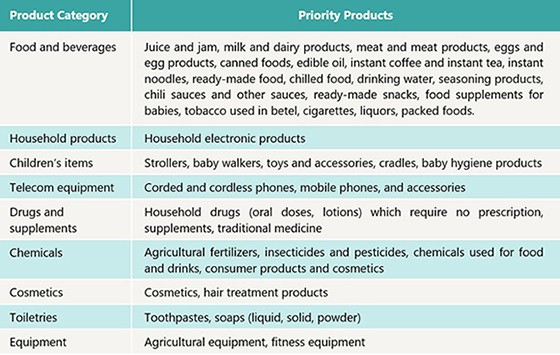
The committee may announce other products to be included in the list in the future.

Companies will have a six-month grace period from the notification date (October 26, 2018) to comply with the new regulation. Any violations after the grace period will leave companies vulnerable to the following sanctions under Section 19 of the Myanmar Consumer Protection Law 2014:

  • warning;
  • severe warning;
  • order to remedy the violation or compensate;
  • temporary prohibition of the sale and distribution of goods in violation;
  • product recall;
  • destruction of goods; and/or,
  • temporary or permanent revocation of business licenses or permits.

RELATED INSIGHTS​ 

December 7, 2020
Vietnam’s efforts against the outbreak of COVID-19 in the country have been largely successful, and despite two distinct spikes of local transmission, in both cases the spread was halted relatively quickly. As these complications from the COVID-19 pandemic have been playing out in Vietnam throughout 2020, it became clear that effective and strong enforcement of healthcare regulations, especially those related to disease control, was crucial. On September 28, 2020, the government of Vietnam took action on this by issuing Decree No. 117/2020/ND-CP (“Decree 117”), which provides penalties for administrative violations in the healthcare sector. Some provisions of Decree 117—mostly those related to disease control and epidemic situations—took effect immediately, with the remainder taking effect on November 15, 2020. The decree, which was based on a draft proposed by the Ministry of Health, replaced Decree No. 176/2013/ND-CP on the same matter. The main administrative penalties under Decree 117 are reprimands and fines. Depending on the severity of the violation, violators may also be subject to additional penalties such as suspension of a certificate of eligibility for pharmaceutical business (CEPB), a license for healthcare operation, or other licenses and practicing certificates for up to 24 months; confiscation of illegal items; suspension of operations for up to 24 months; or deportation. Furthermore, remedial measures such as forced return of illegal earnings, compulsory quarantine and medical examination, public correction, or compulsory payment of treatment fees may also be applied. Some key highlights of Decree 117 are discussed below. In relation to disease control, the maximum fine for failure to comply with quarantine is doubled to VND 20 million (USD 855) for infected people of type-A contagious diseases, and VND 10 million (USD 427) for those who are not infected but are asked to quarantine. Failure to declare one’s contagious disease to a doctor
November 30, 2020
Vietnamese cuisine has a growing reputation internationally, and a visit to Vietnam will quickly reveal that food plays a very important role in the country’s identity and culture, as well as its economy. More than 80% of the population makes a living through some form of agriculture, and approximately 35% of household income in Vietnam is spent on food and beverages. As food is the most essential of necessities, and thus the first priority in household spending, this percentage tends to be high in developing countries, declining as incomes rise.
November 17, 2020
The Thailand updates to Practical Law’s Life Sciences Global Guide  have been released online, with legal practitioners from Tilleke & Gibbins contributing the Pharmaceutical Intellectual Property and Competition Law section.The guide is a Q&A-style overview of the regulatory frameworks of the life sciences industries across multiple jurisdictions worldwide, with this chapter addressing the following issues as they relate to Thailand: