
You are using an outdated browser and your browsing experience will not be optimal. Please update to the latest version of Microsoft Edge, Google Chrome or Mozilla Firefox. Install Microsoft Edge

November 5, 2018

Myanmar-Language Labeling Required on Wide Range of Products

Myanmar’s Central Committee for Consumer Protection issued Notification 1/2018 on October 26, 2018, which requires labels containing certain information in Myanmar language, jointly or combined with another language, to be affixed to certain products sold in the country. The notification is intended to ensure the safety of consumers.

The notification states that Myanmar-language labels must contain the following information:

  • Directions for use;
  • Storage instructions;
  • Allergy alerts and/or warnings; and
  • Side effects (if any).

The Myanmar-language label must be affixed to consumer units, jointly or combined with labelling in another language, but the legislation does not cover other packaging, such as display boxes.

The list of priority products that require Myanmar-language labelling, jointly or combined with labelling in another language, is as follows: 
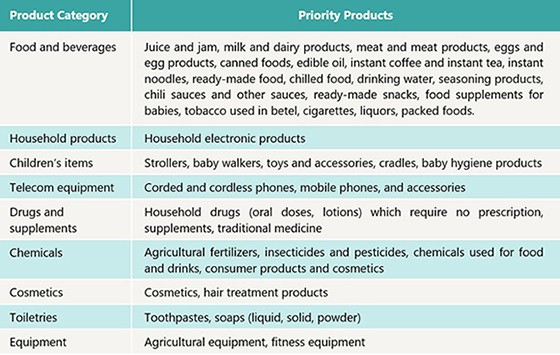
The committee may announce other products to be included in the list in the future.

Companies will have a six-month grace period from the notification date (October 26, 2018) to comply with the new regulation. Any violations after the grace period will leave companies vulnerable to the following sanctions under Section 19 of the Myanmar Consumer Protection Law 2014:

  • warning;
  • severe warning;
  • order to remedy the violation or compensate;
  • temporary prohibition of the sale and distribution of goods in violation;
  • product recall;
  • destruction of goods; and/or,
  • temporary or permanent revocation of business licenses or permits.

RELATED INSIGHTS​ 

October 26, 2021
Parallel imports—branded goods imported into a domestic market and sold there without the consent of the intellectual property (IP) owner—pose a unique challenge for IP owners. In contrast to counterfeit goods, parallel imported goods are manufactured by or under the license of the IP owner and formulated or packaged for a particular jurisdiction and then imported into a different jurisdiction without the authorization of the IP owner. Intellectual property laws and perspectives on parallel import vary throughout Southeast Asia. The distinct legal landscape in each nation should be carefully navigated in consultation with legal experts to ensure brand protection to the fullest degree. This guide provides insight into the legal frameworks relating to parallel imports in Cambodia, Indonesia, Laos, Myanmar, Thailand, and Vietnam. Each section examines the relevant laws and regulations that pertain to parallel imports and explores the remedies available to IP owners in each country. Finally, the guide presents some strategies to combat parallel importation and maximize IP protection in Southeast Asia. The full guide can be downloaded through the button below.   This guide was prepared with the assistance of Tilleke & Gibbins interns Christian Pederson and Keoni Williams.
October 25, 2021
Michael Ramirez, a counsel in Tilleke & Gibbins’ dispute resolution group in Bangkok, has updated the firm’s contribution to the Global Attorney-Client Privilege Guide, published by Lex Mundi. The newly expanded guide provides information on what constitutes attorney-client privilege in over 70 countries around the world. The Thailand section of the guide contains in-depth information on the function and applications of attorney-client privilege in Thailand (or, as explained in the guide, an equivalent concept enshrined in Thai law), including coverage of the following topics: Privilege in corporations Common interest doctrine Litigation funding Crime-fraud exception Work product doctrine/litigation privilege Other privileges including mediation, accountant-client and settlement negotiation The interactive guide features expert contributions by Lex Mundi member firms from jurisdictions worldwide. Readers can browse the contributions, generate country-specific reports, and compare attorney-client privilege in multiple jurisdictions. For more information, please visit the Lex Mundi website.
October 14, 2021
As part of its membership in Lex Mundi, Tilleke & Gibbins has published an updated edition of its Guide to Doing Business in Thailand for 2021. This guide outlines all of the key factors for starting and operating a business in the Thai market. Issues covered include: Investment incentives Financial facilities Exchange controls Import and export regulations Structures for doing business Requirements for the Establishment of a Business Operation of the Business Cessation or Termination of the Business Labor legislation, relations, and supply Tax Immigration requirements This publication is part of Lex Mundi’s Guides to Doing Business series prepared by member firms in more than 100 jurisdictions worldwide. The guides serve as a useful resource when planning an international business strategy or researching a new market.
October 11, 2021
A registration process for plant variety protection (PVP) has been in effect in Myanmar since enactment of the New Plant Variety Protection Law 2016, which was later replaced by the New Plant Variety Protection Law 2019 (“PVP Law 2019”). In accordance with its implementation of this law, the government is encouraging private companies, associations, organizations, and individual plant breeders to apply for the protection of new plant varieties in order to increase crop production in the country. Despite the challenges of the COVID-19 pandemic in Myanmar, Tilleke & Gibbins successfully secured a plant breeder’s rights certificate for a client in June 2020, making the client the first certificate holder in Myanmar. This article summarizes the PVP application and registration process, and offers some practical insights into the authorities’ activities and approach. PVP Registration The Central Committee for National New Plant Variety Protection (PVP Committee) oversees PVP registration, which is administered by the PVP Section of the Department of Agricultural Research (DAR) in the Ministry of Agriculture, Livestock, and Irrigation. To apply for plant breeder’s rights in Myanmar, an application and a technical questionnaire on the new plant variety should be filed with the PVP Section, which reviews the technical questionnaire and determines whether the plant qualifies as a new variety. Four groups are eligible to apply for PVP registration in order to secure plant breeder’s rights under the current PVP legislation: Myanmar nationals; Foreign nationals and organizations whose permanent residence is in Myanmar; Persons or entities resident in a country that has a PVP agreement with Myanmar; and International organizations. An application can be examined in one of four ways (determined by the PVP Committee): Official field trial involving planting the new variety in Myanmar; On-site field inspection of the breeder’s field by the PVP Section; Examination of test