
You are using an outdated browser and your browsing experience will not be optimal. Please update to the latest version of Microsoft Edge, Google Chrome or Mozilla Firefox. Install Microsoft Edge

March 2, 2021

Methods of Stamp Duty Payment in Thailand

Informed Counsel

Like many countries, Thailand requires stamp duty to be paid on the execution of certain legal instruments. A liable person who fails to pay stamp duty on a required instrument can be subject to a maximum surcharge of six times the applicable stamp duty, and an instrument on which stamp duty has not been paid will not be admissible as evidence in civil cases (that is, it will have limited legal weight and enforceability).

Before July 2019, there were three methods for paying stamp duty:

  1. Affixing adhesive stamps on the instrument (and canceling it by the liable person in order to make sure that the adhesive stamp duty cannot be reused);
  2. Having a stamp impressed on the paper instrument; or
  3. Filing a prescribed form and paying the duty by cash or cashiers cheque at an area revenue office.

In addition to paying the correct amount of stamp duty, the law also requires that stamp duty on certain instruments be paid using a specific prescribed method from the list above. Failure to use the prescribed method would be considered as that the stamp duty not having been paid.

For example, a hire-of-work instrument is subject to stamp duty, but if the remuneration stated within the agreement is at least THB 1,000,000 (approximately USD 33,500), the stamp duty must be paid by filing a prescribed form and paying by cash or cashier’s cheque at an area revenue office. Affixing adhesive stamp duty is not allowed in that circumstance.

E-Stamp Duty

In June 2019, the Revenue Department introduced a fourth method of paying stamp duty, allowing online payments in specific circumstances (e-Stamp Duty). After the launch of the e-Stamp Duty system, the Revenue Department issued a notification (Notification of the Director-General of Revenue concerning Stamp Duty (No. 58)) requiring stamp duty on five instruments that are executed in electronic format (e-Instruments), to be paid via the e-Stamp Duty system.

The five e-Instruments are:

  • hire of work service instruments;
  • loan instruments or bank overdraft instruments;
  • powers of attorney (POA);
  • proxy letters for voting at company meetings; and
  • guarantee instruments.

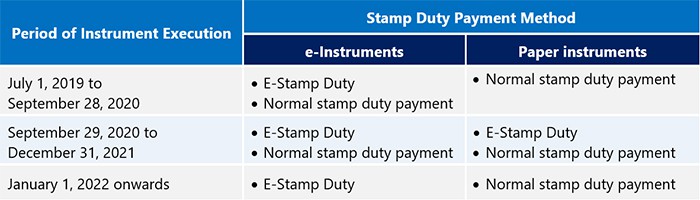
To allow taxpayers to become acquainted with the e-Stamp Duty system, the Revenue Department issued another notification (Notification of the Director-General of Revenue concerning Stamp Duty (No. 59)) which temporarily allowed taxpayers to omit the use of the e-Stamp Duty system by paying stamp duty on these e-Instruments at an area revenue office instead. Originally due to end on December 31, 2020, the measure was extended to December 31, 2021, under Notification of the Director-General of Revenue concerning Stamp Duty (No. 61), and now applies to e-Instruments executed between July 1, 2019 and December 31, 2021.

The Revenue Department also issued a notification allowing taxpayers to use the e-Stamp Duty system to pay stamp duty on the same five instruments executed in the traditional paper format; provided that the instruments are executed during September 29, 2020 to December 31, 2021. Again, this was originally due to end on December 31, 2020 (Notification of the Director-General of Revenue Re: Stamp Duty (No. 60)), but has been extended to December 31, 2020 (Notification of the Director-General of Revenue Re: Stamp Duty (No. 62)).

The table below summarizes the methods of stamp duty payment for the five instrument categories mentioned above.
Practicalities of the e-Stamp Duty System

The e-Stamp Duty system allows taxpayers to pay stamp duty online by filing the prescribed form (Form Or.Sor.9) through the website of the Revenue Department (www.rd.go.th) or the Revenue Department’s Application Programming Interface.

The e-Stamp Duty system allows taxpayers to file Form Or.Sor.9 and pay stamp duty before or within 15 days from the date of instrument execution. As of the date of this article, taxpayers can file a request to pay e-Stamp Duty no earlier than 30 days before the date on which an instrument is executed. If a taxpayer opts to pay e-Stamp Duty after executing an instrument, and the last date of paying stamp duty is due on public holiday, then the due date is extended to the next working day.

For example, if an instrument is due to be executed on March 31, 2021, the liable person can file Form Or.Sor.9 and pay e-Stamp Duty as early as March 2, 2021, or as late as April 16, 2021, (extended from April 15, 2021 which is a public holiday).

Taxpayers should note that the e-Stamp Duty system does not currently support late payment. Therefore, late filing and paying stamp duty will have to be done at an area revenue office.

After a taxpayer submits Form Or.Sor.9, they will receive a QR code and a pay-in-slip which can be used to make the e-Stamp Duty payment to the designated bank account of the Revenue Department.

Once the e-Stamp Duty is duly paid, the Revenue Department will generate a unique receipt code for the taxpayer to use as evidence of payment. This evidence of e-Stamp Duty payment can be downloaded from www.rd.go.th, or from the API (depending on where the taxpayer submitted Form Or.Sor.9).

Taxpayers should maintain the downloaded unique code and receipt for reference in the future. For instruments executed in paper format, taxpayers can maintain the downloaded unique code for reference in the future or print out the unique code and receipt and attach them to the instrument (instead of the usual official endorsement for paying stamp duty in cash at an area revenue office).

RELATED INSIGHTS​ 

December 8, 2023
Thailand’s Ministry of Interior has extended the deadlines for payment of the 2024 land and building tax and related procedures by two months. The announcement was published in the Government Gazette on November 30, 2023. According to the new timeline in the ministry’s announcement, the official land and building tax assessment forms will be sent to taxpayers by the end of April 2024 (extended from February 2024) while the deadline for payment of land and building tax has been extended to June 30, 2024 (from April 30, 2024). For payments made in installments, the announcement also extended the deadline for each installment as follows: For more details on these measures, or any aspect of Thailand’s land and building tax, please contact Chaiwat Keratisuthisathorn at [email protected] or Supranee Arjjit at [email protected].
November 23, 2023
Thailand’s Revenue Department has issued an order clarifying its recent order imposing personal income tax (PIT) on the offshore-sourced income of Thailand tax residents whenever it is brought into Thailand. The clarifying order, which was issued on November 20, 2023, confirms that the new rule will not apply to offshore-sourced income earned before January 1, 2024, which is the date the order comes into effect. This means that offshore-sourced income earned before January 1, 2024, will not be subject to PIT if it is brought into Thailand after the year 2023. This grandfather protection means that Thai tax residents will not have to pay PIT on offshore-sourced income earned before 2024 and brought into Thailand at any time after 2023. This is favorable to many who have earned income from offshore sources but may not have had sufficient time to revise their tax planning in response to the new rule. For more details on Thailand’s taxation of tax residents’ offshore-sourced income, or on any aspect of tax laws and regulations in Thailand, please contact Tilleke & Gibbins at [email protected].
October 30, 2023
On October 9, 2023, Laos issued Presidential Decree No. 003, which raised excise tax rates for certain goods, effective immediately. The move to increase excise tax rates comes amid the marked depreciation of the Lao kip (LAK). The Lao government is trying to monitor and discourage imports of non-essential products in order to reduce the outflow of foreign currency from the country. Increasing the tax rate for some of these products is part of these efforts. The specific products and excise tax rates are listed in the table below.   This new rate policy is also in line with recent government efforts to encourage avoiding payment in foreign currency to prevent the depletion of foreign currency reserves in Laos. In this regard, commercial banks have already taken action to ration the supply of foreign currency by prioritizing imports of essential goods, such as fuel. The products listed above formalize this impetus to prioritize certain imports and discourage others deemed not essential. In addition, the increased excise tax rates on fuel-powered vehicles show the commitment of the Lao government to move toward electric vehicles, which would also lessen the country’s dependence on fuel imports. For more information on these excise tax changes, or on any aspect of Laos’ international trade regulations, please contact Tilleke & Gibbins at [email protected].
October 16, 2023
On September 15, Revenue Departmental Order No. Por. 161/2566 was published, fundamentally changing how Thailand tax residents’ offshore-sourced income will be taxed. Under the order, starting from January 1, 2024, the offshore-sourced income of tax residents will be subject to Thai personal income tax (PIT) in any year that it is brought into Thailand. The purpose of this new rule is to ensure consistent tax collection practices among tax officers and to tackle tax avoidance strategies commonly used by individual taxpayers. PIT on Offshore-Sourced Income According to the resident rule in Thailand’s Revenue Code, Thailand tax residents (i.e., persons who reside in Thailand for at least 180 days in a calendar year) are subject to PIT on their domestic-sourced and offshore-sourced income. “Offshore-sourced income” is broadly defined to include income from work, business, or assets outside Thailand. Existing Practice Currently, Thailand tax residents’ offshore-sourced income is exempted from PIT if it is brought into Thailand after the calendar year in which it was earned. This exemption was adopted 28 years ago in the Revenue Department’s interpretation stated in a resolution from February 1985. This exemption by interpretation has led some Thailand tax residents to avoid PIT by simply holding their newly earned offshore-sourced income abroad temporarily and then bringing it into Thailand at a later time. Through the years, a number of tax rulings have affirmed this practice. New PIT Collection Rules for Offshore-Sourced Income Revenue Departmental Order No. Por. 161/2566 simply revokes the favorable exemption adopted under the February 1985 resolution so that the delay tactic is no longer able to succeed in avoiding tax. Starting from January 1, 2024, the offshore-sourced income of Thailand tax residents will be subject to PIT whenever it is brought into Thailand, at which time the offshore-sourced income must be declared to