
You are using an outdated browser and your browsing experience will not be optimal. Please update to the latest version of Microsoft Edge, Google Chrome or Mozilla Firefox. Install Microsoft Edge

March 2, 2021

Methods of Stamp Duty Payment in Thailand

Informed Counsel

Like many countries, Thailand requires stamp duty to be paid on the execution of certain legal instruments. A liable person who fails to pay stamp duty on a required instrument can be subject to a maximum surcharge of six times the applicable stamp duty, and an instrument on which stamp duty has not been paid will not be admissible as evidence in civil cases (that is, it will have limited legal weight and enforceability).

Before July 2019, there were three methods for paying stamp duty:

  1. Affixing adhesive stamps on the instrument (and canceling it by the liable person in order to make sure that the adhesive stamp duty cannot be reused);
  2. Having a stamp impressed on the paper instrument; or
  3. Filing a prescribed form and paying the duty by cash or cashiers cheque at an area revenue office.

In addition to paying the correct amount of stamp duty, the law also requires that stamp duty on certain instruments be paid using a specific prescribed method from the list above. Failure to use the prescribed method would be considered as that the stamp duty not having been paid.

For example, a hire-of-work instrument is subject to stamp duty, but if the remuneration stated within the agreement is at least THB 1,000,000 (approximately USD 33,500), the stamp duty must be paid by filing a prescribed form and paying by cash or cashier’s cheque at an area revenue office. Affixing adhesive stamp duty is not allowed in that circumstance.

E-Stamp Duty

In June 2019, the Revenue Department introduced a fourth method of paying stamp duty, allowing online payments in specific circumstances (e-Stamp Duty). After the launch of the e-Stamp Duty system, the Revenue Department issued a notification (Notification of the Director-General of Revenue concerning Stamp Duty (No. 58)) requiring stamp duty on five instruments that are executed in electronic format (e-Instruments), to be paid via the e-Stamp Duty system.

The five e-Instruments are:

  • hire of work service instruments;
  • loan instruments or bank overdraft instruments;
  • powers of attorney (POA);
  • proxy letters for voting at company meetings; and
  • guarantee instruments.

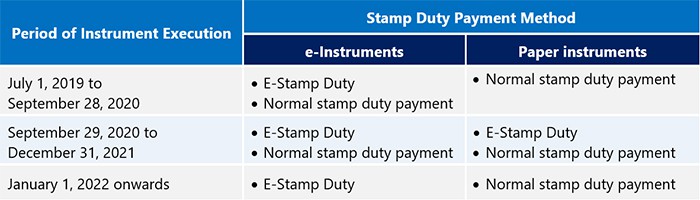
To allow taxpayers to become acquainted with the e-Stamp Duty system, the Revenue Department issued another notification (Notification of the Director-General of Revenue concerning Stamp Duty (No. 59)) which temporarily allowed taxpayers to omit the use of the e-Stamp Duty system by paying stamp duty on these e-Instruments at an area revenue office instead. Originally due to end on December 31, 2020, the measure was extended to December 31, 2021, under Notification of the Director-General of Revenue concerning Stamp Duty (No. 61), and now applies to e-Instruments executed between July 1, 2019 and December 31, 2021.

The Revenue Department also issued a notification allowing taxpayers to use the e-Stamp Duty system to pay stamp duty on the same five instruments executed in the traditional paper format; provided that the instruments are executed during September 29, 2020 to December 31, 2021. Again, this was originally due to end on December 31, 2020 (Notification of the Director-General of Revenue Re: Stamp Duty (No. 60)), but has been extended to December 31, 2020 (Notification of the Director-General of Revenue Re: Stamp Duty (No. 62)).

The table below summarizes the methods of stamp duty payment for the five instrument categories mentioned above.
Practicalities of the e-Stamp Duty System

The e-Stamp Duty system allows taxpayers to pay stamp duty online by filing the prescribed form (Form Or.Sor.9) through the website of the Revenue Department (www.rd.go.th) or the Revenue Department’s Application Programming Interface.

The e-Stamp Duty system allows taxpayers to file Form Or.Sor.9 and pay stamp duty before or within 15 days from the date of instrument execution. As of the date of this article, taxpayers can file a request to pay e-Stamp Duty no earlier than 30 days before the date on which an instrument is executed. If a taxpayer opts to pay e-Stamp Duty after executing an instrument, and the last date of paying stamp duty is due on public holiday, then the due date is extended to the next working day.

For example, if an instrument is due to be executed on March 31, 2021, the liable person can file Form Or.Sor.9 and pay e-Stamp Duty as early as March 2, 2021, or as late as April 16, 2021, (extended from April 15, 2021 which is a public holiday).

Taxpayers should note that the e-Stamp Duty system does not currently support late payment. Therefore, late filing and paying stamp duty will have to be done at an area revenue office.

After a taxpayer submits Form Or.Sor.9, they will receive a QR code and a pay-in-slip which can be used to make the e-Stamp Duty payment to the designated bank account of the Revenue Department.

Once the e-Stamp Duty is duly paid, the Revenue Department will generate a unique receipt code for the taxpayer to use as evidence of payment. This evidence of e-Stamp Duty payment can be downloaded from www.rd.go.th, or from the API (depending on where the taxpayer submitted Form Or.Sor.9).

Taxpayers should maintain the downloaded unique code and receipt for reference in the future. For instruments executed in paper format, taxpayers can maintain the downloaded unique code for reference in the future or print out the unique code and receipt and attach them to the instrument (instead of the usual official endorsement for paying stamp duty in cash at an area revenue office).

RELATED INSIGHTS​ 

July 30, 2024
In May and June 2024, Cambodia’s General Department of Taxation (GDT) issued two notable tax incentive packages that aim to encourage business growth in the country. The details of these incentives are outlined below. Tax Incentives for Expansion of Qualified Investment Projects The GDT’s May 10, 2024, regulation (Prakas No. 313 MEF. PrK. PD) provides income tax incentives for expansion of qualified investment projects (QIPs), including an income tax exemption for the following types of expansion: Expansion of existing production. Expansion through product line diversification within the same lines. Implementation of new technologies that enhance productivity or protect the environment. Other forms of expansion set out in future sub-decrees. The number of years for the income tax exemption depends on the investment activities of the QIP, in accordance with the business groupings provided in the Sub-Decree on the Implementation of the Investment Law in Cambodia—9 years for group 1, 6 years for group 2, and 3 years for group 3. After receiving approval for the QIP expansion from the Council for the Development of Cambodia (CDC) or one of its Provincial-Municipal Investment Sub-Committees (PMISs), the GDT will certify the income tax exemption period. The exemption begins on the date the enterprise first receives income from the QIP expansion. QIPs seeking this tax exemption need to declare the amount of money that they intend to use for the expansion. Once allowed, the company must use that money for construction materials or new production equipment before the expiration of the tax exemption period. The income tax exemption can be revoked if: The enterprise does not use the capital to expand the QIP by purchasing the construction material and new production equipment as requested for the expansion. The enterprise fails to invest the prescribed amount before the expiration of the tax exemption
March 22, 2024
Laos has returned its value-added tax rate to 10% from the 7% rate that had been observed for the last two years. The new rate was specified in Ordinance No. 003/PDT, dated March 19, 2024, and announced on the website of the Ministry of Trade and Commerce. Prior to this, the last announcement of an adjustment in the VAT rate came in the last week of December 2021, when the Ministry of Justice published the Law Amending Certain Provisions of the Laws on Tax No. 01/NA, dated August 7, 2021, in the Government Gazette. This law, which entered into force in January 2022, amended the VAT rate from 10% to 7%. Under Lao law, the ordinance is effective from its date of signing by the president of Laos (i.e., March 19, 2024). However, the tax authorities have indicated that the new rate will not be enforced immediately but will be implemented in the near future, such as when it is published in the Lao Official Gazette. This change of the VAT rate to 10% does not come as a surprise. Some international experts and organizations had been recommending that Laos adopt a 10% VAT rate given its current economic challenges, arguing that Laos should prioritize collecting tax and replenishing the state budget. This was, for instance, recommended by the World Bank in the November 2023 Lao PDR Economic Monitor. Tilleke & Gibbins will continue to monitor the situation to determine when the 10% VAT rate will be enforced. For more details on the rate changes, or on any aspect of tax law in Laos, please contact Tilleke & Gibbins at [email protected].
January 12, 2024
Thailand’s Revenue Department (RD) has issued a notification requiring electronic platforms to report their revenue from business operators on their platform. With this information, the RD intends to track business operators’ income from the sale of goods and services through electronic platforms in order to facilitate accurate and efficient tax collection. The notification, which was enacted on December 27, 2023, took effect on January 1, 2024. Under the notification, electronic platforms are required to compile a “special account” containing information on the revenue received from each business operator on their platform and submit it to the RD through the department’s electronic reporting system within 150 days of the end of the fiscal year. The notification defines “electronic platforms” as entities that intermediate between business operators (i.e., sellers of goods or providers of services via the electronic platform) and consumers for the purpose of enabling electronic transactions between the parties. This covers online marketplace operators, ride-hailing operators, food delivery operators, and so on. This reporting requirement applies to electronic platforms registered in Thailand that have (or previously had, starting from the notification’s effective date) annual revenue exceeding THB 1 billion (approx. USD 28.5 million), except for electronic platforms under the supervision of the Bank of Thailand or the Office of the Securities and Exchange Commission, such as payment service providers and cryptocurrency exchanges. Electronic platforms can appoint a third party to prepare and submit the required special account information to the RD on their behalf. Compliance Steps As the requirements established by this notification mean that the RD will now have direct access to information on the income earned by vendors and merchants on electronic platforms, these business operators—whether corporate or individual—should ensure that they faithfully disclose their earnings, submit tax payments correctly, and file income tax returns in a
December 15, 2023
As part of its membership in Lex Mundi, Tilleke & Gibbins has published an updated edition of its Guide to Doing Business in Thailand for 2023. This guide outlines the key factors for starting and operating a business in the Thai market. Issues covered include: Investment incentives Financial facilities Exchange controls Import and export regulations Structures for doing business Requirements for the Establishment of a Business Operation of the Business Cessation or Termination of the Business Labor legislation, relations, and supply Tax Immigration requirements This publication is part of Lex Mundi’s Country Guides series prepared by member firms in more than 100 jurisdictions worldwide. The guides serve as a useful resource for planning international business strategy and researching new markets. The full Guide to Doing Business in Thailand is available through the button below.